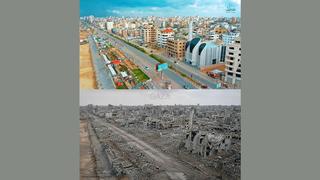
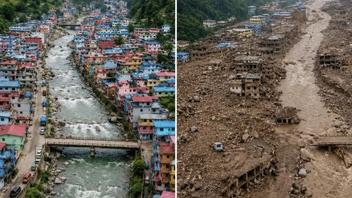
Do a pair of real images show a Nepal town before and after a flash flood washed through the valley? No, that's not true: Both the before and after images are AI-generated. The OpenAI Verify tool found SynthID watermarks in each image, indicating the images were generated using OpenAI tools.
The claim appeared in a post (archived here) published by the @jimmatuga account on Facebook on Aug. 27, 2026. It read:
As I'm watching the videos of the flooding in Nepal, I keep thinking, I can't believe what I'm seeing is real. It looks almost unreal.
I wonder if we were ever meant to witness this much suffering: homes disappearing, people and souls swept away by water and mud, all thousands of miles away yet appearing on a screen in our hands.
A hundred years ago, we might not have heard about a disaster on the other side of the world for weeks, if ever. Now we see it almost as it happens. The distance is gone, but we still don't always know what to do with what we're seeing.
We carry these images while continuing with our own lives. Sometimes they deepen our compassion. Sometimes they simply leave us overwhelmed.
Let's pray for the people of Nepal today.
This is what the post looked like on Facebook at the time of writing:
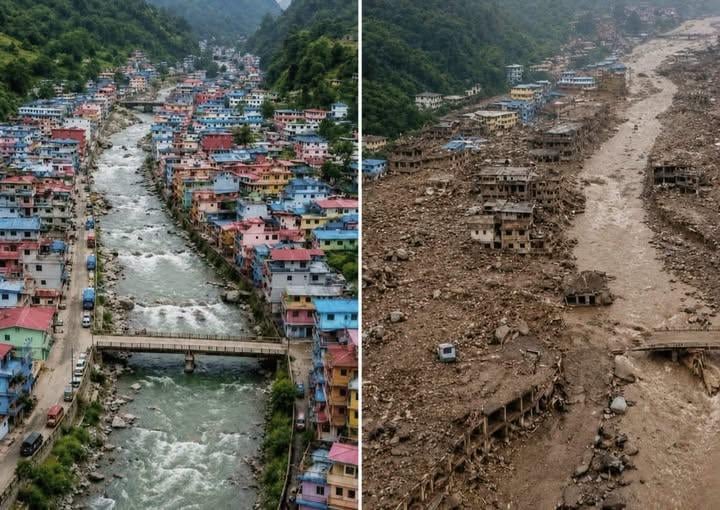
(Image source: post by @jimmatuga on Facebook.)
These fake images have appeared on multiple platforms. The @jimmatuga caption does not specify a place. A separate Aug. 27, 2026, posting of the images on Instagram (archived here) claims it shows the Trishuli Bazaar in Nepal. This area was impacted by the flash flood, as reported by Reuters with photographs on Aug. 26, 2026, (archived here) but the images above do not show the Trishuli Bazaar -- they are AI-generated. The images also do not resemble the topography of the Trishuli Bazaar (archived here) which was heavily developed on a floodplain of an inner curve of the Trishuli river (pictured below) .
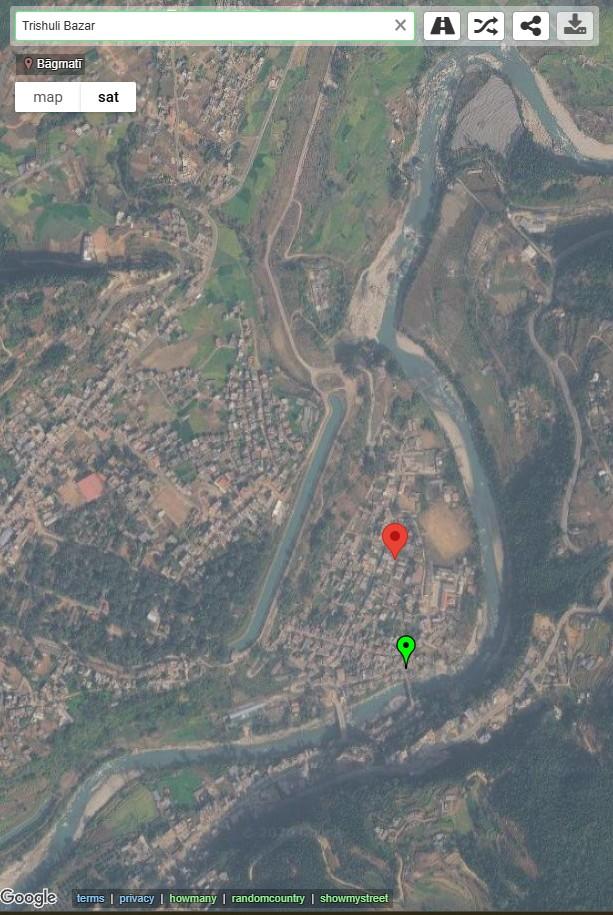
(Image source: Instant Street View.)
Lead Stories uploaded the images to OpenAI's Verify tool. First, as they appear in the Facebook post as a composite image (archived here). Lead Stories then separated the before and after images (archived here and here) and uploaded them individually. In all three cases the Verify tool detected a SynthID watermark (pictured below).
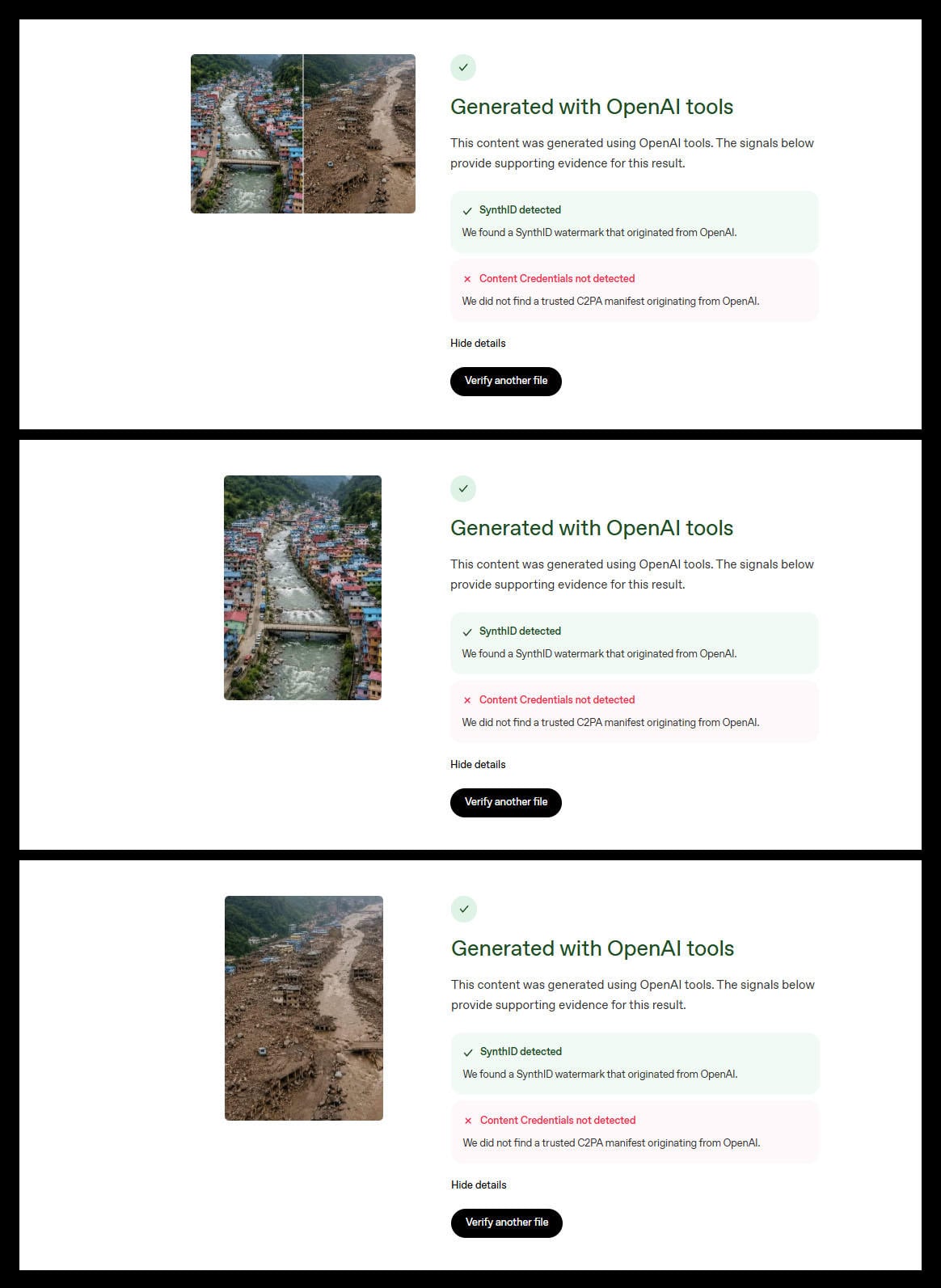
(Image source: Lead Stories composite with screenshots from OpenAI.)
The SynthID watermark, a product of Google DeepMind (archived here) is not visible to the human eye. It can be detected with the Verify tool if the images were made with OpenAI tools, or detected with Google Gemini if the images were made with Google's AI.
Other fact checks
This claim was also investigated by AAP FactCheck in Australia.