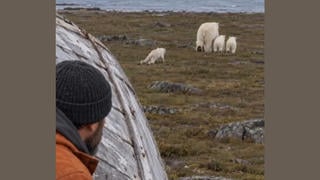
Does a real video show a man who helped a polar bear cub that could not walk until it could be released a year later? No, that's not true: This video was originally posted with a creator-added AI disclaimer label by an Instagram account that focuses on AI-generated videos. The same account published another video with a similar storyline the following day -- in that video, a panda cub that could not walk was rescued by a five-year-old girl.
The claim appeared in a post (archived here) by the @Gabriele_Corno account on X on Oct. 22, 2026. It read:
A man watched a polar bear mother walk away from her weakest cub on the tundra. What happened over the next year changed both of their lives forever.
This is what a screenshot of the video in the post looked like at the time of writing:

(Image source: post by @Gabriele_Corno on X.)
A reverse image search with Google Lens (archived here) found many copies of the video published on social media in the past two days. One post in a Facebook group included the video with a watermark, pointing Lead Stories to the Instagram account @anton.yehorov. The video in question (archived here) was posted on Oct. 21, 2026. The post caption read:
A man on the Hudson Bay coast watched a polar bear mother walk away from her weakest cub on the tundra. What happened over the next year changed both of their lives forever.
The account bio (archived here) reads:
Digital creator
AI-generated videos
Creative ideas • Future vibes
All videos on the account share the same caption style and recurring themes. The polar bear story in question fits in between an Oct. 20, 2026, polar bear rescue story (archived here) from the Hudson Bay and an Oct. 22, 2026, story about a baby panda that could not walk that was helped by a little girl (archived here). Clearly, this account is where the video originated.
All of these videos have an AI content disclaimer. Selecting the ⋯ menu and choosing "About this reel" opens an Instagram pop-up with more details (pictured below).

(Image source: post by @anton.yehorov on Instagram.)
The video is two minutes and 26 seconds long, with several cuts that show different scenes throughout the story. The man finds the bear in the wild by the Hudson Bay, drives the cub to the animal hospital, talks to the vet as they prep for surgery, and waits in the recovery room. The man cares for the bear at home with his friendly dog, eventually an adult-sized bear is released, and finally, an adult bear returns with his own cub to visit the man.
Some AI-generated content detection tools have limitations on the type of content -- images or videos -- and how large the files can be. Lead Stories used Clipchamp to sample three nine-second clips of the video: beginning, middle and end. The SynthID Detector hosted by Google found a SynthID watermark in the opening clip (pictured below), but not in the clips from the middle and end of the video. The results for the first clip (archived here) said:
SynthID was detected
This media was made or edited with OpenAI
Please note that this media may have been edited further since then.

(Image source: SynthID.com/video-detection.)
Another detection tool, Sightengine, provides a graph depicting the reading throughout the course of the video clip. A slider bar shows which moments in the clip have the highest and lowest readings, as well as suggestions as to the likely source of the AI-generated material. As shown below, the Sightengine results revealed moments in each clip -- beginning, middle and end -- that were 99% likely to be AI-generated. However, there was a moment in the middle clip when the reading dropped to 1% likely to be AI-generated (archived here). The graph's likely source of the AI-generated material alternated between Grok, Sora, and Seedance.

(Image source: Lead Stories composite image with screenshots from Sightengine.)