Have you seen viral videos showing a courtroom sentencing where the convicted person is an over-the-top villain? Lead Stories has spotted a number of such videos recently and has found that many of them were created using artificial intelligence. They do not show real people or situations but are clickbait entertainment, possibly intended to ragebait people over stereotypes involved in certain types of crime.
This article is part of a series of stories examining various types of what is commonly called "AI-slop": short, vertical videos generated with artificial intelligence tools with the aim of going viral, often by exploiting the emotions or curiosity of the viewer with made-up content.
What these "courtroom sentencing" videos look like
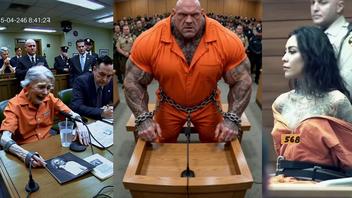
These videos show courtroom scenes where the defendant reacts to the sentence being read. Many of the stories are based on a stereotype of the criminal, a gangbanger with facial tattoos or a supersized lifer who has been working out in the prison yard. There are scantily clad prostitutes scolded for inappropriate dress, Somali daycare owners wearing headscarves and speaking with thick accents, and dangerous psychopaths restrained to a chair with cuffs, chains, collars, and bite guards or hoods over their head. The sentence handed down is an unusually long period of time, hundreds or even thousands of years. The background scene of the courtroom is typically quite still like a photograph. The other people -- the bailiffs, lawyers, and the people seated in the back -- don't or hardly react if the inmate has an extreme outburst.
Some examples
A video on TikTok shows a courtroom lit with dim cinematic lighting (archived here). The dour judge reads a sentence of 4 billion years. The defendant's emotional outburst seems to switch from laughing to sobbing.
@casefile07 Man gets sentenced to 4 Billion years in state prison #sentenced #court #prison ♬ original sound - Casefile
A video on X has three clips of Latina women in revealing orange jumpsuits (archived here). Each woman reacts in a menacing way when her sentence, over a hundred years, is read.
They ignored the warning after all 😧😧 pic.twitter.com/oNCoG8s8bj
-- MEGAN (@MeganJo011) March 17, 2026
A reel from the Facebook page Golden Years Grief shows an elderly woman wearing an orange jumpsuit weeping in the courtroom with an emotional message for her husband (archived here).
Keywords
Here are hashtags or keywords often associated with videos like these: #CourtroomCCTV #CourtroomDrama #CourtroomFootage #CourtroomClip #Sentence #JusticeScene #EmotionalStory #EmotionalVideo #OldWomanStory #Heartbreaking #CryingScene #SadStory #TrueLove #ViralFootage #ViralMoment #ViralReels #TrendingNow #StoryReels #TerrifyingMoment #FearFeed #ShockingUSA
How to tell they are false
Some of these videos do have disclaimers that they were AI-generated. Others come from an account where the content has a cookie-cutter look -- collections of videos that are a variation of a theme. In the TikTok example shared earlier, the watermarks from the AI platform which made it have been removed. Some blurry patches along the margins are left behind which flicker throughout the video. The AI rendering of some of the characters can be so outlandish as to seem like a cartoon. In other videos a scenario like a masked man shakled to the floor, or a sentence of 4 billion years, is just absurd.
If you see videos like these on social media, here are some things you can try.
First, look for AI-disclaimers added by the platform or the poster. On TikTok they might say "Contains AI-generated media" or "AI-generated" (archived here), on X they read "Made with AI" (archived here) and on Facebook/Instagram they often say "AI info" (archived here). Check the description of the video too: in some cases the creator might have added a note or a hashtag like #AI, #madewithAI or #fiction. Don't forget to check the main page of the account that posted the video either: maybe there is a disclaimer in the bio and in some cases AI use is really obvious when an account is posting dozens and dozens of variations of the same type of video.
Don't stop at the account that posted the video: maybe they copied it from somewhere else. Use a tool to take a screenshot of the first frame of the video and run it through a reverse image searching tool to see where else on the internet it appears. It may have originated on an account that posts satire, AI-creations or actual art.
If you are still not sure, try downloading the video itself. There are several AI detection tools that can tell you if there are watermarks or other technical characteristics present in the video that would indicate it was likely made with AI.
Finally, use common sense: if the video shows an event that would otherwise be newsworthy, use a news search engine to check if it has been reported on by a news service you trust. Also pay close attention to the video itself: look for physical impossibilities or glitches typical of AI-generated footage like:
- People or things appearing (or disappearing) out of thin air
- Objects behaving in physically impossible ways (heavy objects falling slowly, rigid objects bending...)
- Garbled writing, oddly shaped letters or signs
- People or objects blending into or moving through each other
- Inconsistencies between different shots of the video (extra architectural elements in buildings, changing backgrounds, differences in clothing or hairstyle)
- An audio track that sounds strange: flat, unnatural speech, scripted-sounding yelling from bystanders ("Did you see that? OMG!"), sound effects being out of sync with events.
Unsure about a video? Email [email protected] and we will take a look!
These materials were developed in 2026 for the Prebunking at Scale project, with support from the European Fact-Checking Standards Network. If you share this on social media, use #prebunkingatscale.