
Do real photos show an Israel Defense Forces soldier repairing and revering the same crucifixion statue he vandalized? No, that's not true: Two images -- one showing a soldier washing the statue and another showing a soldier kneeling at the base of the cross -- are AI-generated. The photos were identified by Google Gemini as having a SynthID watermark. The fake pictures began to circulate after a real image of an Israel Defense Forces (IDF) soldier vandalizing the Christian monument went viral. The act of vandalism was real and has been condemned by Israeli Prime Minister Netanyahu.
The fake images appeared in a post (archived here) published on X by @EretzIsrael on April 20, 2026. The post was captioned:
Israel made the same IDF soldier that was vandalizing the statue of Jesus in Lebanon to put it back.... before they sent him to trial.
The composite image in the post (pictured below) has two AI-generated images side by side and a logo of a Lebanese WhatsApp news channel:

(Image source: @EretzIsrael post on X.)
Lead Stories queried Google Gemini using the composite image (above) featuring the logo of the WhatsApp channel "Breaking News 24/24" (archived here). Gemini was unable to detect a SynthID watermark (archived here), stating:
The digital analysis indicates that this image does not contain a SynthID watermark, which means it was not created or edited using Google's generative AI models.
Since this file is a side-by-side collage featuring multiple figures and a graphic overlay, please note:
- Collage Limitations: For the most accurate SynthID check, it is best to crop the image to focus on one specific panel at a time and re-run the check. Watermarks can sometimes be harder to detect when multiple images are merged or heavily edited.
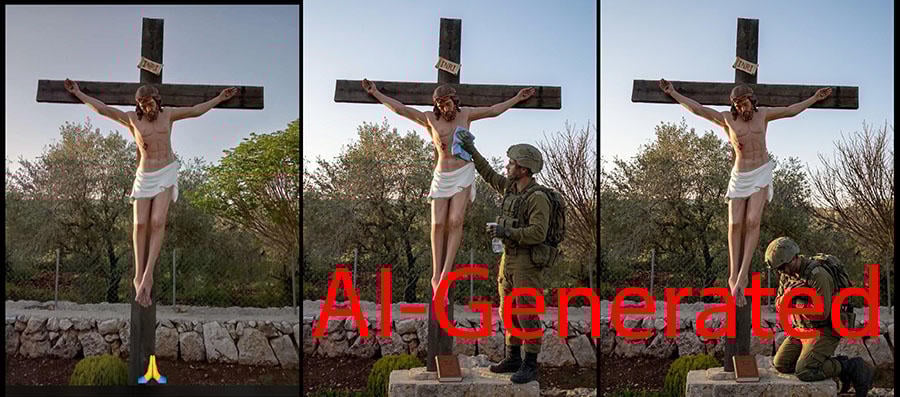
Another April 20, 2026 post (archived here) on X by @MarwanEsm02 included the two individual high-resolution images . Lead Stories asked Google Gemini if either image had a SynthID watermark. These watermarks are invisible to the human eye and are only present in images made by Google's AI products, not in images made by other AI platforms. When directly queried, Google's Gemini could detect a watermark in each image (pictured below) stating:
Digital analysis confirms that most or all of this image was generated or edited using Google's generative AI models, as it contains a SynthID watermark.
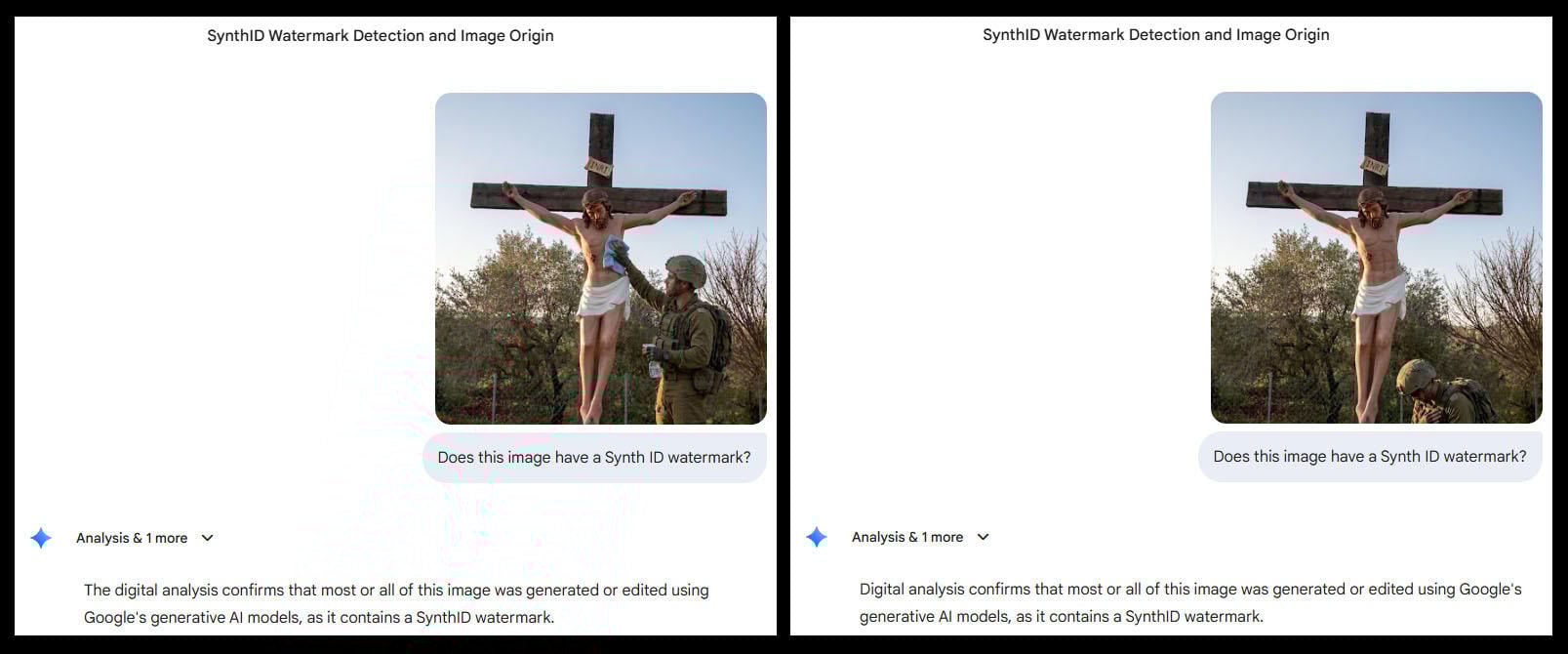
(Image source: Google Gemini screenshots.)
The photo of the IDF soldier vandalizing the crucifixion statue was originally posted on X (archived here) on April 19, 2026 by a Palestinian journalist, Younis Tirawi (embedded below).
Lebanon |
-- Younis Tirawi | يونس (@ytirawi) April 19, 2026
An Israeli soldier smashing the head of a Jesus Christ statue during operations in southern Lebanon. pic.twitter.com/Sj1m16tj9q
A second post (archived here) from Tirawi referred to a post on Facebook from the town of Debel, in southern Lebanon, where the vandalism happened (archived here). The April 19, 2026 Facebook post (embedded below) has an undated photo of the crucifixion statue which appears to have been taken some time before it was vandalized.
Comparing the two real photos (below) it appears that some time has passed between when the images were taken. The area behind the chain-link fence is overgrown and the paint of the statue appears to be weathered in the Tirawi image. Lead Stories has marked with a blue box a distinctive area in the stone wall appearing unchanged in both photos.
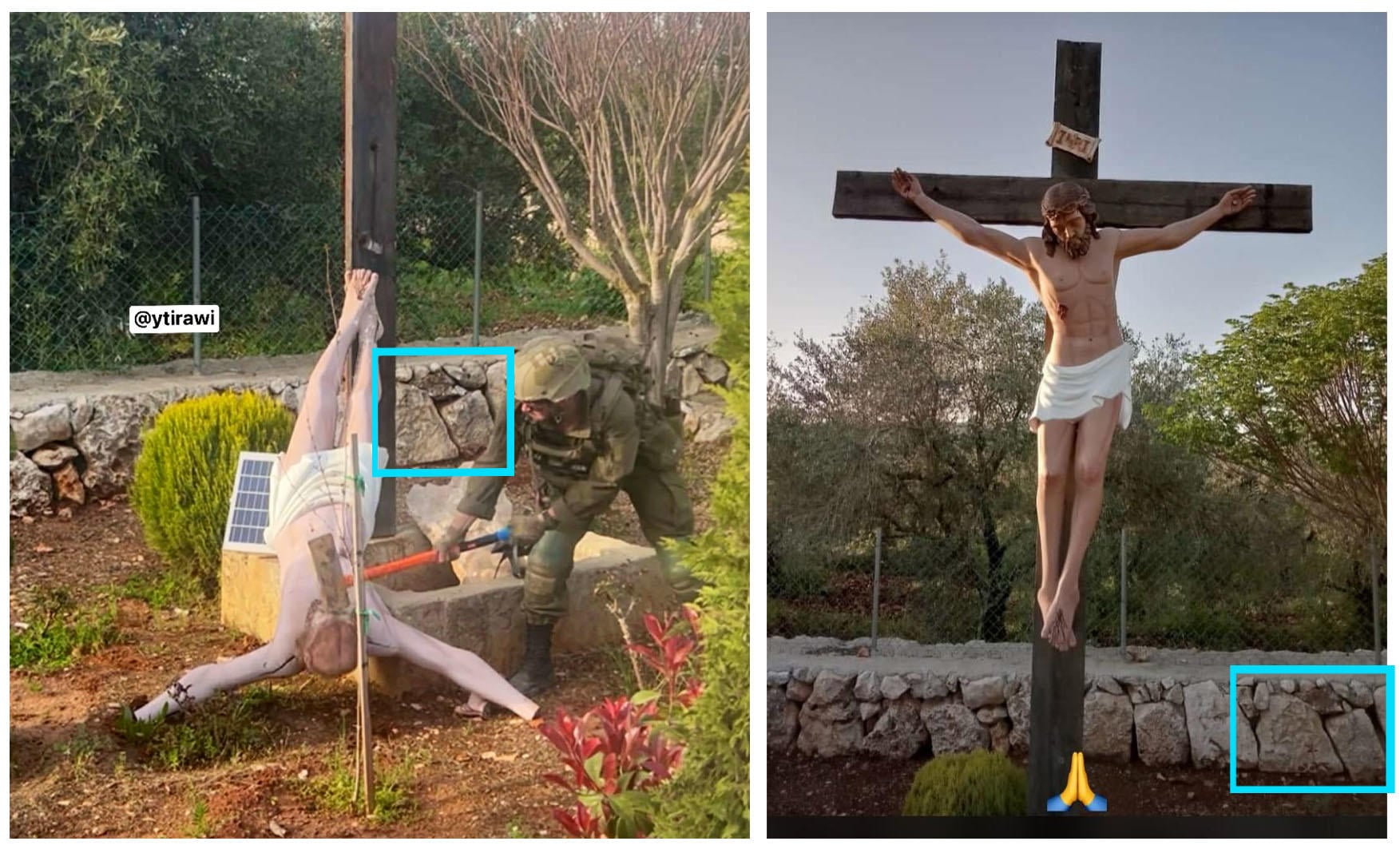
(Image source: @ytirawi post on X and Debel Alerts post on Facebook.)
The AI-generated images (below center and right) appear to be based on the Debel image (below left), with notable additions including a soldier, a concrete platform, a book, and a leafless tree in the background.
On April 20, 2026 Israeli Prime Minister Benjamin Netanyahu posted on X about the incident (archived here). His post reads in part:
Yesterday, like the overwhelming majority of Israelis, I was stunned and saddened to learn that an IDF soldier damaged a Catholic religious icon in southern Lebanon. I condemn the act in the strongest terms. Military authorities are conducting a criminal probe of the matter and will take appropriately harsh disciplinary action against the offender.