
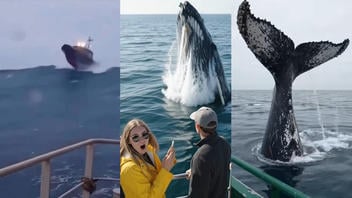
Have you seen viral videos showing dramatic encounters with whales at sea, frequently presented with a boat for scale? Lead Stories has spotted a number of such videos recently and has found that many of them were created using artificial intelligence. While there are many real whale watching videos of whales breaching or swimming beneath the surface, the popular topic has been swallowed up by AI content creators chasing big engagement.
This article is part of a series of stories examining various types of what is commonly called "AI-slop": short, vertical videos generated with artificial intelligence tools with the aim of going viral, often by exploiting the emotions or curiosity of the viewer with made-up content.
What these whale encounter videos look like
These videos show whales of several species encountering boats at sea. Many of the videos show the cameraman's perspective on a ship's deck with the railings, ropes and cleats. The AI-generated breaching whale may come so close that water splashes on the lens for a make-believe real camera effect. The whales are rendered with realistic details like crusty barnacles on their face and fins or uniquely identifiable scars and markings. In some cases the whale surfaces near a boat to provide a dramatic size comparison.
Some examples
One example of this trend (archived here) published on X on Sept. 30, 2026, appears to be filmed from the deck of a large ship. It shows a seaworthy small patrol boat with search lights shining as it charges over the stormy swells. Without warning, the shiny gray back of a gigantic whale emerges from the dark water in the space between the two boats, slowly diving and revealing a dorsal fin before vanishing under the surface.
It is impossible to understand the true size of a whale until you see one in the open ocean next to a fishing boat
-- USA NEWS 🇺🇸 (@usanewshq) September 30, 2026
A video uploaded to TikTok (archived here) on Aug. 25, 2026, shows an underwater scene of a whale swimming slowly under the back-lit hull of a small boat above. The video appears to have a major flaw in the rendering of the scene -- the boat's entire hull appears to be submerged with none of it extending above the waterline.
@wavesandtales A humpback passing under a small boat. It weighs 30 tonnes and can place itself within centimetres of something without touching it. That is a decision, not luck. 🐋 #tiktokgrowthchallenge #fyp #whales #oceanlife ♬ som original - RIQUE NOLIFE
A reel posted on Facebook (archived here) on Sept. 30, 2026, shows a "40-foot gray whale" covered in patches of barnacles slowly surfacing next to a boat, so close it could be touching the hull. The direction the whale is facing is apparent as its face surfaces first -- but after the dorsal fin comes into view the AI rendering glitches -- showing the whale's tail surface from the direction of its head.
A reel published on Instagram (archived here) on Sept. 6, 2026, shows a battle-scarred humpback whale making a splash with its tail. The splash sends realistic waterdrops onto the lens of the camera envisioned by the AI prompt, or perhaps the fictional cameraman caught the scene while standing behind a glass window.
A final example is a video short posted on YouTube (archived here) on Sept. 29, 2026. It shows people at the rail of a whale-watching boat. This time the glitch in the AI-generated video is not how the scene is rendered, but how the people behave. As the whale begins to breach very close to the boat, the couple turns and looks back as if to check if the people behind them are reacting, missing the moment when the whale's body was almost entirely out of the water. However, they still react to the breach, facing the wrong way.
Keywords
These are some of the keywords and hashtags associated with the videos reviewed in this prebunk:
humpback whale, whale under boat, marine life, ocean animals, whale behavior, animal precision, large whale, humpback movement, ocean documentary, whale facts
#amazinganimals #amazingocean #animalvideos #boatadventure #closeencounter #facebookreels #fyp #giantwhale #graywhale #incrediblenature #marineanimals #marinelife #nature #naturelovers #ocean #oceanadventure #oceanlife #oceanlovers #oceanwildlife #pacificcoast #shorts #sealife #seacreatures #tiktokgrowthchallenge #tourists #viralanimals #viralreels #whale #whalebreach #whaleencounter #whalejump #whalenearboat #whales #whalewatching #whalewatchingusa #wildlifephotography #wildlife #wildlifevideos #youtubeshorts
How to tell they are false
This AI-generated whale content trend closely follows real nature videos -- showing the types of things real whales do. They do not feature scenes that stand out as fake such as over-the-top mortal combat or sentimental animal/human interactions. The ocean waves may be stormy, but not extreme. The ships in the foreground show little more than the railing -- no ship markings to verify or navigational details to reference where the sighting may have occurred. They have just enough beauty or surprise to catch the eye of the social media audience for a few seconds. Why? Likely because every major social media platform has an incentive program that pays content creators. A Sept. 1, 2026, article in Digiday reviews "How every major platform pays creators" (archived here).
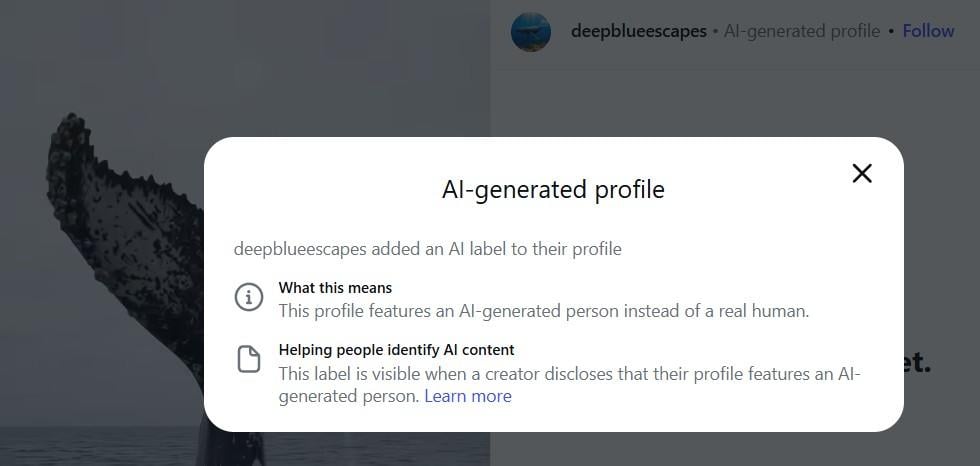
The videos frequently contain glitches typical of AI-generated content (described in the examples above) but the most consistent clues that a video is fake will be found with a check of the account that posted them. Many of these accounts have an AI-disclaimer, the Instagram account @deepblueescapes is labeled as an AI-generated profile (pictured below) and the post is labeled as AI-generated content:
Content in this post may have been created with AIThis is based on a signal added by the tool used to create the content. This signal typically identifies content that was entirely AI-generated instead of content that was only modified with AI.
One more place to check is the channel's homepage where the thumbnails of the videos are displayed in a grid. Does it appear that the videos follow a formula? Were they produced in small batches -- variations spun from small tweaks of a similar prompt to an AI video tool? Another red flag is if the channel has changed the type of content they publish -- was it African animals one month, earthquake building collapses the next and marine mammals this month? Is the account relatively new with a profile name that is part of a package that goes along with the theme of the videos?
Lead Stories investigated another AI-generated video trend which, like these whale videos, copied a popular existing genre of real videos: staged insect battles.
If you see videos like these on social media, here are some things you can try.
First, look for AI-disclaimers added by the platform or the poster. On TikTok they might say "Contains AI-generated media" or "AI-generated" (archived here), on X they read "Made with AI" (archived here) and on Facebook and Instagram they often say "AI info" (archived here). Check the description of the video too: in some cases the creator might have added a note or a hashtag like #AI, #madewithAI or #fiction. Don't forget to check the main page of the account that posted the video either: maybe there is a disclaimer in the bio and in some cases AI use is really obvious when an account is posting dozens and dozens of variations of the same type of video.
Don't stop at the account that posted the video: maybe they copied it from somewhere else. Use a tool to take a screenshot of the first frame of the video and run it through a reverse image searching tool to see where else on the internet it appears. It may have originated on an account that posts satire, AI-creations or actual art.
If you are still not sure, try downloading the video itself. There are several AI detection tools that can tell you if there are watermarks or other technical characteristics present in the video that would indicate it was likely made with AI.
Finally, use common sense: if the video shows an event that would otherwise be newsworthy, use a news search engine to check if it has been reported on by a news service you trust. Also pay close attention to the video itself: look for physical impossibilities or glitches typical of AI-generated footage like:
- People or things appearing (or disappearing) out of thin air
- Objects behaving in physically impossible ways (heavy objects falling slowly, rigid objects bending...)
- Garbled writing, oddly shaped letters or signs
- People or objects blending into or moving through each other
- Inconsistencies between different shots of the video (extra architectural elements in buildings, changing backgrounds, differences in clothing or hairstyle)
- An audio track that sounds strange: flat, unnatural speech, scripted-sounding yelling from bystanders ("Did you see that? OMG!"), sound effects being out of sync with events
Unsure about a video? Email [email protected] and we will take a look!
These materials were developed in 2026 for the Prebunking at Scale project, with support from the European Fact-Checking Standards Network. If you share this on social media, use #prebunkingatscale.