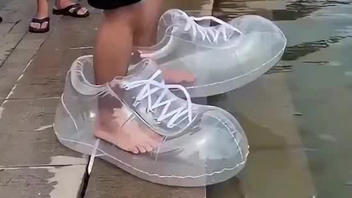
Have you seen viral videos showing people walking on water while wearing some type of floating or anti-gravity shoes? Lead Stories has spotted a number of such videos recently and has found that many of them were created using artificial intelligence. Except in rare situations, they do not show real people or events because what they show is physically not possible: These shoes do not displace sufficient water to generate the buoyancy needed to keep a person from sinking.
This article is the first part of a series of stories examining various types of something that is often called "AI-slop": short, vertical videos generated with artificial intelligence in order to go viral by exploiting the emotions or curiosity of the viewer with made-up content.
What these "Floating shoes" videos look like
Most of these videos will describe a sensational new invention that allows people to walk on water. In some cases the invention is said to have happened in an exotic or faraway location like China or the Middle East and there is no clear mention of the name of the inventor or the company. Some of the shoes look like they are inflatable flotation devices; others look futuristic with a blue LED-like glow and vague claims about AI or anti-gravity. In most of the videos, a person can be seen wearing the shoes while walking on the surface of a lake, river or pool while onlookers are excitedly filming and pointing.
Some examples
Here's an example we found on X (archived here):
These Floating shoes are designed with ultra-light materials and air pockets that help them stay on the water's surface instead of sinking. pic.twitter.com/zNglPGdKlw
-- ViralPulse (@ViralPulse1419) June 6, 2026
But we also found examples on YouTube (archived here):
@multiverse_matrix Unreal Innovation! Floating Shoes Let You Walk on a Lake -- Internet Goes Wild 👟🌊😱 In an unbelievable viral clip from India, a man wearing futuristic floating shoes is seen walking calmly across a lake -- literally defying gravity! The sleek white footwear, powered by hidden buoyant tech and magnetic stabilization, keeps him perfectly balanced as ripples spread under his feet. Onlookers cheer in amazement, calling it "the real-life miracle of science." The internet agrees -- the future of walking has arrived, and it floats! 🚀✨ #FloatingShoes #WalkOnWater #MadeInIndia #Innovation #Unbelievable #FutureTech #ViralVideo #AI #Sora #MultiverseMatrix #ExplorePage #Trending #Reels #Viral #FYP Do follow and support this channel ❤️
♬ original sound - Multiverse Matrix
You can probably find more if you search for "floating shoes" on that platform here.
Keywords
Here are some hashtags or keywords often associated with videos like these: Aerofoot, Innovation, FloatingShoes, WalkOnWater, WaterShoes, HoverShoes...
We already spotted the "Aerofoot" one as early as October 2025 when it was used in a fake video about flying shoes.
How to tell they are false
The physics of flotation and buoyancy have been well understood since the days of Archimedes (archived here), as Britannica explains:
(The) physical law of buoyancy, discovered by the ancient Greek mathematician and inventor Archimedes, stating that any body completely or partially submerged in a fluid (gas or liquid) at rest is acted upon by an upward, or buoyant, force, the magnitude of which is equal to the weight of the fluid displaced by the body.
In other words, if the shoes in question don't displace a volume of water that has the same weight as the person wearing the shoes, that person will get wet.
In this video (archived here) you can see an actual pair of inflatable shoes that do sort of work, but as you can see they are huge:
This video also shows another problem with shoes like these: it would be difficult to keep your balance in them while walking because as soon as one foot is lifted out of the water, the walker's center of gravity would no longer be above the "footprint" of the other shoe and they would start tipping over.
Videos like these are often produced to generate a sense of curiosity or wonder in order to get audiences to keep watching them so social media platform algorithms will make them go viral, which in turn leads to their creators making money through advertising or brand deals. Sometimes they also try to trigger underlying prejudices or fears in the audience or they take a slightly propagandistic angle when they evoke the supposed technical superiority of certain nations.
If you see videos like these on social media, here are some things you can try if you want to find out if they are real or not.
First, look for AI-disclaimers added by the platform or the poster. On TikTok they might say "Contains AI-generated media" or "AI-generated" (archived here), on X they read "Made with AI" (archived here) and on Facebook/Instagram they often say "AI info" (archived here). Check the description of the video too: in some cases the creator might have added a note or a hashtag like #AI, #madewithAI or #fiction. Don't forget to check the main page of the account that posted the video either: maybe there is a disclaimer in the bio and in some cases AI use is really obvious when an account is posting dozens and dozens of variations of the same type of video.
Don't stop at the account that posted the video: maybe they copied it from somewhere else. Use a tool to take a screenshot of the first frame of the video and run it through a reverse image search tool to see where else on the internet it appears. It may have originated on an account that posts satire, AI-creations or even actual art.
If you are still not sure, try downloading the video itself. There are several AI detection tools that can tell you if there are watermarks or other technical characteristics present in the video that would indicate it was likely made with AI.
Finally, use common sense: if the video shows an event that would otherwise be newsworthy, use a news search engine to check if it has been reported on by a news service you trust. Also pay close attention to the video itself: look for physical impossibilities or glitches typical of AI-generated footage like:
- People or things appearing out of thin air or disappearing
- Objects behaving in physically impossible ways (heavy objects falling slowly, rigid objects bending...)
- Garbled writing, oddly shaped letters or signs
- People or objects blending into each other
- Inconsistencies between different shots (extra architectural elements in buildings, changing backgrounds, differences in clothing or hairstyle of people...)
These materials were developed in 2026 for the Prebunking at Scale project, with support from the European Fact-Checking Standards Network. If you share this on social media, use #prebunkingatscale.