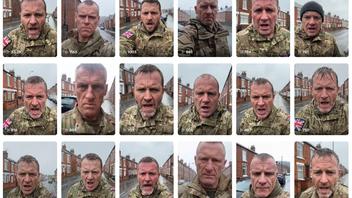
Have you seen viral videos showing people, mostly veterans in military fatigues with the U.K.'s flag, invoking patriotism to make social media users follow a specific account? Lead Stories has spotted a number of such videos recently and found that many of them were created using artificial intelligence. Some of these accounts post videos of different-looking men saying the exact same script, in an apparent effort to build up a social media following.
This article is part of a series of stories examining various types of something often called "AI-slop": short, vertical videos generated with artificial intelligence in order to go viral by exploiting the emotions or curiosity of the viewer with made-up content.
What these 'Veterans ask you to follow an account' videos look like
Such clips feature one or several people appealing to the audience's sense of civic responsibility by invoking some vaguely worded issues, with the implication that life has become worse compared to what it used to be in the past. Very often, the characters are dressed in army uniforms or plain, dark clothes. To increase the dramatic effect, these videos show either a rainy day or a bunker or a remote, isolated location.
Some examples
One example (archived here) featured a supposed veteran on TikTok. In it, the man said:
I didn't bury my mates in the desert so politicians could give this country away. If you still believe in loyalty to Britain, press 'Follow.' The rest of you can scroll on.
@tmthanh9991 #unitedkindom ♬ original sound - Freddie Ray
As of this writing, the same account, @tmthanh9991 (archived here), posted 29 videos of this type. All the men in those clips were repeating the same phrases.
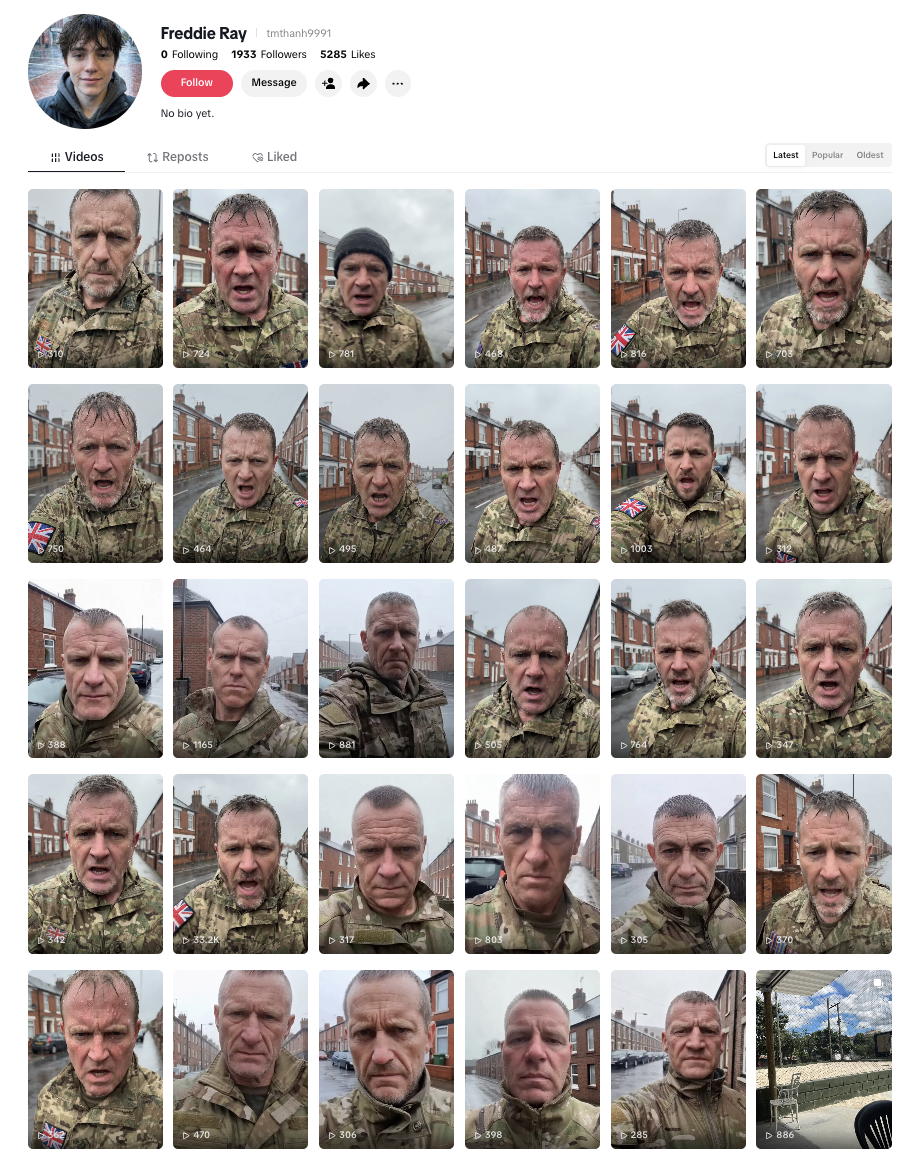
(Image source: @tmthanh9991 account on TikTok.)
Interestingly, the audio track had the same name, "Original sound -- Freddie Ray," even though people's voice registers varied. At the same time, when Lead Stories clicked on those posts and tried to search other entries by the sound, it would only show one match. That suggested that slightly different audio tracks were named identically on purpose -- to avoid detection.
Another page -- the @charlie.anderson437 account on TikTok (archived here) -- published 29 videos too. This set of men was repeating the exact same lines as those in the @tmthanh9991 videos.
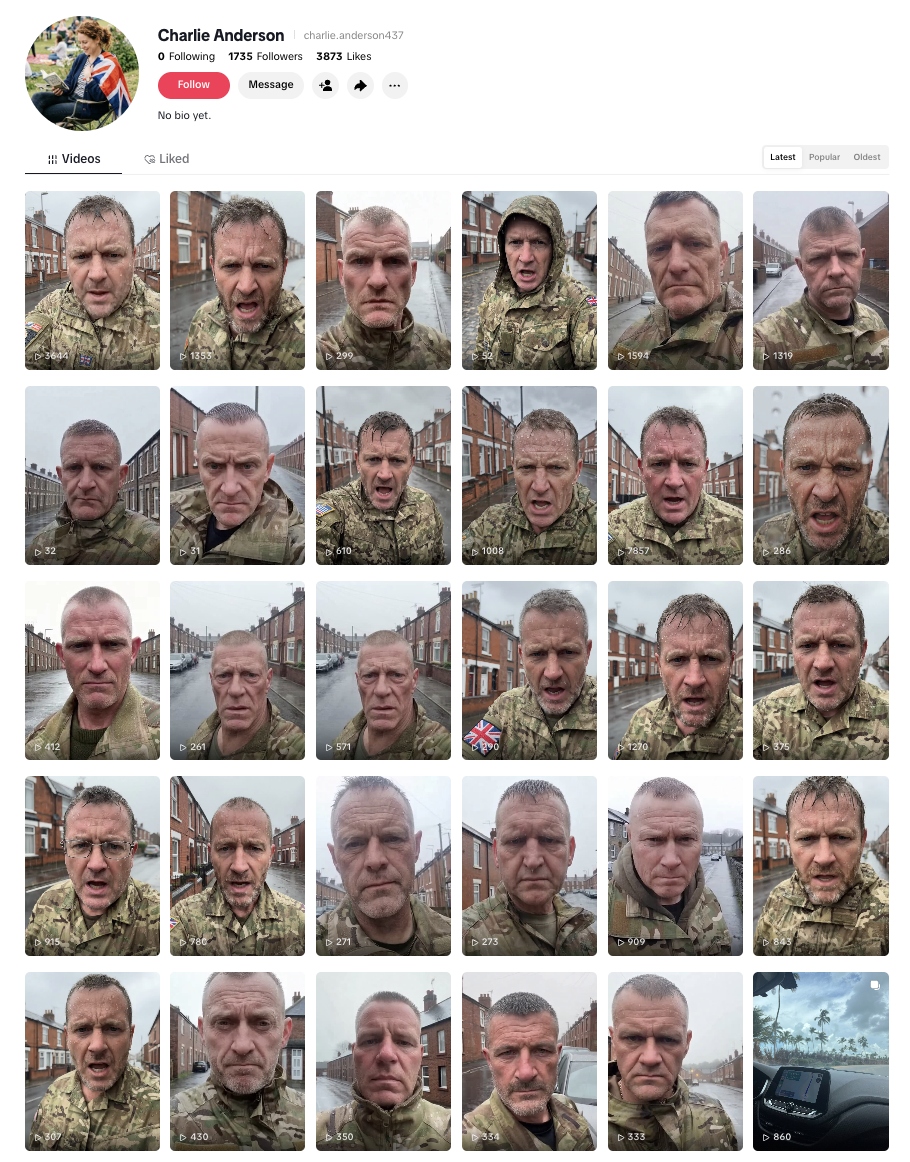
(Image source: @charlie.anderson437 account on TikTok.)
@charlie.anderson437 #unitedkindom ♬ original sound - Charlie Anderson
Some accounts on TikTok -- for example, @sam072173 (archived here) -- featured groups of uniformed men. Videos by this account showed they all yelled (archived here):
People of Britain! Our troops are on duty 24/7. Now it's your turn! Hit follow and stand with your army!
Previously, the same account posted cats:
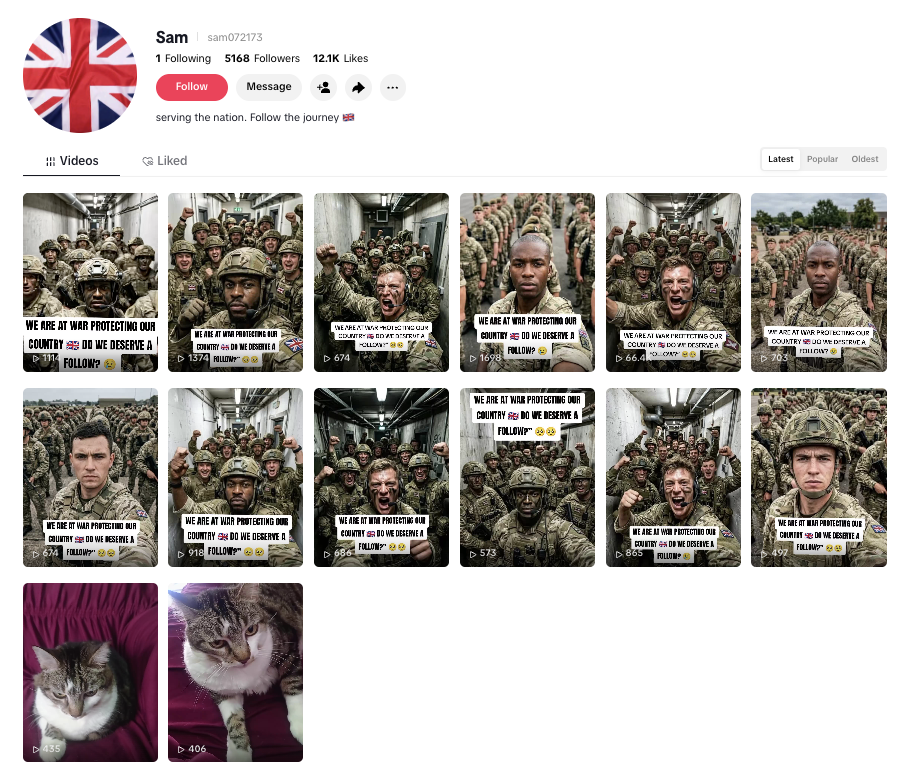
(Image source: @sam072173 account on TikTok.)
The trend reviewed in this prebunk had variations, too. For example, the @salesunited7 account on TikTok (archived here) featured characters coming from slightly different walks of life. Their words varied but the key message remained the same: If a social media user feels patriotic, they should follow the account that posted the videos.
An older man who seemed to be a farmer or retiree said (archived here):
They're trying to make us feel like strangers in our own land and bury the traditions we love. If you refuse to let our heritage fade, follow me.
A person wearing a firefighter uniform said (archived here):
30 years protecting this country taught me one thing: If you believe community still matters, comment 'United' and follow for more.
And the "service member" from that series said (archived here):
They're tearing down our history and expecting us to stay quiet. If you're ready to take Britain back, follow me and comment: 'Hold the line.'
One more account on TikTok, @susan.wright976 (archived here), only published variations of the character who seemed to have been cast as a World War II veteran:
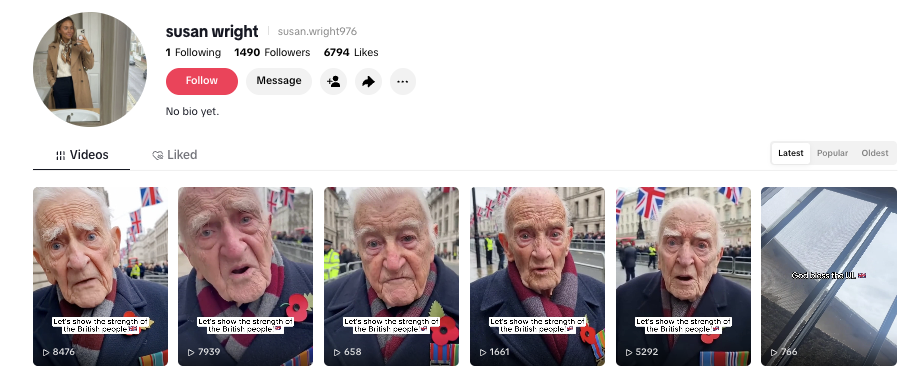
(Image source: @susan.wright976 account on TikTok.)
They also asked (archived here) people to press the follow button:
This is not what I fought for 80 years ago. If you want to see the United Kingdom strong again, please, follow this account. Show the strength of the British people.
Keywords
Here are hashtags or keywords often associated with videos like these: veteran, U.K., "follow," #unitedkindom, #unitedkingdomtiktok, #unitedkingdom🇬🇧❤️, "I LOVE UK," "We are at war protecting our country 🇬🇧 Do we deserve a follow? 🥺🥺" and "Let's show the strength of the British people 🇬🇧."
How to tell they are false
In many cases, original uploads of these videos showed AI labels:
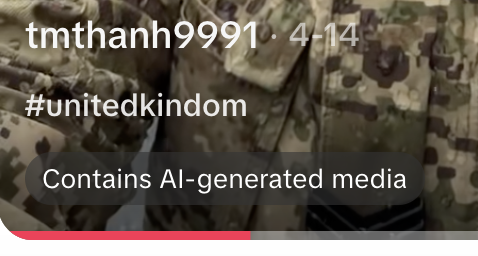
(Image source: post by @tmthanh9991 on TikTok.)

(Image source: post by @tmthanh9991 on TikTok.)
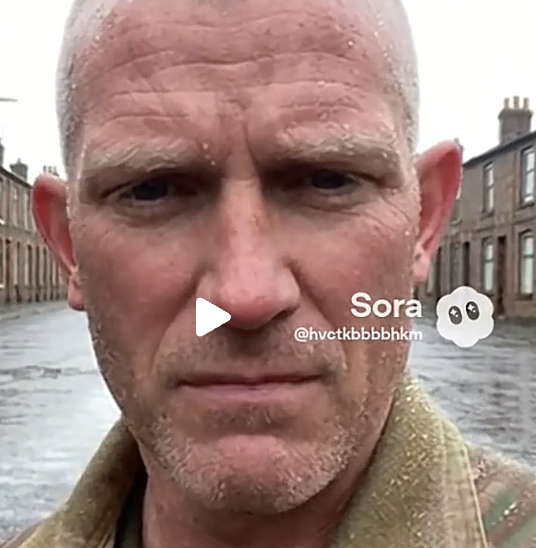
(Image source: post by @charlie.anderson437 on TikTok.)
There were inconsistencies strongly pointing to AI, too. For example, while many of the purported vets were seen standing in the pouring rain without an umbrella, the water droplets on their foreheads remained still, even though their facial muscles were moving.
How the streets in the background looked also gave away the footage's artificial nature. For example, we could see buildings without windows or doors:
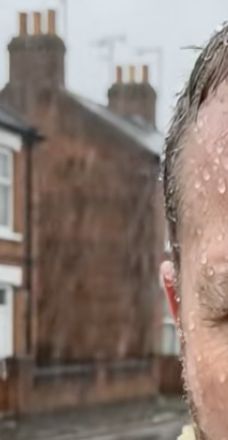
(Image source: post by @tmthanh9991 on TikTok.)
In another instance, what appeared to be either the building's front wall or a brick barrier before the front yard completely blocked the entrance door:
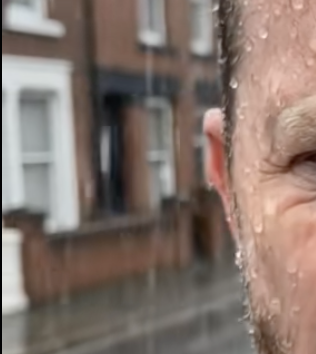
(Image source: post by @tmthanh9991 on TikTok.)
In one instance, the patches worn by the man significantly differed from the standard appearance of the U.K.'s national flag (archived here):
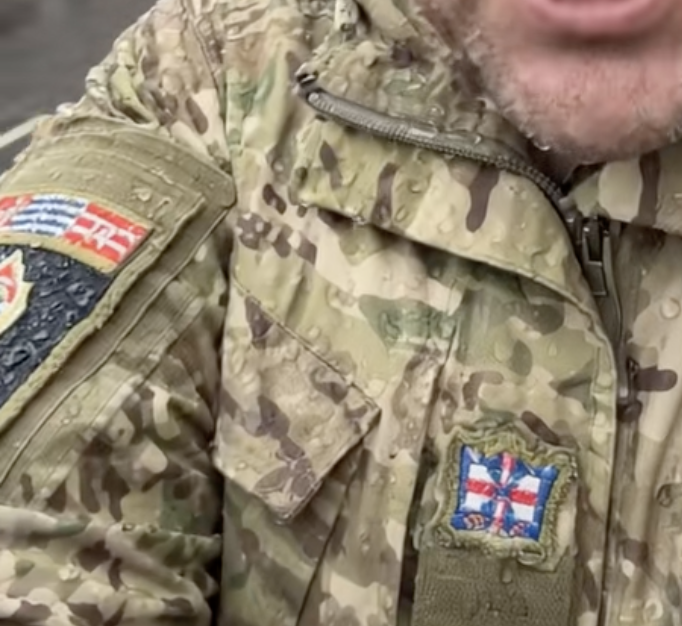
(Image source: post by @charlie.anderson437 on TikTok.)
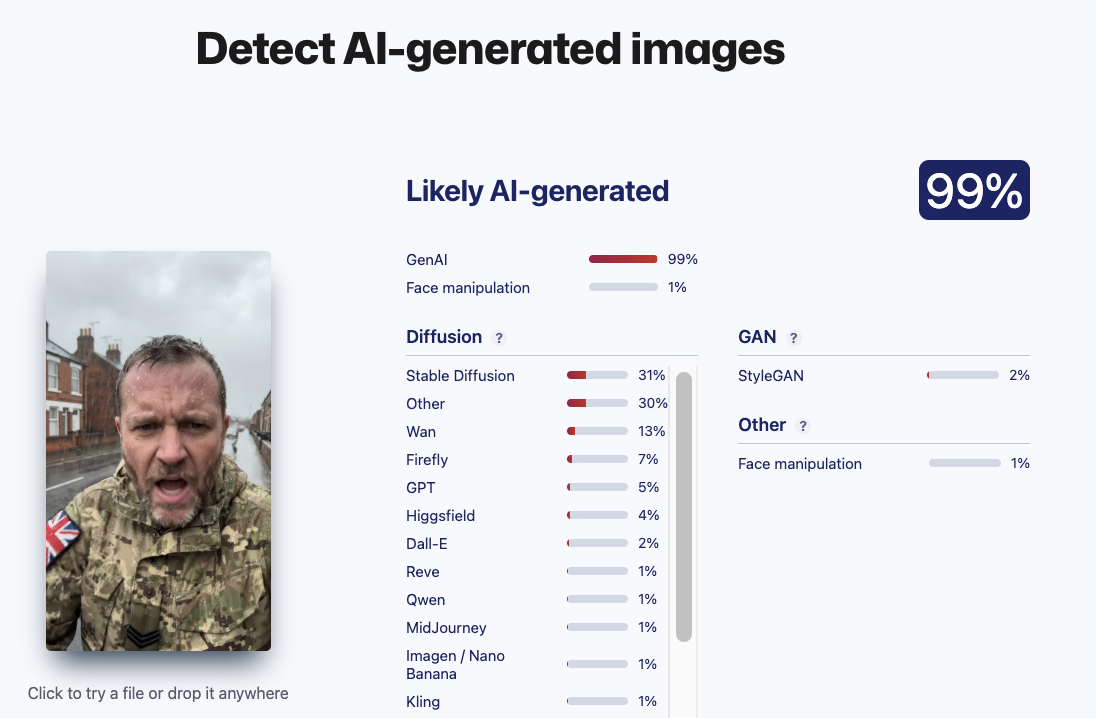
When Lead Stories tested thumbnail images from those videos, two online AI detectors -- Hive Moderation and Sightengine -- ruled that they were 99% likely to have been created by AI:
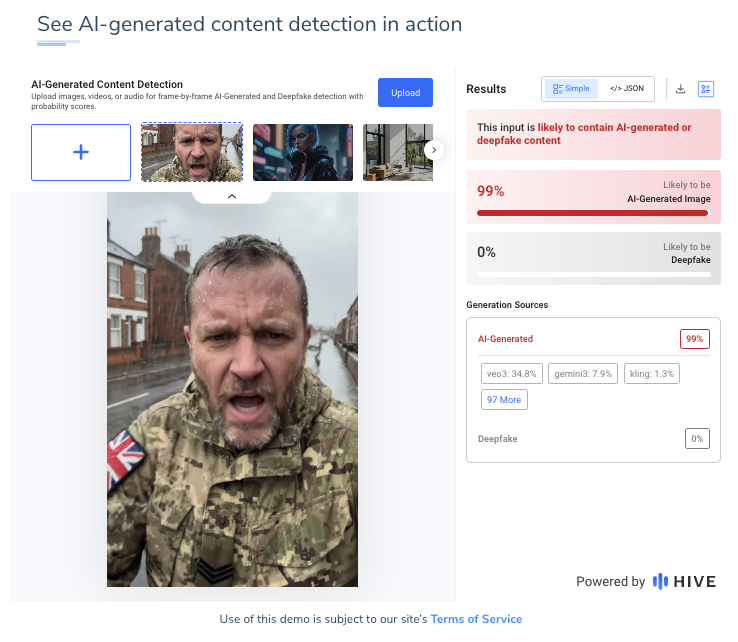
(Image source: Hive Moderation.)
(Image source: Sightengine.)
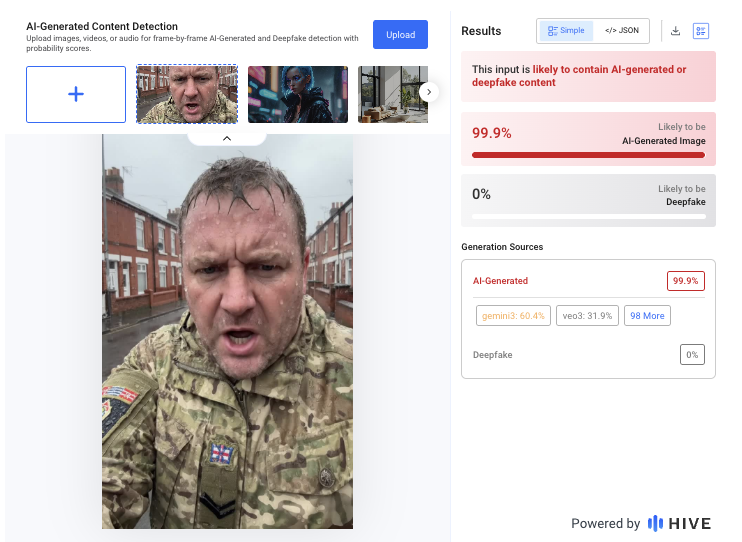
(Image source: Hive Moderation.)
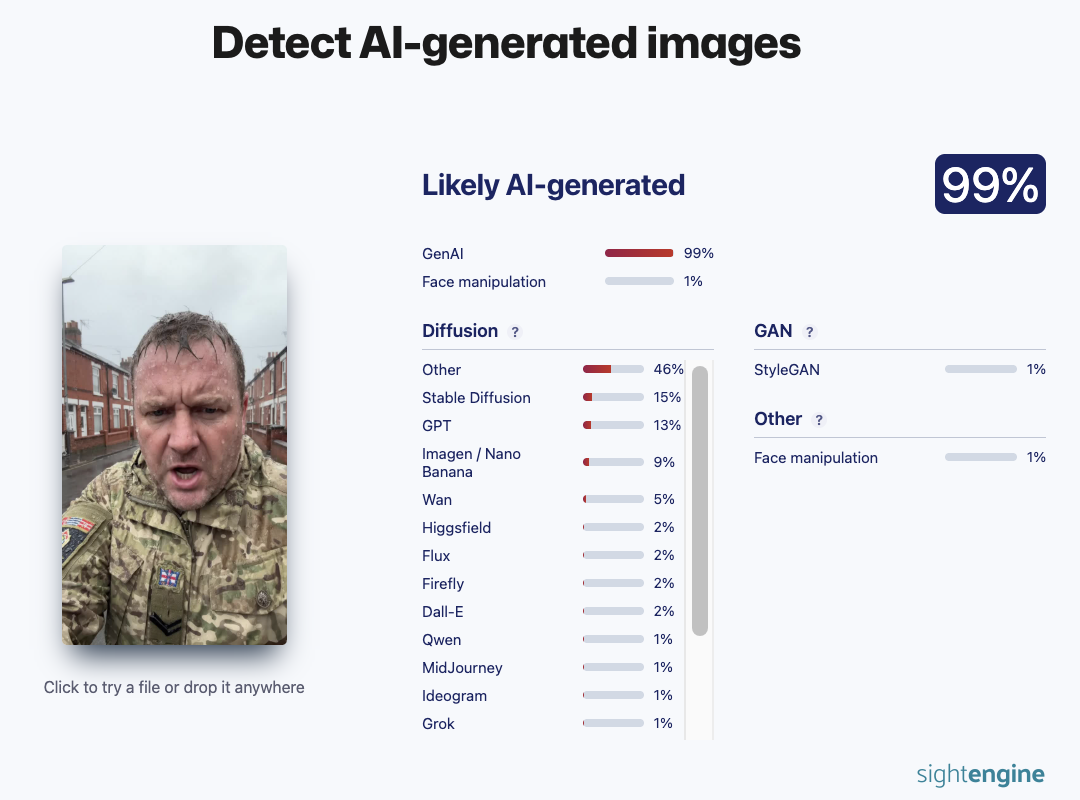
(Image source: Sightengine.)
If you see videos like these on social media, here are some things you can try.
First, look for AI-disclaimers added by the platform or the poster. On TikTok they might say "Contains AI-generated media" or "AI-generated" (archived here), on X they read "Made with AI" (archived here) and on Facebook/Instagram they often say "AI info" (archived here).
Check the description of the video too: In some cases the creator might have added a note or a hashtag like #AI, #madewithAI or #fiction. Don't forget to check the main page of the account that posted the video either: Maybe there is a disclaimer in the bio. In some cases AI use is really obvious when an account is posting dozens and dozens of variations of the same type of video.
Don't stop at the account that posted the video: Maybe they copied it from somewhere else. Use a tool to take a screenshot of the first frame of the video and run it through a reverse image search tool to see where else on the internet it appears. It may have originated on an account that posts satire, AI-creations or actual art.
If you are still not sure, try downloading the video itself. There are several AI detection tools that can tell you if there are watermarks or other technical characteristics present in the video that would indicate it was likely made with AI.
Finally, use common sense: if the video shows an event that would otherwise be newsworthy, use a news search engine to check if it has been reported on by a news service you trust. Also pay close attention to the video itself: Look for physical impossibilities or glitches typical of AI-generated footage like:
- People or things appearing (or disappearing) out of thin air
- Objects behaving in physically impossible ways (heavy objects falling slowly, rigid objects bending ...)
- Garbled writing, oddly shaped letters or signs
- People or objects blending into or moving through each other
- Inconsistencies between different shots of the video (extra architectural elements in buildings, changing backgrounds, differences in clothing or hairstyle)
- An audio track that sounds strange: flat, unnatural speech, scripted-sounding yelling from bystanders ("Did you see that? OMG!"), sound effects being out of sync with events.
Unsure about a video? Email [email protected] and we will take a look!
These materials were developed in 2026 for the Prebunking at Scale project, with support from the European Fact-Checking Standards Network. If you share this on social media, use #prebunkingatscale.