Do studies show an 81% or 82% miscarriage rate in pregnant women vaccinated against COVID-19 in the first trimester? No, that's not true: The numbers are a long-running misrepresentation of early safety data on how mRNA COVID-19 vaccines affected pregnant people. The 81% and 82% figures come from miscalculating percentages from early, incomplete data -- no study actually found those miscarriage rates.
The claim appeared in a post by political talk show host Katie Pavlich (@KatiePavlich) on X on Aug. 10, 2026. It read:
The mandated and doctor recommended COVID-19 shot for pregnant women was effectively an abortion shot according to new documents just released by Senators Johnson and Paul.
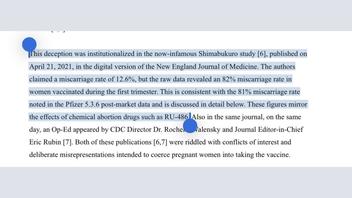
'The authors claimed a miscarriage rate of 12.6%, but the raw data revealed an 82% miscarriage rate in women vaccinated during the first trimester. This is consistent with the 81% miscarriage rate noted in the Pfizer 5.3.6 post-market data. These figures mirror the effects of chemical abortion drugs such as RU-486.'
This is what the post looked like on X at the time of writing:
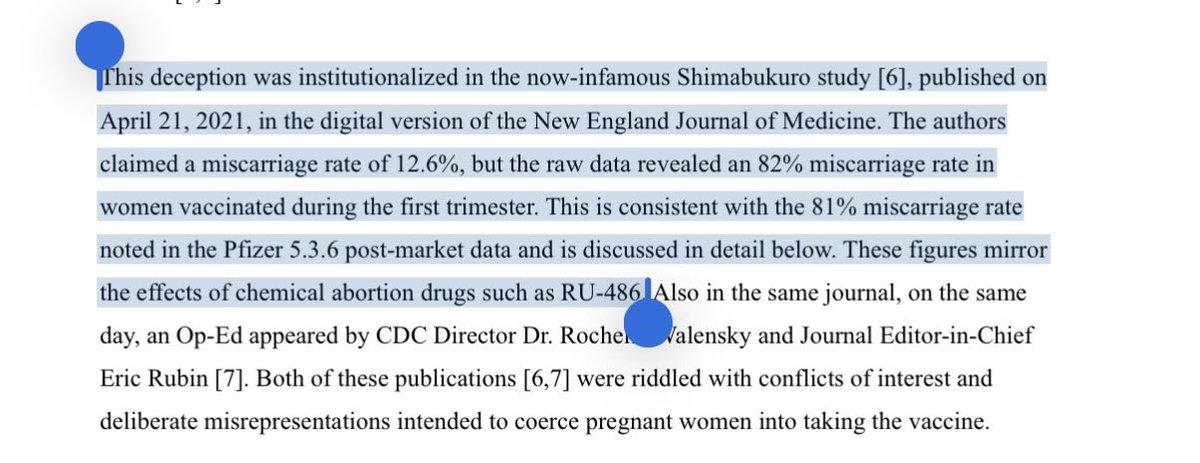
(Image source: post by @KatiePavlich on X.)
Shimabukuro study
The "Shimabukuro study" (mentioned above) was published in the New England Journal of Medicine (archived here) in April 2021. It examined how mRNA COVID-19 vaccines (Pfizer and Moderna) affected pregnant people, using Centers for Disease Control and Prevention (CDC) surveillance data collected from December 2020 to February 2021.
Table 4 in the study shows that the "pregnancy loss among participants with a completed pregnancy" in the V-safe Pregnancy Registry (archived here) -- developed and run by the CDC -- was 104 spontaneous abortions at less than 20 weeks out of 827 completed pregnancies, which would be a 12.6% miscarriage rate, not 82%.
Critics got 82% by tossing out the 700 women vaccinated in the third trimester and dividing by the remaining 127. But that is not a valid way to calculate a miscarriage rate. The 700 women vaccinated in the third trimester cannot simply be removed from the denominator because the study was tracking pregnancy outcomes among everyone in the registry, not asking whether each woman was at risk of miscarriage at the exact time she received the vaccine. Their inclusion helps explain why the 104 miscarriages cannot be used to calculate a miscarriage rate specifically for first-trimester vaccination. Removing them after seeing the outcomes changes the population being measured and produces a misleading percentage.
Meanwhile, the small group of early-pregnancy cases that were "complete" by the study's cutoff was mostly early losses simply because those resolve fast -- while healthy pregnancies from the same period had not had time to finish yet.
Lead Stories previously addressed this claim in the article, "Fact Check: New England Journal of Medicine Did NOT Find 82% Miscarriage Rate Among Pregnant Women Vaccinated Against COVID-19," in July 2021.
Pfizer 5.3.6
The 81% miscarriage rate came from data in Pfizer's 5.3.6 Cumulative Analysis of Post-authorization Adverse Event Reports (archived here) for their first mRNA COVID-19 vaccine, covering data collected through February 2021. It is a separate source, unrelated to the New England Journal of Medicine study, although it came up with a similar miscarriage rate and its data was miscalculated similarly.
Pfizer's report included 270 pregnancies reported after vaccination. At the time the report was compiled, 238 of those pregnancies had no outcome reported. Of the remaining 32 pregnancies, 28 had reported pregnancy losses and one had a normal outcome. The report separately lists five additional pregnancies as "outcome pending" -- a figure that does not cleanly reconcile with the rest of Pfizer's accounting, a discrepancy other reviewers have also noted.
The 81% claim comes from dividing the 28 reported pregnancy losses by the 32 pregnancies with a known outcome. There's a basic math problem there: 28 divided by 32 equals 87.5%, not 81%. So the 81% figure does not even match the calculation being attributed to the Pfizer data. That calculation excludes the 238 pregnancies with no reported outcome, making it an inappropriate way to estimate the miscarriage rate among all 270 pregnancies.
As with the Shimabukuro data discussed above, the incomplete follow-up meant that pregnancies ending early were disproportionately represented among the available outcomes, while many pregnancies that would eventually result in live births had not yet reached an outcome.
Looking at all 270 reported pregnancies rather than only the 32 with known outcomes, the 28 reported pregnancy losses represented about 10.4% of the 270 pregnancies. That figure should not be considered a true miscarriage rate, however, because outcomes were not reported for 238 pregnancies.
Comprehensive study
In a significantly larger research paper (archived here) published in February 2023, researchers combined data from 21 studies (five clinical trials, 16 observational studies) covering about 150,000 pregnant women to see if COVID-19 vaccination is linked to miscarriage. The study question was:
What is the risk of miscarriage among pregnant women who received any of the COVID-19 vaccines?
The meta-analysis reported a 9% miscarriage rate among vaccinated women (14,749 of 123,185). The 9% figure was the researchers' combined estimate from multiple studies, not a simple calculation of the two numbers shown, which would produce a rate of about 12%.
Bottom line: No evidence was found that COVID-19 vaccines increase miscarriage risk -- though the authors noted at the time that the evidence is still limited and called for larger studies to confirm this further.