
Have you seen viral videos showing a father crying at the hospital bedside of his unconscious young daughter asking viewers for prayers? Lead Stories has spotted a number of such videos recently and has found that many of them were created using artificial intelligence. They do not show real people or situations but appear to be modeled after social media accounts of real people dealing with a family health crisis, including the promise that they will continue to update on the child's condition, encouraging people to follow the account.
This article is part of a series of stories examining various types of what is commonly called "AI-slop": short, vertical videos generated with artificial intelligence tools with the aim of going viral, often by exploiting the emotions or curiosity of the viewer with made-up content.
What these 'Father's Plea For Prayers' videos look like
These dimly lit scenes show a crying man speaking directly into the camera from his daughter's hospital bedside. The first word of the script is almost always "Please." He cries as he describes his daughter's dire health while holding her small unmoving hand. His eyes are puffy and red, and he wipes his tears away while asking for prayers. The little girl lies still on the hospital bed, hooked up to monitors and IV bags, with an oxygen mask on her face. The young fathers are typically portrayed in casual or blue-collar work clothes, T-shirts, hoodies, in muted colors of blue, gray and green. The accounts posting these videos occasionally post videos featuring a mother character: these focus on a dire financial situation -- perhaps due to the father's incarceration -- and a child's health crisis. Having no money to fill a prescription seems to set the stage for a plea for donations, but the videos end with a request to support her family with follows and shares.
The TikTok accounts posting these videos have handles that are just a string of letters and numbers such as @oyfhkdrzu5e or @npfdbdajf4b. The thumbnails of all the videos published by any one of the accounts typically show more than one father portrayed in the bedside plea for prayers video formula. These accounts also seem to share or copy the same material. Some of the accounts show an abrupt change of theme in the content they post: for example, one account switched from Spanish-speaking fathers asking for prayers, to outdoor accent lighting inspiration reels, to paid partnership bra and cosmetics ads.
Some examples
A hospital monitor beeps throughout one video (archived here). It begins with a crying father speaking unintelligibly but the conclusion has a clearly spoken request to "Please follow my account".
@oyfhkdrzu5e "Please... I don't know how to keep going without knowing if she's going to be okay. I keep telling myself she can feel me here.#prayersforher#familyfirst#devastated#truestoryPlease♬ original sound - MiracleMoments
@ecssgjew22l "Please... I just need everyone to know that I'm still here with her every single moment. I keep talking to her because I believe she can hear me. I just want her to know her dad is right here. Please follow my account for updates and keep supporting us." 💔😭 #sad #hospital #heartbroken #staystrong #emotional ♬ original sound - ecssgjew22l
@weskecastell6501 💔💔💔#heartbroken#family#foryou#fyp♬ original sound - urrrtil
Keywords
Here are hashtags often associated with videos like these:
#devastated #emotional #family #familyfirst #foryou #fyp #heartbroken #hospital #medicalemergency #needsupport #prayersforher #sad #staystrong #truestory
This caption from one video is representative of the types of things included in most captions:
Please... I just need everyone to know that I'm still here with her every single moment. I keep talking to her because I believe she can hear me. I just want her to know her dad is right here. Please follow my account for updates and keep supporting us.
How to tell they are false
The highly emotional subject matter and the sight of a father in tears can catch an otherwise critical person off guard. Most of these videos have a label which reads, "Contains AI-generated media". But the comments are still full of prayers and expressions of concern from viewers who did not realize the scene was fictional. When viewed alone, they may be convincing, but a quick scan of the account that posted it betrays a formula for engagement and not a real family in crisis.
Some of the videos contain obvious glitches typical of AI generated content. In one video (archived here) the father is holding his daughter's hand but his hand is malformed (below left). His hospital bracelet is taped over his knuckles rather than circling his wrist -- the bracelet later vanishes. The father is also inexplicably shirtless and the daughter's oxygen mask seems to be supplied by three different tubes. In another video (archived here) the patient monitor has text that is malformed (below right) and the waveforms do not depict the readings they represent (archived here). The two numeral nines visible on the screen are not the same shape, and the readout which would represent heart rate, O2 saturation, and respiratory rate do not match those of a living, breathing patient.
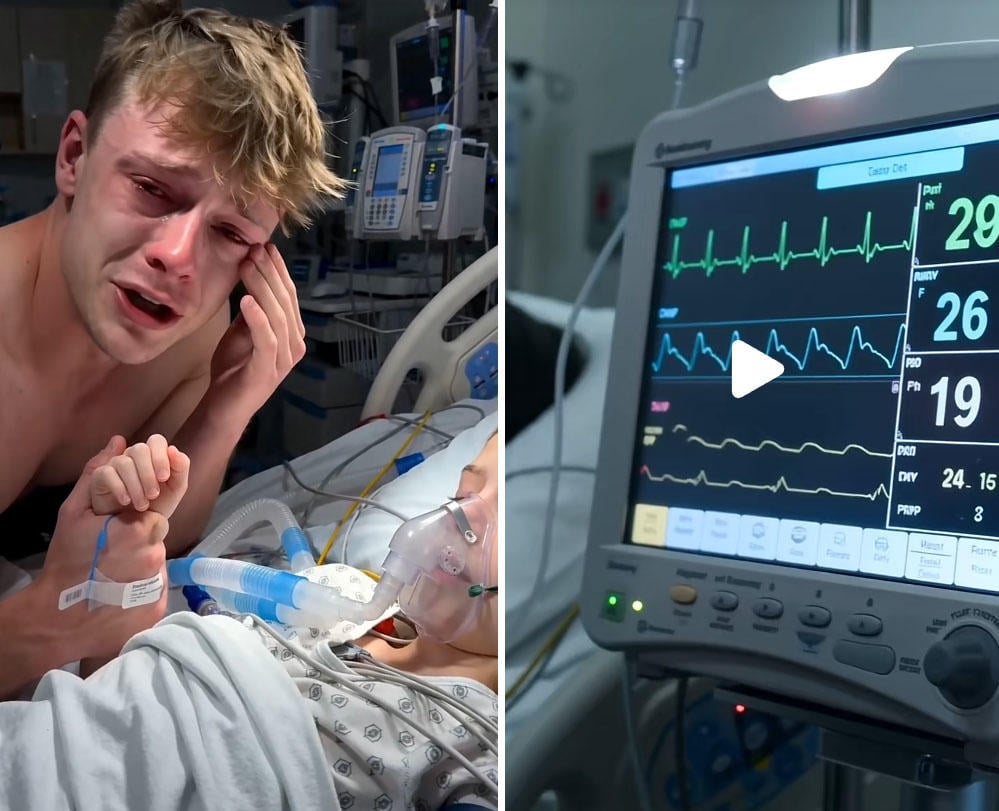
(Image source: posts by @oyfhkdrzu5e and @huanykrlwcf on TikTok.)
If you see videos like these on social media, here are some things you can try.
First, look for AI-disclaimers added by the platform or the poster. On TikTok they might say "Contains AI-generated media" or "AI-generated" (archived here), on X they read "Made with AI" (archived here) and on Facebook/Instagram they often say "AI info" (archived here). Check the description of the video too: in some cases the creator might have added a note or a hashtag like #AI, #madewithAI or #fiction. Do not forget to check the main page of the account that posted the video either: maybe there is a disclaimer in the bio and in some cases AI use is really obvious when an account is posting dozens and dozens of variations of the same type of video.
Do not stop at the account that posted the video: maybe they copied it from somewhere else. Use a tool to take a screenshot of the first frame of the video and run it through a reverse image searching tool to see where else on the internet it appears. It may have originated on an account that posts satire, AI-creations or actual art.
If you are still not sure, try downloading the video itself. There are several AI detection tools that can tell you if there are watermarks or other technical characteristics present in the video that would indicate it was likely made with AI.
Finally, use common sense: if the video shows an event that would otherwise be newsworthy, use a news search engine to check if it has been reported on by a news service you trust. Also pay close attention to the video itself: look for physical impossibilities or glitches typical of AI-generated footage like:
- People or things appearing (or disappearing) out of thin air
- Objects behaving in physically impossible ways (heavy objects falling slowly, rigid objects bending...)
- Garbled writing, oddly shaped letters or signs
- People or objects blending into or moving through each other
- Inconsistencies between different shots of the video (extra architectural elements in buildings, changing backgrounds, differences in clothing or hairstyle)
- An audio track that sounds strange: flat, unnatural speech, scripted-sounding yelling from bystanders ("Did you see that? OMG!"), sound effects being out of sync with events.
Unsure about a video? Email [email protected] and we will take a look!
These materials were developed in 2026 for the Prebunking at Scale project, with support from the European Fact-Checking Standards Network. If you share this on social media, use #prebunkingatscale.