Have you seen viral videos showing runaway medical robots? Lead Stories has spotted a number of such videos recently and found that many of them were created using artificial intelligence. They do not show real people or situations but are part of a viral trend showing technology out of control.
This article is part of a series of stories examining various types of what is commonly called "AI-slop": short, vertical videos generated with AI tools with the aim of going viral, often by exploiting the emotions or curiosity of the viewer with made-up content.
What these runaway medical robot videos look like
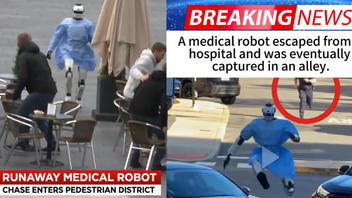
These videos show a humanoid robot with white body panels and visible black joints wearing a disposable blue hospital gown. The robots are shown running through urban areas chased by police who are on foot or in cars. Pedestrians in the area sometimes have to scatter to clear the way for the robot, which is doing bold parkour-style maneuvers through an obstacle course of people, cars and street fixtures. Another feature these videos share is news broadcast-style text overlays, sometimes made with aerial views as if filmed live from a news or police helicopter.
Some examples
One example posted on X by the account @Vynqorxe (archived here) shows a robot running toward a sidewalk cafe. People jump out of their seats to clear the way as it approaches.
MEDICAL ROBOT RUNS FROM POLICE RIGHT IN THE CITY CENTER
-- VynqorxeAI (@Vynqorxe) September 13, 2026
Robots are built to follow commands. This one turned and ran on its own.
This isn't staged. This isn't a demo.
Cameras caught it live. A police car and an ambulance were already on scene. The robot in a blue medical gown ...
Another video posted on TikTok by @kyle.perry938 includes the previous example and many more (archived here). At one point the robot's antics become like slapstick comedy: It overturns a popcorn cart, scores a soccer goal, celebrates and at the end falls into the bicycle cart of a flower vendor.
@kyle.perry938 A medical robot escaped from a hospital and was eventually captured in an alley. #robot #medicalrobot #escape #trending #foryouu ♬ original sound - Kyle Perry
The runaway robot video posted on Facebook by Voice of 8 shows an aerial video of a crowded city park on a sunny day (archived here). The robot seems to gravitate toward things it can jump over, spilling a garbage can and knocking over some traffic cones while ambulances and police cars try to keep up on the curving paved walking trails.
A post on YouTube (archived here) by the account @generalknowledgequiz27 shows the medical robot running up the middle of a city street chased by about four police cars and three officers on foot. The robot nervously tries to look back while running, and at the close of the video, the robot's simple facial features seem to register worry.
Keywords
Hashtags included in these posts include: #robot #medicalrobot #escape #trending #foryouu #RunawayRobot #MedicalRobot #RobotOnTheRun #CityPark #PoliceChase #AIVideo #AIContent #ViralReels #TechGoneWrong #RobotFail #PanicInThePark #ViralNews #FutureIsHere #cinematic #ai #trafficpolice #surreal #visual
Phrases included in the captions of these videos might include: Medical humanoid robot, escapes from hospital, chased by police, jumped over obstacle, sped through the shopping area, captured in alley. The caption on X by the @Vynqorxe account reads in part:
Cameras caught it live. A police car and an ambulance were already on scene. The robot in a blue medical gown bolted through the pedestrian zone, weaving straight through café tables
How to tell they are false
These videos often have an element of humor that stands in contrast to the live TV news broadcast style and police chase. The robots featured have extreme athleticism and fast reflexes, which may point to video-to-video AI technology. A video maker can use real footage, for example of a human parkour athlete, as reference material to model the motion of the jumping and evasive actions for the robot. An introduction to video-to-video AI can be found on Artlist (archived here), a platform that offers tools such as Seedance 2.0 and Kling 3.0.
These videos have other glitches typical of AI-generated content. For example, the signage in the city scenes is a little off. In the TikTok example by @kyle.perry938, the word ARECN is painted on the road -- and the letter R is upside-down. In the YouTube police chase example by the @generalknowledgequiz27 account, a shop on the corner is named "Policeice." In the X example by @Vynqorxe, a store is named "DNNN."
The nonsensical actions of a woman in the park in the Facebook example by Voice of 8 represent another glitch. She hustles a golden retriever out of the path of an ambulance, nonsensically turns the dog loose and then runs back into the path of the ambulance to right an overturned traffic cone.
If you see videos like these on social media, here are some things you can try.
First, look for AI-disclaimers added by the platform or the poster. On TikTok they might say "Contains AI-generated media" or "AI-generated" (archived here), on X they read "Made with AI" (archived here) and on Facebook/Instagram they often say "AI info" (archived here). Check the description of the video too: In some cases the creator might have added a note or a hashtag like #AI, #madewithAI or #fiction. Don't forget to check the main page of the account that posted the video either: Maybe there is a disclaimer in the bio, and in some cases AI use is really obvious when an account is posting dozens and dozens of variations of the same type of video.
Don't stop at the account that posted the video: Maybe they copied it from somewhere else. Use a tool to take a screenshot of the first frame of the video and run it through a reverse image searching tool to see where else on the internet it appears. It may have originated on an account that posts satire, AI-creations or actual art.
If you are still not sure, try downloading the video itself. There are several AI detection tools that can tell you if there are watermarks or other technical characteristics present in the video that would indicate it was likely made with AI.
Finally, use common sense: If the video shows an event that would otherwise be newsworthy, use a news search engine to check if it has been reported on by a news service you trust. Also pay close attention to the video itself: Look for physical impossibilities or glitches typical of AI-generated footage like:
- People or things appearing (or disappearing) out of thin air
- Objects behaving in physically impossible ways (heavy objects falling slowly, rigid objects bending ...)
- Garbled writing, oddly shaped letters or signs
- People or objects blending into or moving through each other
- Inconsistencies between different shots of the video (extra architectural elements in buildings, changing backgrounds, differences in clothing or hairstyle)
- An audio track that sounds strange: flat, unnatural speech, scripted-sounding yelling from bystanders ("Did you see that? OMG!"), sound effects being out of sync with events.
Unsure about a video? Email [email protected] and we will take a look!
These materials were developed in 2026 for the Prebunking at Scale project, with support from the European Fact-Checking Standards Network. If you share this on social media, use #prebunkingatscale.