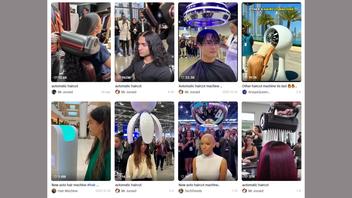
Have you seen viral videos showing automatic haircut machines? Lead Stories has spotted a number of such videos recently and found that many were created using artificial intelligence. These videos do not show real people or situations. Instead, they exploit the novelty of such machines to drive engagement on social media.
This article is part of a series of stories examining various types of what is commonly called "AI-slop": short, vertical videos generated with artificial intelligence tools with the aim of going viral, often by exploiting the emotions or curiosity of the viewer with made-up content.
What these "automatic haircut machine" videos look like
These videos claim to feature real-life examples of automatic haircut machines in action. Ultimately, the videos rely on a familiar set of engagement tactics and visual cues -- including futuristic-looking machines, dramatic haircut transformations, close-up shots of the machines cutting and styling hair, exaggerated claims about speed and precision, and calls for viewers to follow, comment, or tag someone who would use the machine -- to boost credibility, encourage interaction, and increase the content's reach.
Some examples
Here is a video uploaded on Nov. 24, 2025, to the TikTok account @mikejonesbusiness (archived here) that shows several people getting a haircut using an automatic machine:
@mikejonesbusiness This Machine Gives You A HAIRCUT!
♬ original sound - mikejonesbusiness
Here is another video published on Dec. 8, 2025, to the YouTube account @TechtrimStudios (archived here), that shows a woman getting her hair styled and dyed:
Here is a different video posted on the Instagram account @AI creativity hairstyle (archived here), published on Feb. 6, 2026, that shows several women getting their hair cut or styled:
Keywords
Here are hashtags and keywords often associated with videos like these: #AutomaticHaircut, #HaircutMachine, #AIHaircut, #FutureTechnology, #HairTransformation, #HairStyling, #Innovation, #Tech, #ArtificialIntelligence, #AI, #ViralVideo, #Trending, "automatic haircut machine," "AI haircut machine," "robot cuts hair," "machine cuts hair," "automatic hair styling machine," "futuristic haircut machine," "robot barber," "AI hair transformation," and "haircut machine video."
How to tell they are false
These videos follow a similar theme. They show people getting their hair cut or styled by a machine in settings ranging from shopping malls and public parks to traditional salons, without the help of a human being. The people ooh and aah over the results and often say how much they love them. Onlookers are amazed, too.
Here is a screenshot of a video posted on the Instagram account @AI creativity hairstyle (archived here) that shows the label "AI content" on the bottom left:
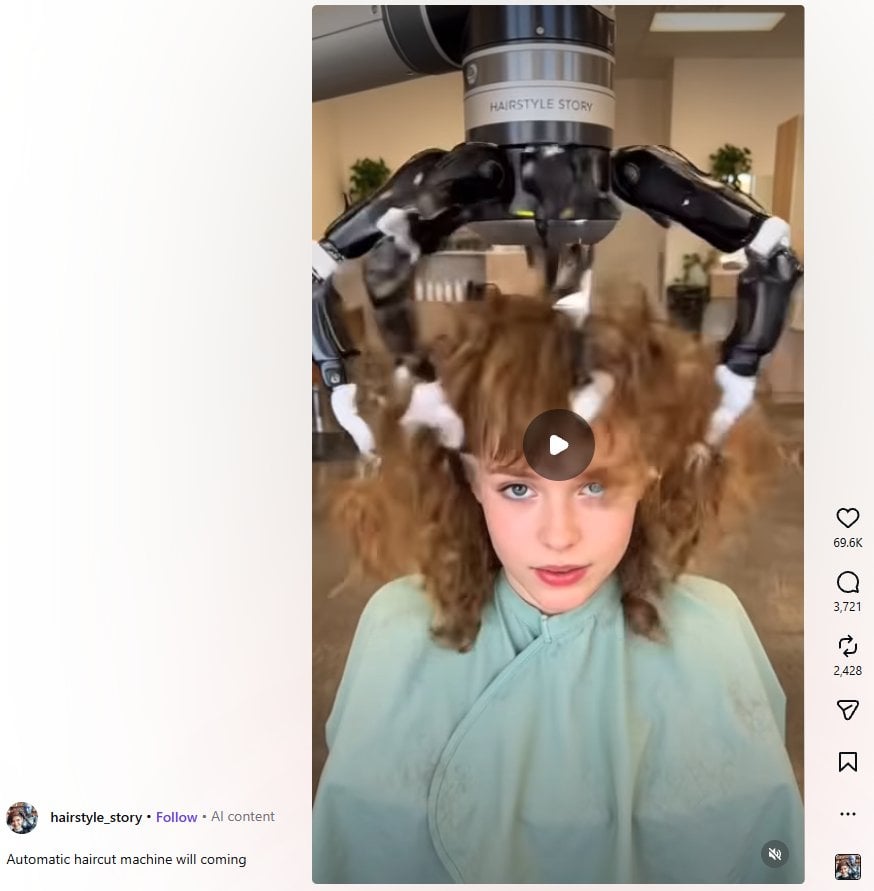
(Image source: post by @AI creativity hairstyle on Instagram.)
A second video (archived here) posted on the YouTube account @TechtrimStudios shows a woman getting part of her hair dyed a light purple and also styled. The disclaimer in the post's description reads (bottom):
AI Haircut Machine 3.0 ✂️
This is what a screenshot from the post looked like at the time of writing:
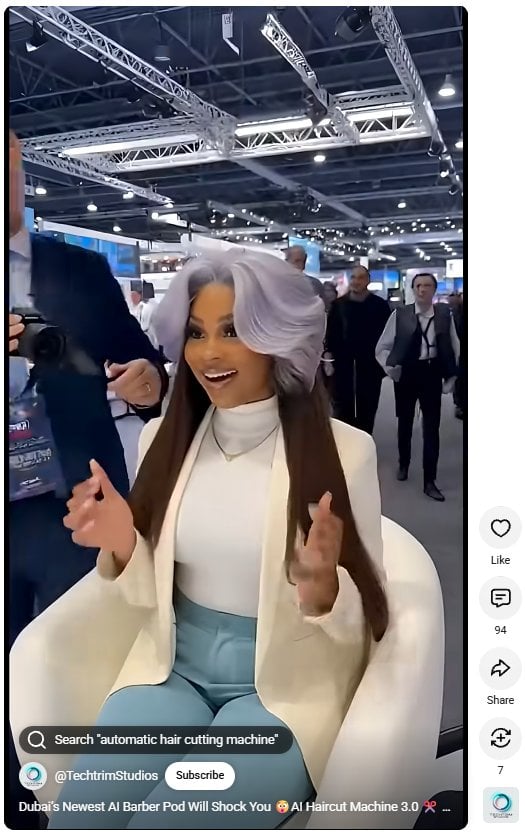
(Image source: post by @TechtrimStudios on YouTube.)
If you see videos like these on social media, here are some things you can try.
First, look for AI-disclaimers added by the platform or the poster. On TikTok they might say "Contains AI-generated media" or "AI-generated" (archived here), on X they read "Made with AI" (archived here) and on Facebook/Instagram they often say "AI info" (archived here). Check the description of the video too: in some cases the creator might have added a note or a hashtag like #AI, #madewithAI or #fiction. Do not forget to check the main page of the account that posted the video either: there may be a disclaimer in the bio and in some cases AI use is really obvious when an account is posting dozens and dozens of variations of the same type of video.
Do not stop at the account that posted the video: they may have copied it from somewhere else. Use a tool to take a screenshot of the first frame of the video and run it through a reverse image searching tool to see where else on the internet it appears. It may have originated on an account that posts satire, AI-creations or actual art.
If you are still not sure, try downloading the video itself. There are several AI detection tools that can tell you if there are watermarks or other technical characteristics present in the video that would indicate it was likely made with AI.
Finally, use common sense: if the video shows an event that would otherwise be newsworthy, use a news search engine to check if it has been reported on by a news service you trust. Also pay close attention to the video itself: look for physical impossibilities or glitches typical of AI-generated footage like:
- People or things appearing (or disappearing) out of thin air
- Objects behaving in physically impossible ways (heavy objects falling slowly, rigid objects bending...)
- Garbled writing, oddly shaped letters or signs
- People or objects blending into or moving through each other
- Inconsistencies between different shots of the video (extra architectural elements in buildings, changing backgrounds, differences in clothing or hairstyle)
- An audio track that sounds strange: flat, unnatural speech, scripted-sounding yelling from bystanders ("Did you see that? OMG!"), sound effects being out of sync with events.
Unsure about a video? Email [email protected] and we will take a look!
These materials were developed in 2026 for the Prebunking at Scale project, with support from the European Fact-Checking Standards Network. If you share this on social media, use #prebunkingatscale.