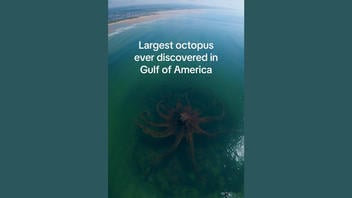
Does actual drone footage show a giant "eclipse Octopus" in the Gulf of America (sometimes also called the Gulf of Mexico)? No, that's not true: The video originated on a TikTok channel with a disclaimer that says it publishes videos made with artificial intelligence tools and which posted many other faked animal videos. The "octopus" in the video also had more than eight tentacles, another dead giveaway the footage wasn't real.
The video (archived here) where it was published by TikTok channel @connarclips where it was uploaded on September 18, 2025 with a description that read:
Largest Octopus Ever Discovered in the Gulf of America
Scientists draw connections to recent eclipses and lunar changes
Gulf of Mexico -- Marine biologists announced today the discovery of what is believed to be the largest octopus ever recorded, found deep within the Gulf of America. The specimen, measuring over 45 feet across with tentacles spanning the length of a city bus, was documented by a joint research expedition led by the Gulf Marine Institute and international oceanographers.
"This is a once-in-a-lifetime discovery," said Dr. Elena Vargas, lead marine biologist on the expedition. "The octopus exhibits features unlike any we've cataloged before, suggesting an entirely new subspecies adapted to the shifting currents and ecological changes of the Gulf."
The timing of the discovery has sparked broader cultural and scientific interest. Many are linking the appearance of the giant cephalopod to the recent series of eclipses and lunar anomalies observed in 2025, which have affected tides and marine migration patterns. While scientists caution against drawing direct conclusions, they acknowledge that unusual lunar cycles can play a significant role in deep-sea behavior.
Local communities along the Gulf Coast have already begun referring to the creature as the "Eclipse Octopus," symbolizing the rare overlap of celestial events and oceanic mysteries.
Researchers are now studying tissue samples and environmental data to better understand the octopus' biology, its origins, and what its presence may signal about changes in the Gulf ecosystem.
"This discovery reminds us how little we know about the deep ocean," Dr. Vargas added. "The sea still holds secrets that connect us to forces larger than ourselves--the tides, the moon, and the universe itself."
Marine biologists uncover the colossal 'Eclipse Octopus,' revealing secrets about tides and lunar influences in the Gulf. Learn more! #EclipseOctopus #GulfOfAmerica
This is what the first frame of the video looked like on TikTok at the time of writing:
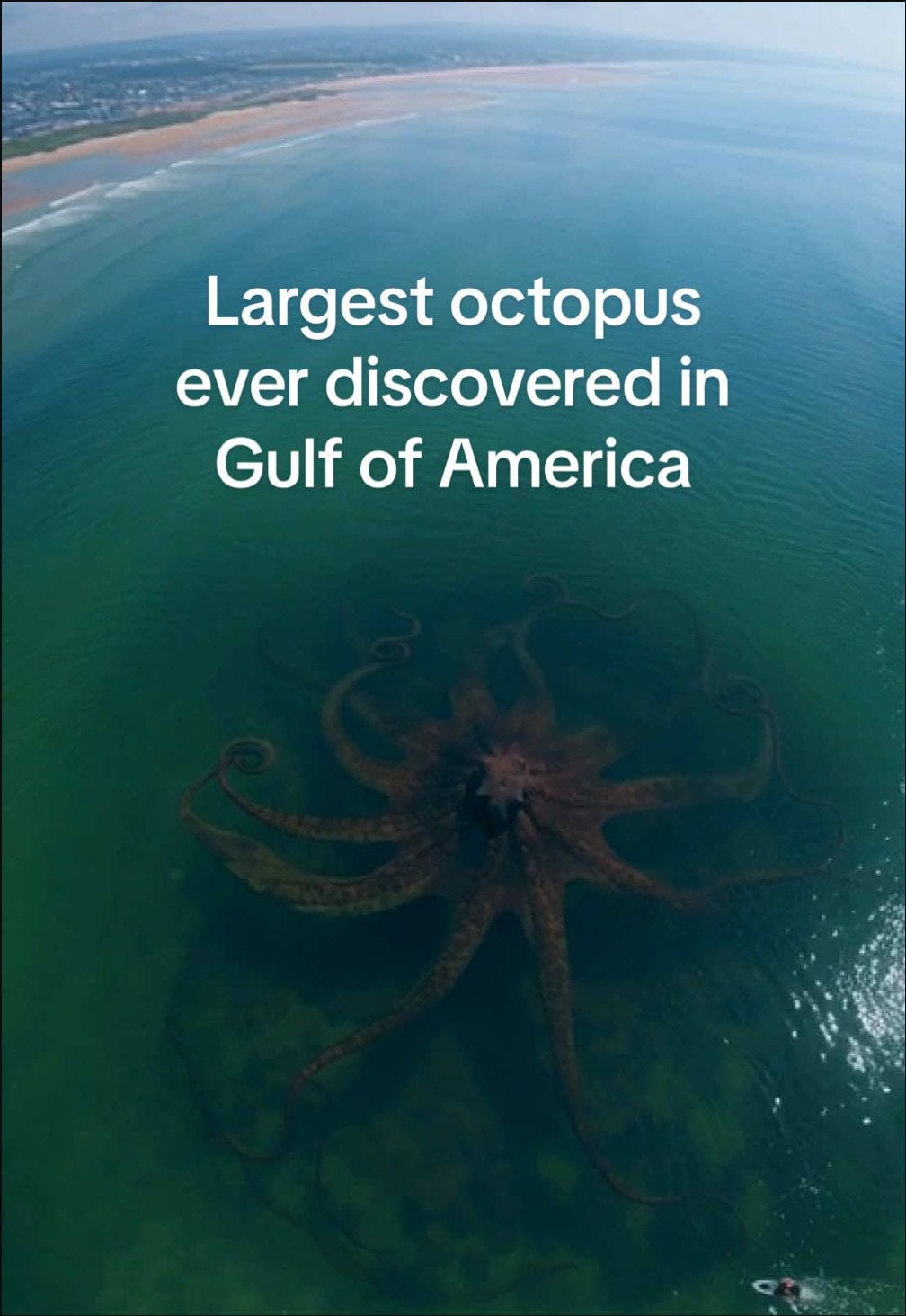
(Source: TikTok screenshot taken on Thu Dec 18 09:14:19 2025 UTC)
@connarclips September 17, 2025 - Gulf Of America Largest Octopus Ever Discovered in the Gulf of America Scientists draw connections to recent eclipses and lunar changes Gulf of Mexico -- Marine biologists announced today the discovery of what is believed to be the largest octopus ever recorded, found deep within the Gulf of America. The specimen, measuring over 45 feet across with tentacles spanning the length of a city bus, was documented by a joint research expedition led by the Gulf Marine Institute and international oceanographers. "This is a once-in-a-lifetime discovery," said Dr. Elena Vargas, lead marine biologist on the expedition. "The octopus exhibits features unlike any we've cataloged before, suggesting an entirely new subspecies adapted to the shifting currents and ecological changes of the Gulf." The timing of the discovery has sparked broader cultural and scientific interest. Many are linking the appearance of the giant cephalopod to the recent series of eclipses and lunar anomalies observed in 2025, which have affected tides and marine migration patterns. While scientists caution against drawing direct conclusions, they acknowledge that unusual lunar cycles can play a significant role in deep-sea behavior. Local communities along the Gulf Coast have already begun referring to the creature as the "Eclipse Octopus," symbolizing the rare overlap of celestial events and oceanic mysteries. Researchers are now studying tissue samples and environmental data to better understand the octopus' biology, its origins, and what its presence may signal about changes in the Gulf ecosystem. "This discovery reminds us how little we know about the deep ocean," Dr. Vargas added. "The sea still holds secrets that connect us to forces larger than ourselves--the tides, the moon, and the universe itself."
♬ Drone Sound Effect - DJ THIAGO ARMANDO SC
The TikTok account @connarclips (archived here) has a bio indicating it published "AI" generated videos:
Clips of Unexpl𝐀𝐈nable Events 😈🦄😇
At the time it posted the massively viral octopus video with 6.2 million views it was on a streak of posting other AI-generated videos about other mysterious animals and creatures being sighted:
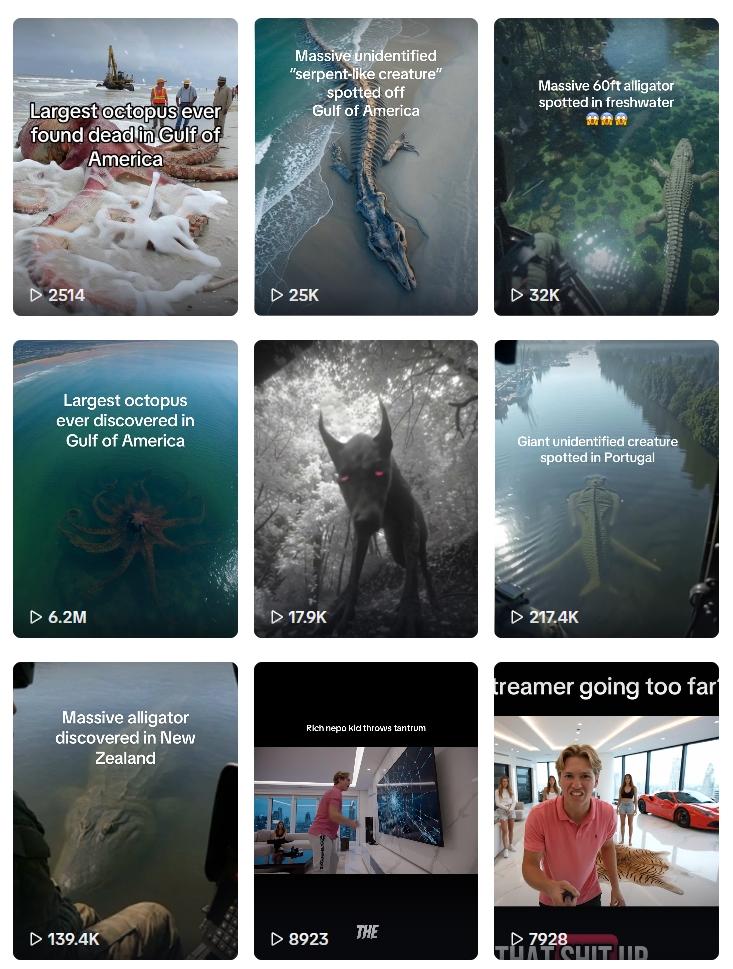
(Image: screenshot of detail of @connarclips TikTok account page.)
According to the National Wildlife Federation (archived here), octopuses are described as:
The octopus is a marine mollusk and a member of the class Cephalopoda, more commonly called cephalopods. Cephalopoda means "head foot" in Greek, and in this class of organisms, the head and feet are merged. A ring of eight equally-long arms surround the head. They use their arms to "walk" on seafloor. The undersides of the arms are covered with suction cups that are very sensitive to touch and taste. The sack-like body is perched atop the head, which has two complex and sensitive eyes, while the mouth is on the underside. Octopuses have a hard beak, which they use to pierce the shells of crustacean prey.
(Emphasis by Lead Stories)
However, the creature seen in the video has at least eleven arms, and some of them appear to be joined together at the tip or split at the end:
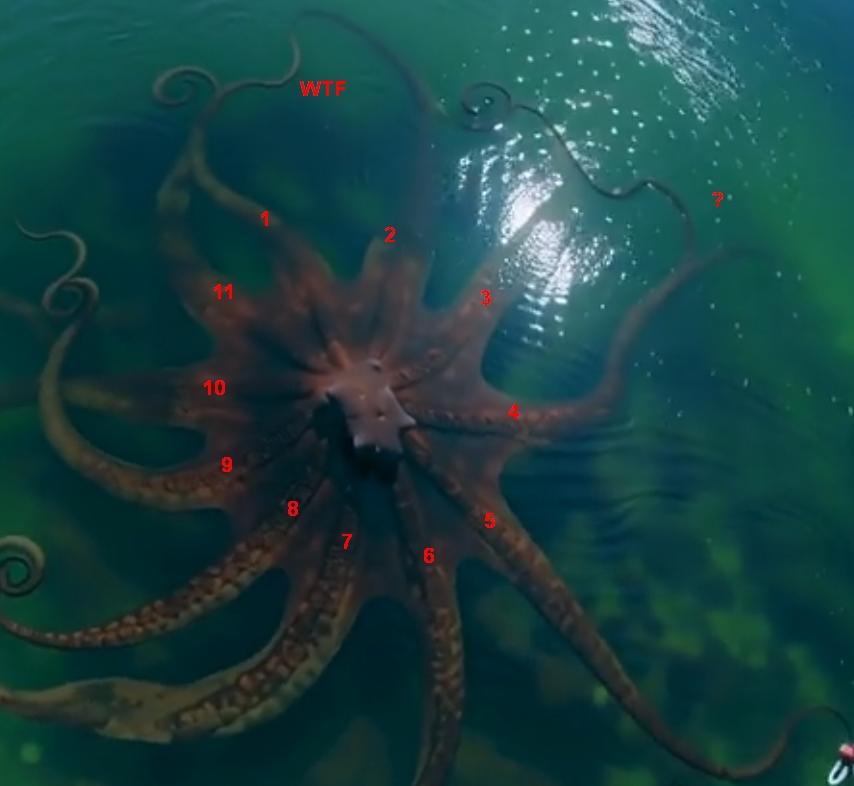
(Image: screenshot of detail of @connarclips TikTok video with red annotations by Lead Stories.)
Just to be sure Lead Stories uploaded the video to the Hive AI detection tool and it said it was 96.6% likely the video contained AI-generated or deepfake content:
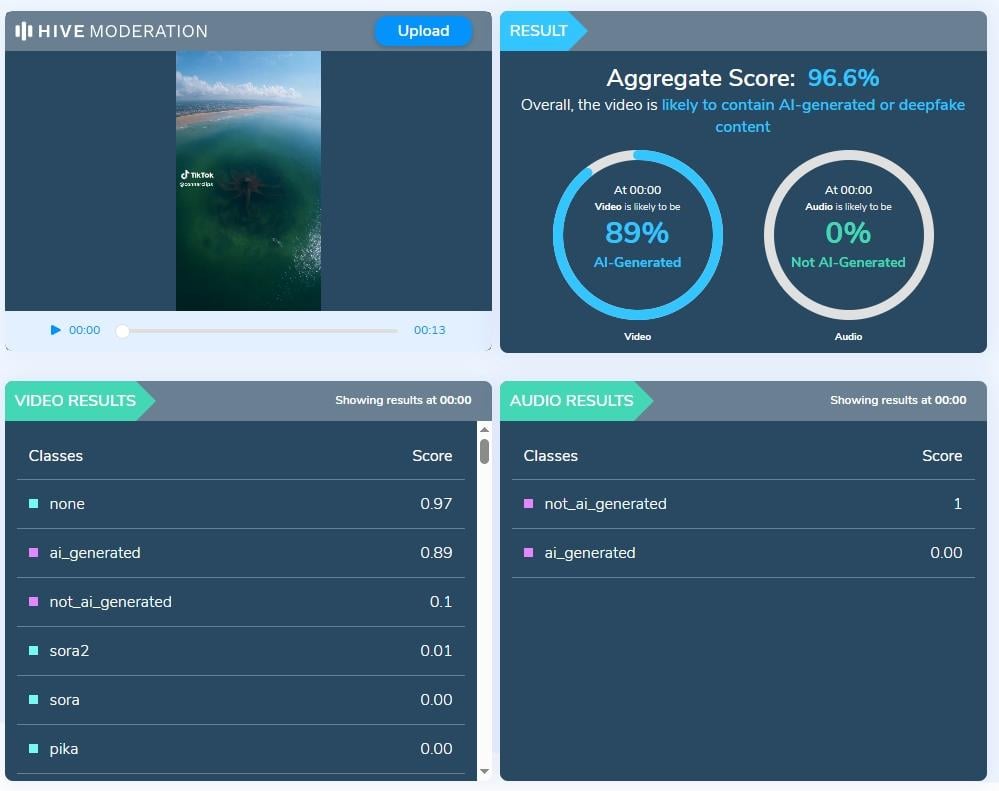
(Image: Hive results screenshot.)