Did the BBC air a report allegedly capturing a stolen Cézanne painting on the wall of Volodymyr Zelenskyy's presidential office? No, that's not true: The video was doctored to replace a real painting. The work of art seen in the original footage of a different presidential address was painted by a Ukrainian impressionist.
The claim appeared in a post (archived here and here) on X, where it was published on April 21, 2026. It opened:
Imagine how the stolen Cézanne artwork story might have played out if the times were different? Before social media, before breaking news, Zelensky might have gotten away with it. The painting would have stayed on his wall. No one would have noticed. But in 2026, everything is recorded, shared, and archived.
The post included a video with the visible BBC logo. This is what that video looked like on X at the time of writing:
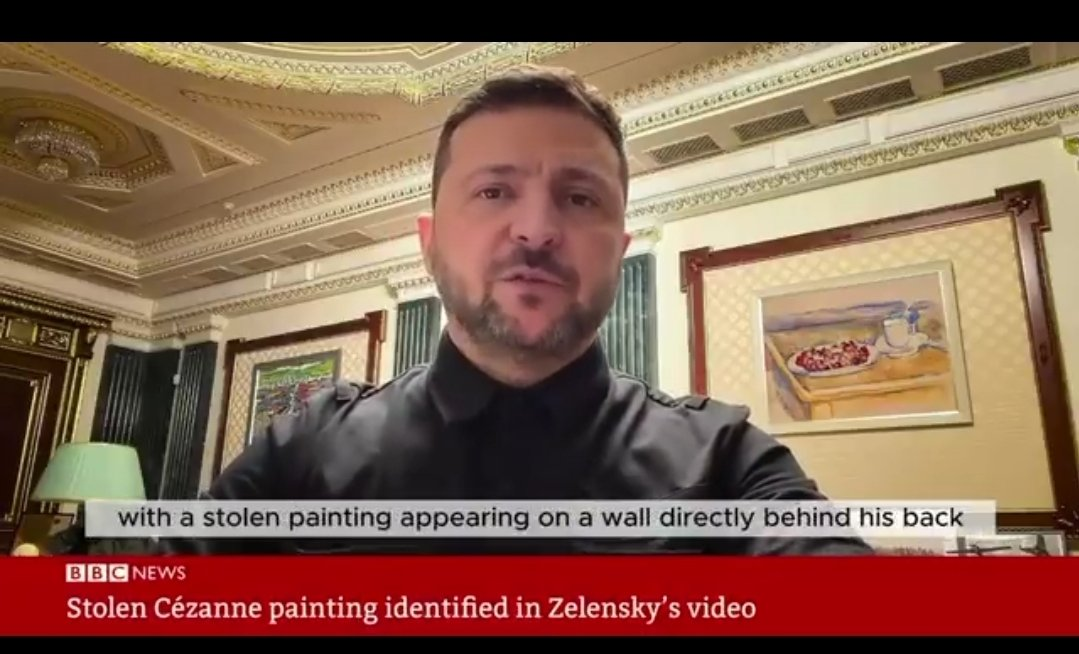
(Image source: post by @GarbageHuman24 on X.)
In what was claimed to be an authentic BBC news report, the voice-over narrated:
On March 22, three paintings by French masters Cézanne, Renoir and Matisse, worth more than $10 million were stolen from a museum near the Italian city of Parma. The theft has since been investigated by Italy's carabinieri and the cultural heritage protection unit. Surprisingly, less than a month after the heist, one of the stolen paintings, 'Cup and Plate of Cherries' by Paul Cézanne, appeared in one of President Zelenskyy videos, presumably recorded on April 16. The video shows Zelenskyy addressing Ukrainians with a stolen painting appearing on a wall directly behind his back. The video was published on the official website of the President of Ukraine, but has since been removed. This is a rare case of a stolen painting reappearing in public.
Chris Marinello, founder of Art Recovery International, says that a very small percentage of stolen art is ever found:
'5 to 10% of all art that's stolen is ever recovered, which is why we need to start focusing more on prevention.'
He also confirms that stolen art often ends up in countries where the rule of law is weak:
'They move them on through Belgium or Eastern Europe, countries where due diligence is not often practiced as it is in the West.'
The paintings of the three renowned artists were indeed stolen in Italy on March 22, 2026, and the BBC reported that (archived here), but the BBC never produced the video shown in the post.
A Google search across the BBC website for the keywords seen here (archived here) generated a single result, but that page (archived here) contained multiple news headlines, and the headlines mentioning the Ukrainian president didn't say anything about the stolen paintings.
On April 22, 2026, a BBC spokesperson told Lead Stories via email:
... we can confirm this is fake.
Lead Stories reached out to Chris Marinello (archived here), cited in the purported report. In an April 22, 2026, email, he said that the claim reviewed in this fact check is:
...completely fake.
In a follow-up phone call on the same day, Marinello confirmed that he was interviewed by the BBC in connection with the theft in Italy: "I did say that." However, he emphasized that he was not talking about the purported "finding" of Cézanne's painting inside the office of the Ukrainian president:
It's absolutely absurd because it's the Russians who are the biggest thefts of art. Stolen art ends up in Russia, and they refuse to give it back.
Lead Stories checked the website of the Ukrainian president (archived here), and it did not show a supposed April 16, 2026, address.
In contrast, Lead Stories found Zelenskyy recorded an address to the nation in a similar setting on January 19, 2026, (archived here):
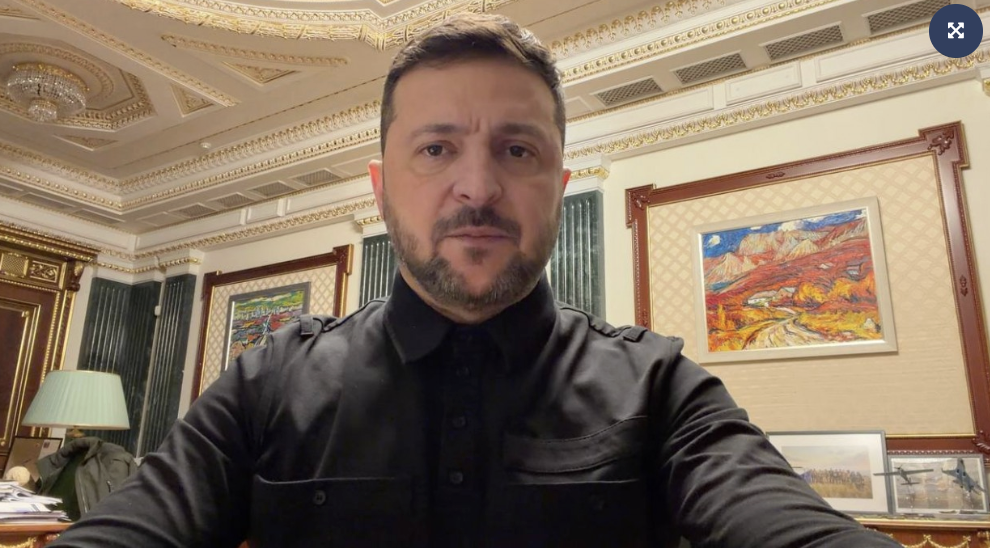
(Image source: President.gov.ua.)
However, the picture in the background was different -- it was a painting (archived here) by Andrii Chebotaru (archived here) that showed Crimea annexed by Russia in 2014.