Did Colonel Richard Whitmore give his wheelchair-bound daughter Eleanor to Josiah Freeman, a 7-foot-tall enslaved man, after she was deemed unmarriageable? No, that's not true: This story is not based on true historical events, but is a fictional romance, illustrated with AI-generated images and details that may seem like real documentation. The earliest mention of a story involving people by these names appears to be a YouTube video published on November 18, 2025. Advanced searches for details from the story did not point to existing historical documents or cemetery records.
The fictional story appeared in a video (archived here) titled, "She Was 'Unmarriageable'--Her Father Gave Her to the Strongest Slave, Virginia 1856". It was published on YouTube by the channel @TheSlavesRevenge on November 18, 2025. The narrative begins:
They called me unmarriageable and after 12 rejections in 4 years, I started to believe them. My name is Eleanor Whitmore. I am 22 years old and my legs have been useless since I was 8. The result of a riding accident that broke my spine and left me dependent on a wheelchair my father commissioned from a craftsman in Richmond. But it wasn't the wheelchair that made me unmarriageable in Virginia society of 1856. It was what the wheelchair represented...
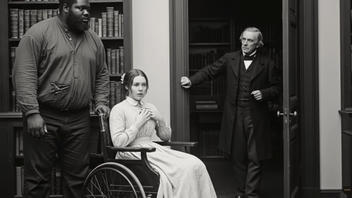
The video's thumbnail (pictured below) features an AI-generated image of the main characters and a text caption that reads:
She had paralysis in her legs since she was 8 years old. No white man wanted to marry her. Her father, desperate, gave her to the strongest slave: 2.10m tall, 140kg, called 'The Brute'. What happened next shocked everyone.
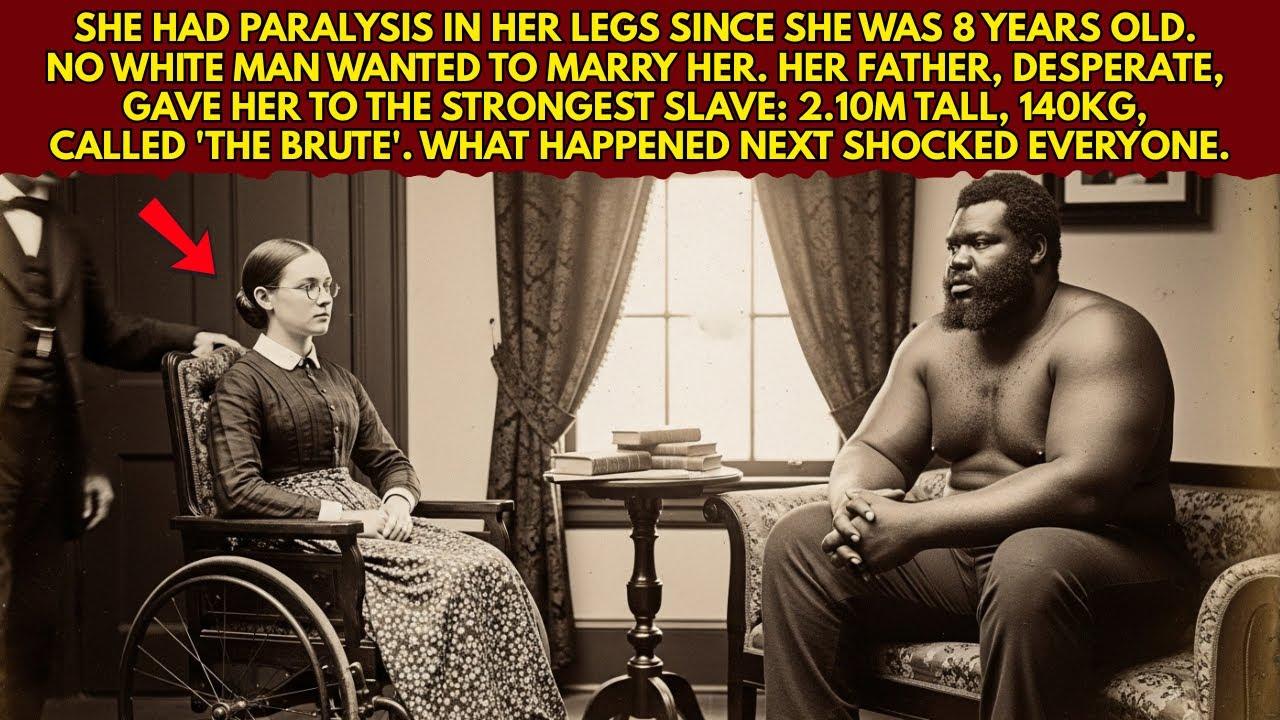
(Image source: @TheSlavesRevenge video on YouTube.)
The video is 53 minutes, 27 seconds. The story contains many specific details: the year, 1856. The place, 20 miles west of Charlottesville in the Piedmont region of Virginia. The story even includes made up details about where the couple is buried, Eden Cemetery in Philadelphia, and the inscription on their tombstone:
Eleanor and Josiah Freeman, married 1857, died 1895.
Love that defied impossibility.
A search on Find A Grave (archived here) of "Freeman" memorials from 1895 in Eden Cemetery returns no results.
Another made-up detail, introduced at fifty minutes, claims that the couple's daughter, Elizabeth Freeman, wrote a book:
...Against All Odds, the Eleanor and Josiah Freeman story in 1920, which became a significant historical document about interracial marriage and disability in the 19th century. The Freeman family of Philadelphia maintained detailed family records, including Colonel Whitmore's letters and Josiah's freedom papers, which were donated to the Historical Society of Pennsylvania in 1965.
A search of the Library of Congress catalog for the author's name has no record of a book by that name published in 1920. An advanced search within the collections of the Historical Society of Pennsylvania for the names "Colonel Whitmore" and separately, "Josiah Freeman," did not produce any of the family records mentioned in the fictional story.
This is not the only video on YouTube like it. Channels with names like @MacabreJustice, @LiturgyofFear-d8i, and @SlaveryStories68 (archived here, here, and here) have duplicated the story with different AI-generated images. Thumbnails of these videos are pictured below.

(Image source: thumbnails from @MacabreJustice, @LiturgyofFear-d8i, and @SlaveryStories68 videos on YouTube.)
The story has also spread on Facebook, in posts with long captions and a clickbait link typically posted in the first comment. One example was posted in the group Dr. Barbara O'Neill Health Tips on April 21, 2026 (pictured below, archived here). The link in the first comment points to an article on a website "allrecipes.delicedcook.com" (archived here). The caption of the Facebook post begins:
She Was Deemed Unmarriageable--So Her Father Gave Her to the Strongest Slave, Virginia 1856"No white man will marry you."Eleanor Whitmore had heard the truth in a dozen different forms before. In lowered voices. In pitying smiles. In the careful little pauses people used when they wanted to discuss her life as if she were not in the room.But hearing it from her father still felt like being struck.
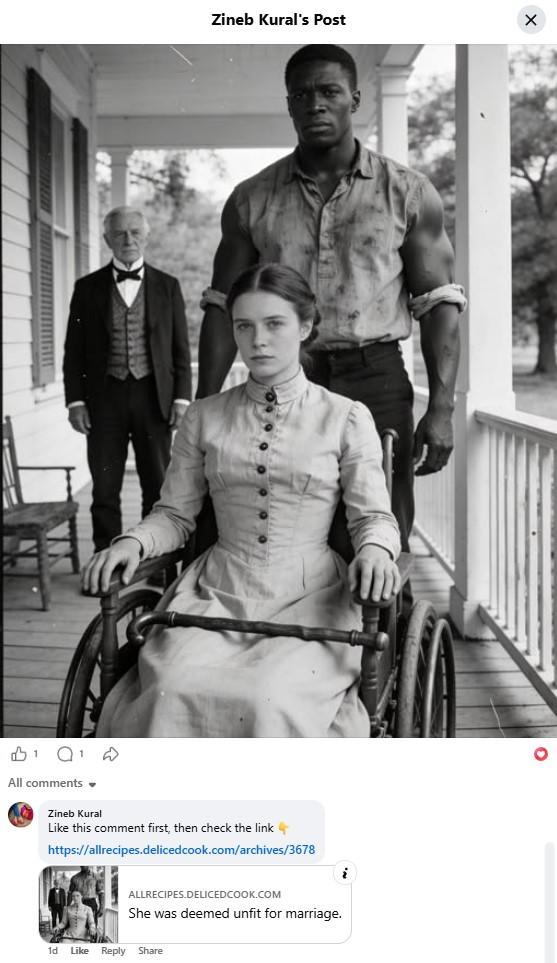
(Image source: @zineb.zezo post on Facebook.)