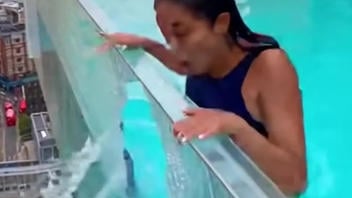
Have you seen viral clips showing people dying from "overfloating" the edge of infinity pools or from falling down from the top of the building after a collapse of the pool's transparent walls? Lead Stories has spotted a number of such videos recently and has found that many of them were created using artificial intelligence. An expert specializing in swimming pool design told Lead Stories that such clips don't even show what infinity pools -- equipped with multiple security features -- look like in real life. No credible media outlet published reports of the supposed wave of deaths from the purported incidents between mid-summer 2025 and mid-summer 2026.
This article is the first part of a series of stories examining various types of something that is often called "AI-slop": short, vertical videos generated with artificial intelligence in order to go viral by exploiting the emotions or curiosity of the viewer with made-up content.
What these 'infinity pool collapse' videos look like
The videos claimed to feature real-life collapses of infinity pools -- pools that feature (archived here), per the Council of Vertical Urbanism (archived here), a "continual edge over which water flows, with no building element impacting the view beyond that edge, such that the water appears to extend beyond the building".
Many of the swimming pools appearing in such clips look like small boxes attached to the external wall of skyscrapers. Several seconds in, a crack appears in the transparent wall, the pool disintegrates, and people fall to their death to the ground or into the sea beneath the skyscraper. In some cases, the disaster appears to have been provoked by people jumping into the pool and, thus, breaking the bottom. In other instances, swimmers would fall outside the edge of the infinity pool with an implication that the incident was fatal, too.
Some examples
Here is one of the most recent examples (archived here) published on X on June 22, 2026:
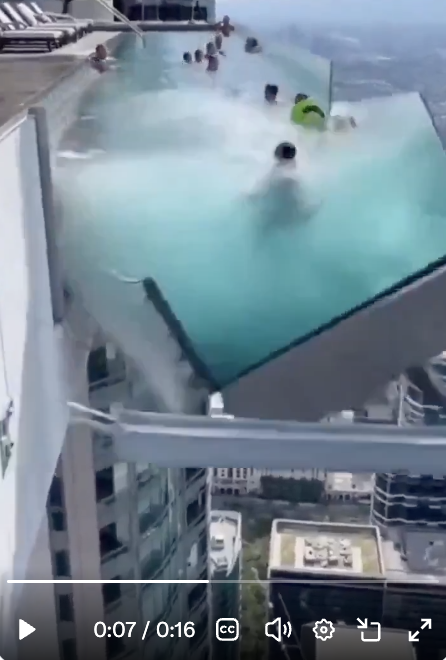
(Image source: Post by @rwabugilii on X.)
Here is another example (archived here) from Instagram:
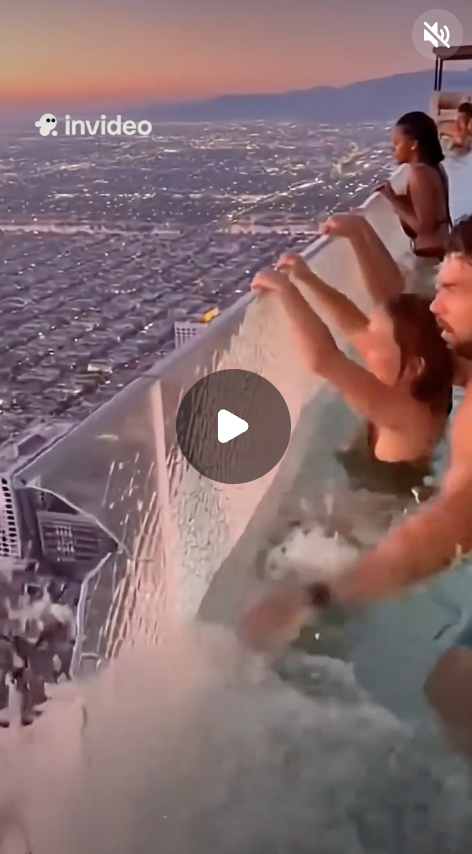
(Image source: Post by @cozyclouds1 on Instagram.)
Similar videos have been online at least since the mid-summer of 2025, as this clip (archived here) published on TikTok on July 19, 2025, confirms:
@aron.creator Sunbathing 60 stories up when the sky-pool's glass wall snaps--and an entire ocean dumps into the city below. Загораешь на высоте 60 этажей, как вдруг стеклянная стенка небесного бассейна трескается -- и целое море обрушивается в город. Want gravity-defying reels like this? DM me. Хочешь такие же зрелищные ролики? Напиши мне. #SkyPool #InfinityPool #RooftopDisaster #UrbanWaterfall #EpicFail #Cityscape #HighRise #GlassBreak #ShockMoment #AdrenalineRush #небесныйбассейн #водопад ♬ SLAY! - Eternxlkz
Keywords
Here are hashtags or keywords often associated with videos like these: "Infinity Pool Falls Apart", "collapse", "rooftop", "disaster", "fail", #SkyPool, #InfinityPool and #RooftopDisaster. Some of the clips would have a little more descriptive coverage. For example, it would read: "Sunbathing 60 stories up when the sky-pool's glass wall snaps--and an entire ocean dumps into the city below." Further research would show that the caption was repeated by other accounts nearly verbatim, but the number of floors would change (archived here) from post to post.
How to tell they are false
Some of those videos contain watermarks of a specific AI-generating software such as Sora or InVideo:

(Image source: Post by @jimbo.g0 on TikTok.)

(Image source: Post by @cozyclouds1 on Instragram.)
When the watermark was absent, online AI detectors such as Hive Moderation and Sightengine would frequently detect a significant presence of AI:
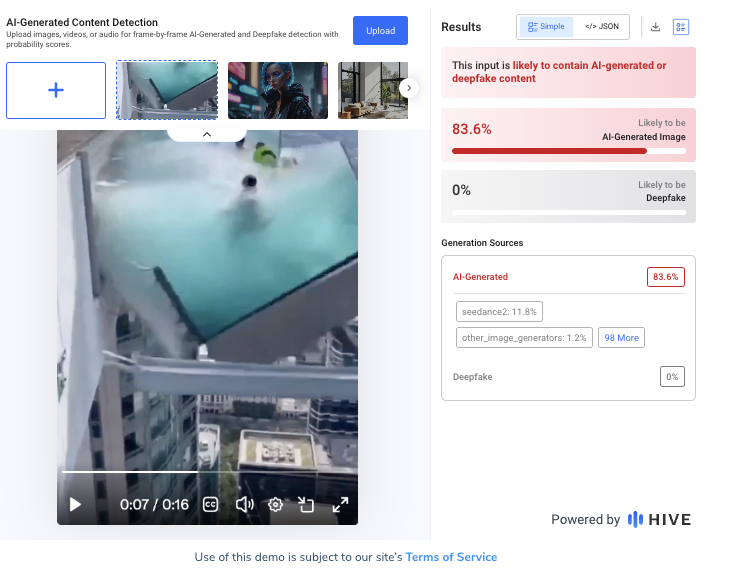
(Image source: Hive Moderation.)
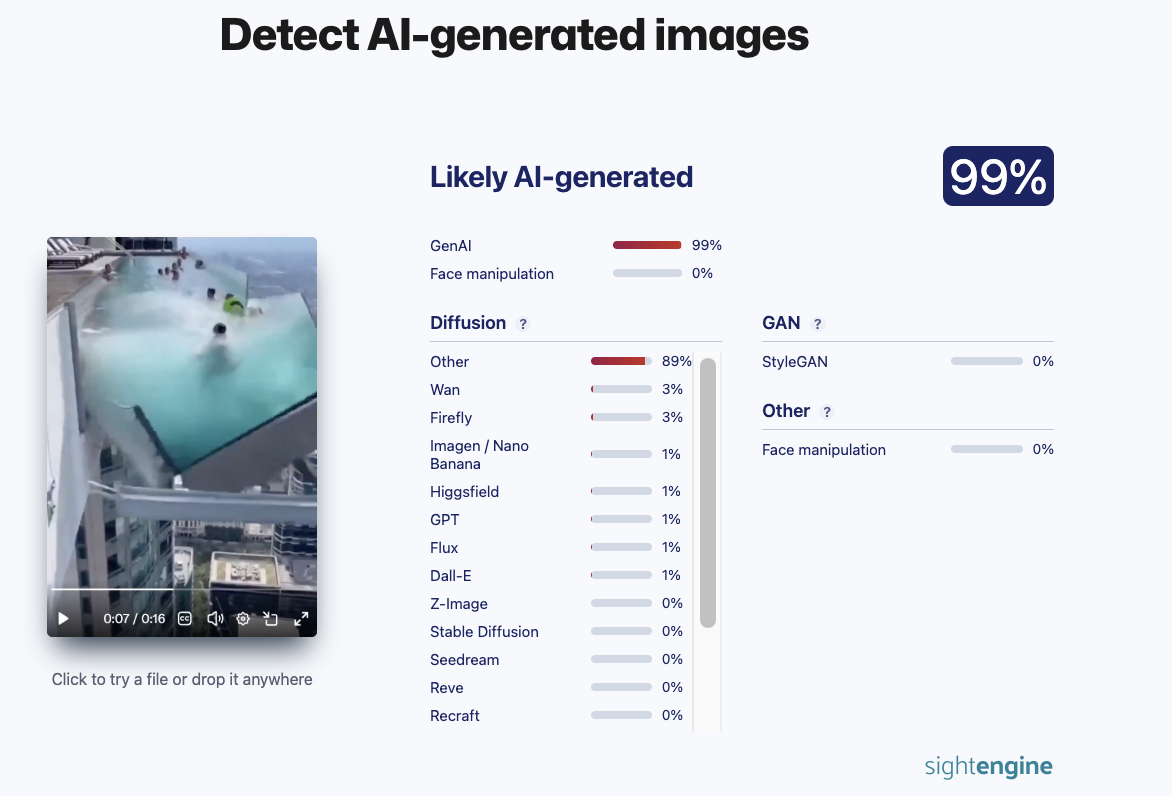
(Image source: Sightengine.)
In some other cases, the scene doesn't make any sense. Take the first scene in this video (archived here) posted on TikTok on December 30, 2025:
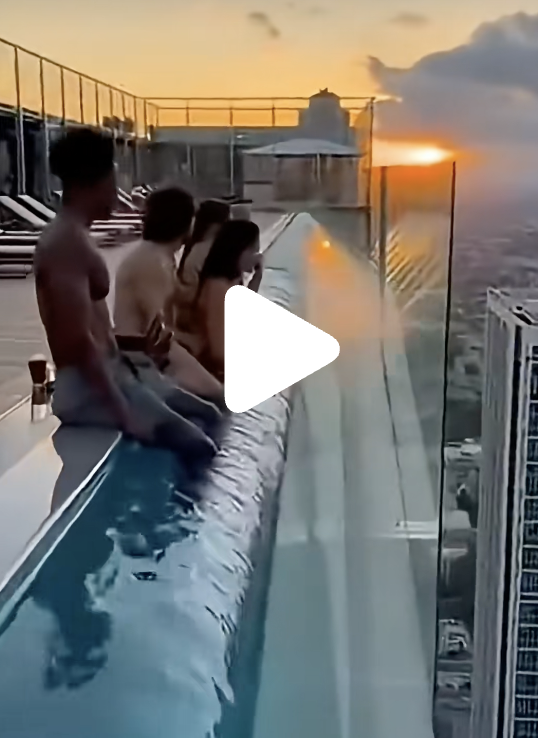
(Image source: post by @alisz604 on TikTok.)
Unlike in real life where swimming pools are built as horizontal bodies of water, what the screenshot above demonstrates rather looks like a waterfall covering one of the building's external walls. It's hard to imagine that a design with zero barriers preventing access to it would pass any safety inspections.
When Lead Stories asked Paolo Benedetti, who is the president of a swimming pool design firm and swimming pool expert witness (archived here) and an instructor at Watershape University (archived here), if the viral videos actually show real infinity pools equipped with the required safety feature, he replied via email on June 29, 2026, saying:
BS.
There have been acrylic panel failures on pools. None of those represented were vanishing edge pools.In a few the clear walls were presented as multi-layers of glass.Glass is not used in these applications. Rather clear acrylic (like in an aquarium) is used.The panels are cast in custom thicknesses to provide engineering safeguards to grossly exceed the minimum requirements required.The top of vanishing edge walls (called a 'weir') should be sloped enough to not encourage walking or sitting on the wall.Excessive fall hazards are mitigated by installing a wider & higher elevation catch basin, sometimes with safety grating &/or a railing on the lower wall.People do not "float" over the top of the weir, even if on a raft.
Incidents involving infinity pools did happen in the past. For example, vacationers washed out into the sea were injured in 2022 (archived here) when one of the infinity pool walls collapsed at Caribbean hotel. Yet, the survivors didn't fall from the height of the skyscraper and were later able to describe what happened to them, talking to reporters.
Had the world actually experienced a massive wave of deaths associated with infinity or rooftop pools, that would have been likely covered in the news, but when Lead Stories searched Google News for the period between July 1, 2025, and June 29, 2026 (archived here), it returned no links to credible reports.
If you see videos like these on social media, here are some things you can try.
First, look for AI-disclaimers added by the platform or the poster. On TikTok they might say "Contains AI-generated media" or "AI-generated" (archived here), on X they read "Made with AI" (archived here) and on Facebook/Instagram they often say "AI info" (archived here). Check the description of the video too: in some cases the creator might have added a note or a hashtag like #AI, #madewithAI or #fiction. Don't forget to check the main page of the account that posted the video either: maybe there is a disclaimer in the bio and in some cases AI use is really obvious when an account is posting dozens and dozens of variations of the same type of video.
Don't stop at the account that posted the video: maybe they copied it from somewhere else. Use a tool to take a screenshot of the first frame of the video and run it through a reverse image searching tool to see where else on the internet it appears. It may have originated on an account that posts satire, AI-creations or actual art.
If you are still not sure, try downloading the video itself. There are several AI detection tools that can tell you if there are watermarks or other technical characteristics present in the video that would indicate it was likely made with AI.
Finally, use common sense: if the video shows an event that would otherwise be newsworthy, use a news search engine to check if it has been reported on by a news service you trust. Also pay close attention to the video itself: look for physical impossibilities or glitches typical of AI-generated footage like:
- People or things appearing (or disappearing) out of thin air
- Objects behaving in physically impossible ways (heavy objects falling slowly, rigid objects bending...)
- Garbled writing, oddly shaped letters or signs
- People or objects blending into or moving through each other
- Inconsistencies between different shots of the video (extra architectural elements in buildings, changing backgrounds, differences in clothing or hairstyle)
- An audio track that sounds strange: flat, unnatural speech, scripted-sounding yelling from bystanders ("Did you see that? OMG!"), sound effects being out of sync with events.
Unsure about a video? Email [email protected] and we will take a look!
These materials were developed in 2026 for the Prebunking at Scale project, with support from the European Fact-Checking Standards Network. If you share this on social media, use #prebunkingatscale.