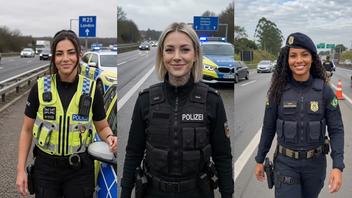
Have you seen a viral video showing a beautiful policewoman asking for engagement or friendship, a simple "Hello" or a follow? Lead Stories has spotted a number of such videos recently and has found that many of them were created using artificial intelligence. They do not show real people or situations although the videos are produced for audiences in several countries with different languages spoken. The police uniforms show regional styles and the road signs and surrounding scenery align with the country represented.
This article is part of a series of stories examining various types of what is commonly called "AI-slop": short, vertical videos generated with artificial intelligence tools with the aim of going viral, often by exploiting the emotions or curiosity of the viewer with made-up content.
What these 'attractive policewomen who want to be your friend' videos look like
In these videos the female officer may be seated in a patrol car or pulled over on the side of a busy highway. Some of the videos are made as if she is holding a phone filming in selfie mode. She makes direct eye contact with the camera and speaks flirtatiously, encouraging the viewer to "Just say hello or leave me a heart" or asking, "Would you go out with a pretty policewoman?" Many videos end with the policewoman character encouraging the viewer to follow them by clicking the plus under their photo.
Some examples
One example of this video trend from the TikTok account @itsellouiselately (archived here) shows a brunette policewoman who speaks with a British accent. In the background is a road sign which reads "M25 London".
@itsellouiselately #policewoman #british ♬ som original - Ellouise | Police girl 🚨
A video from @nina.hoffmann730 on TikTok (archived here) shows a blue-eyed blond speaking German while seated in a patrol car.
@nina.hoffmann730 Nicht jede Heldin trägt ein Cape. 👮♀️🇩🇪 Manche tragen eine Uniform und begegnen jedem Tag mit Stärke, Disziplin und Mut. 💙 #polizei #deutschland #polizistin #fürdich #fypde ♬ Originalton - Nina Hoffmann
The video from @.ana.clara56 on TikTok (archived here) shows a mountainous landscape lit by a low golden sun, the blonde officer strides forward looking straight into the camera speaking Portuguese, leaving her police motorcycle parked on the side of the road.
@.ana.clara56 oi meu lindo #mulherpolicial #policialfeminina #mulher ♬ som original - Ana Clara
Keywords
Here are hashtags or keywords often associated with videos like these:
#policewoman #policeoftiktok #womanempowerment #british #britishpolice #polizei #deutschland #polizistin #mulherpolicial #policialfeminina #mulher #police #policenationale #république #républiquefrançaise
How to tell they are false
Most of these videos have a label which says "Contains AI-generated media" or "Creator labeled as AI-generated". The scripts used to make these videos are much too flirtatious and desperate to be an authentic bid for attention from a professional policewoman on duty. The translated script for the @.ana.clara56 video has the Brazilian Federal Highway Police (PRF) officer saying:
Good afternoon, handsome -- do you really have the nerve to just pass by without following me and saying hi?
Sometimes there are glitches in the traffic patterns in the background. A divided highway will have three lanes of traffic running in both directions, but suddenly a car will appear going the wrong way (visible in the @itsellouiselately and @.ana.clara56 videos). Another pattern which pops up (visible in the @nina.hoffmann730 video) is an overly emphasized police presence in the background scene. As she sits in her patrol car, another police car is parked across the street, and then another police car drives past. In another video, interspersed between the trucks on the highway are patrol cars with flashing lights.
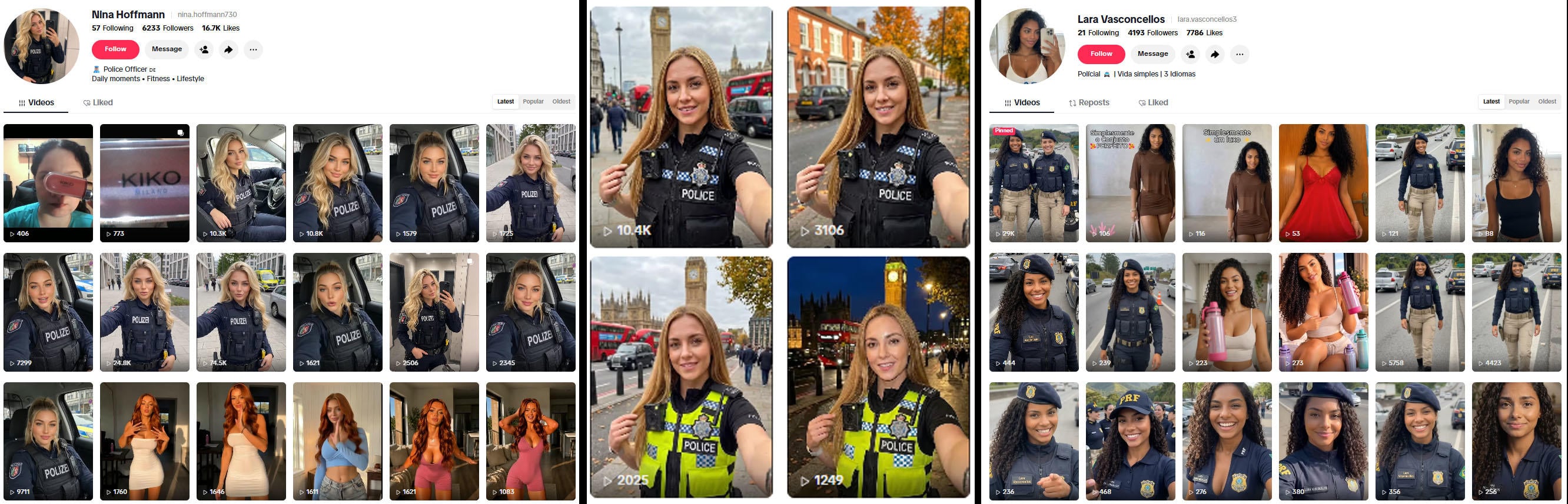
(Image source: screenshots from @nina.hoffmann730, @judesmith777 and @lara.vasconcellos3 on TikTok.)
When all the videos of any one account are taken into consideration there are some common patterns. One pattern is that many videos will be made with identical or similar scripts. Some thumbnail images will show the same flirty gesture, like playing with her hair, repeated across several different settings (pictured above center). Additionally many of the accounts show a sudden shift from posting only videos with skimpy workout clothes, to policewoman videos, to TikTok Shop merchandise--bed linens, skin care, or automatic cat feeders.
The official TikTok account of the National Police in France recently published a warning (archived here) about this fake female police officer trend saying:
What is the goal behind this proliferating content? To discredit the national police and lure you to other platforms to purchase content--often of a sexual nature.
✅ Exercise good judgment and follow official accounts.
@policenationale Vous avez peut-être déjà croisé cette « policière » sur vos réseaux sociaux ? ❌ Elles est très réaliste au point de nous duper ! Pourtant, ce n'est pas une fonctionnaire de police ni une vraie personne. Il s'agit d'images issues de l'intelligence artificielle. Quel est l'objectif de ces contenus qui se multiplient ? Discréditer la police nationale et vous attirer vers d'autres plateformes pour acheter du contenu, souvent sexuel. ✅ Faites preuve de discernement et suivez les comptes officiels. #IA #intelligenceartificielle #fake #policenationale #pourtoi ♬ son original - Police Nationale
If you see videos like these on social media, here are some things you can try.
First, look for AI-disclaimers added by the platform or the poster. On TikTok they might say "Contains AI-generated media" or "AI-generated" (archived here), on X they read "Made with AI" (archived here) and on Facebook/Instagram they often say "AI info" (archived here). Check the description of the video too: in some cases the creator might have added a note or a hashtag like #AI, #madewithAI or #fiction. Don't forget to check the main page of the account that posted the video either: maybe there is a disclaimer in the bio and in some cases AI use is really obvious when an account is posting dozens and dozens of variations of the same type of video.
Don't stop at the account that posted the video: maybe they copied it from somewhere else. Use a tool to take a screenshot of the first frame of the video and run it through a reverse image searching tool to see where else on the internet it appears. It may have originated on an account that posts satire, AI-creations or actual art.
If you are still not sure, try downloading the video itself. There are several AI detection tools that can tell you if there are watermarks or other technical characteristics present in the video that would indicate it was likely made with AI.
Finally, use common sense: if the video shows an event that would otherwise be newsworthy, use a news search engine to check if it has been reported on by a news service you trust. Also pay close attention to the video itself: look for physical impossibilities or glitches typical of AI-generated footage like:
- People or things appearing (or disappearing) out of thin air
- Objects behaving in physically impossible ways (heavy objects falling slowly, rigid objects bending...)
- Garbled writing, oddly shaped letters or signs
- People or objects blending into or moving through each other
- Inconsistencies between different shots of the video (extra architectural elements in buildings, changing backgrounds, differences in clothing or hairstyle)
- An audio track that sounds strange: flat, unnatural speech, scripted-sounding yelling from bystanders ("Did you see that? OMG!"), sound effects being out of sync with events.
Unsure about a video? Email [email protected] and we will take a look!
These materials were developed in 2026 for the Prebunking at Scale project, with support from the European Fact-Checking Standards Network. If you share this on social media, use #prebunkingatscale.