Did 8 million people in Brazil vote without ID after polls were scheduled to close in the Oct. 25, 2026, runoff election? No, that's not true: Brazil's Superior Electoral Court told Lead Stories the claim that 8 million people voted after polling stations closed is false. Its data shows only 34,393 votes were cast after 5 p.m., while Luiz Inácio Lula da Silva won by more than 4 million. The 8.6 million figure in the post's table appears to count voters cleared without fingerprint verification, not voters without ID.
The claim appeared in a post (archived here) on X where it was published by @migueljrinveste on Oct. 28, 2026. The Portuguese caption read:
URGENTE! FOI COMPROVADO QUE FLÁVIO GANHOU A ELEIÇÃO. COM PROVAS 8 MILHÕES DE PESSOAS VOTARAM SEM NENHUMA IDENTIFICAÇÃO DEPOIS DAS URNAS FECHADAS E SEÇÕES FECHADAS!
According to automatic translation on X, that meant:
URGENT! IT HAS BEEN PROVEN THAT FLÁVIO WON THE ELECTION. WITH EVIDENCE THAT 8 MILLION PEOPLE VOTED WITHOUT ANY IDENTIFICATION AFTER THE POLLS CLOSED AND THE STATIONS CLOSED!
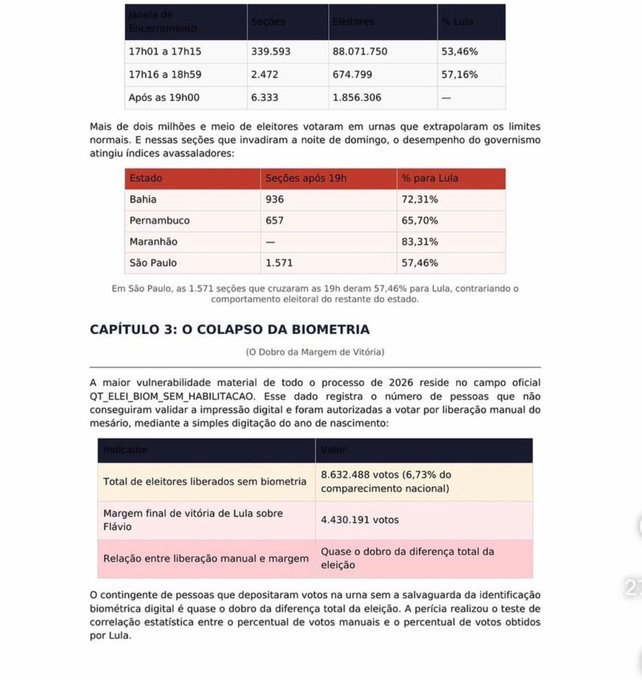
This is what the file attached to the post looked like on X at the time of writing:
(Image source: post by @migueljrinveste on X.)
The Portuguese-language image from X, however, did not support the claim. The figure of roughly 8.6 million appeared in the table with the following description:
Total de eleitores liberados sem biometria | 8.632.488 votos (6,73% do comparecimento nacional).
As translated by Google Translate, it read:
Total voters cleared without biometrics: 8,632,488 votes (6.73% of national turnout).
The figure's description did not say that it represented those who voted without showing any ID or those who voted after the polling places closed or were scheduled to close.
That is about 5.5% of the total number of Brazilian voters (archived here).
On Oct. 29, 2026, a spokesperson for Brazil's highest election authority, the Superior Electoral Court, told Lead Stories via email:
The claim that 8 million people voted after polling stations had closed is false.
Brazilian voters must present their photo ID before voting first; biometric verification is the second step (archived here). If a person does not have their fingerprints in the database or if the voting machine cannot confirm the fingerprint after four attempts, a poll worker will ask for that individual's date of birth to double-check their identity manually.
In Brazil, polling places would normally close at 5 p.m., with only those who had already been in line allowed to vote after the cutoff time (archived here). However, on the evening of the runoff election day, Oct. 25, 2026, when some polling stations started to cease operations, the Supreme Court decided to extend voting hours after two candidates (archived here), Luiz Inácio Lula da Silva and Flávio Bolsonaro, had requested it to do so due to transportation issues and heavy rains.
Later that day, Lula was reelected with 51.79% (64,256,232 votes). His opponent, Flávio Bolsonaro, got 48.21% (59,826,041 votes). People could follow the vote count through an interactive tool (archived here).
The Superior Electoral Court announced the results (archived here) the same day.
The same report by the election authorities also addressed the change of the closing time. As automatically translated by Chrome, it read:
Since the decision was issued after 5 PM, thousands of electronic voting machines had already been shut down, with no possibility of reopening. Given this scenario, it was necessary to temporarily suspend the receipt of Ballot Box Reports ( BUs ), which caused a backlog of files awaiting processing.
The website of Brazil's national election authority later offered the breakdown (archived here) of the figures documenting the last voting hours:
The second round of the 2026 elections registered 34,393 votes cast after 5 PM nationwide, according to a survey by the Superior Electoral Court (TSE). Of this total, 32,399 votes were counted between 5 PM and 6 PM, 1,981 between 6 PM and 7 PM, and 13 after 7 PM. The data considers the 497,333 polling stations that closed after 5 PM.
It continued:
Of the polling stations covered in the survey, 473,065 concluded their work by 5:10 PM, while 24,268 remained open after that time. Considering the votes counted since 5:00 PM in these 24,268 stations, 8,673 votes were registered. The 5:10 PM cutoff time is an estimate for the closing procedures and final printing of the ballot boxes, which can only be completed after 5:00 PM.
The survey also identified that 6,766 polling stations closed after 7 PM. Considering the entire period after 5 PM, these stations accounted for 4,773 votes, with 2,837 between 5 PM and 6 PM, 1,923 between 6 PM and 7 PM, and only 13 after 7 PM. These figures are already included in the 8,673 votes mentioned earlier.
Although Flávio Bolsonaro's party accepted the election outcome, he refused to concede (archived here) and, facing the legal demand to surrender his passport (archived here) amid a money-laundering investigation, flew to the U.S. (archived here).
Searches across Google News (archived here) and Google News Brazil (archived here) showed no reports from established media organizations corroborating the claim reviewed in this fact check.