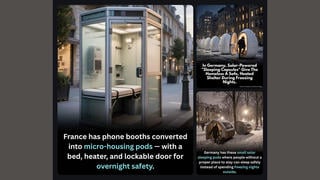
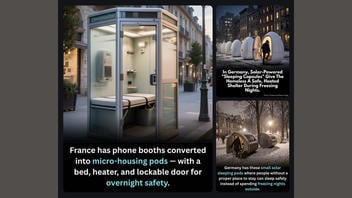
Have you seen viral images showing small sleeping pods for homeless people? Lead Stories has spotted a number of such pictures and videos and has found that many of them were created using artificial intelligence. While there are some real projects aimed at providing unhoused populations with safe spaces for overnight stays by offering them such sleeping pods, the topic has been hijacked by AI content creators chasing engagement.
This article is part of a series of stories examining various types of what is commonly called "AI-slop": AI-generated content produced with the aim of going viral, often by exploiting the emotions or curiosity of the viewer with made-up content.
What these 'sleeping pod' pictures look like
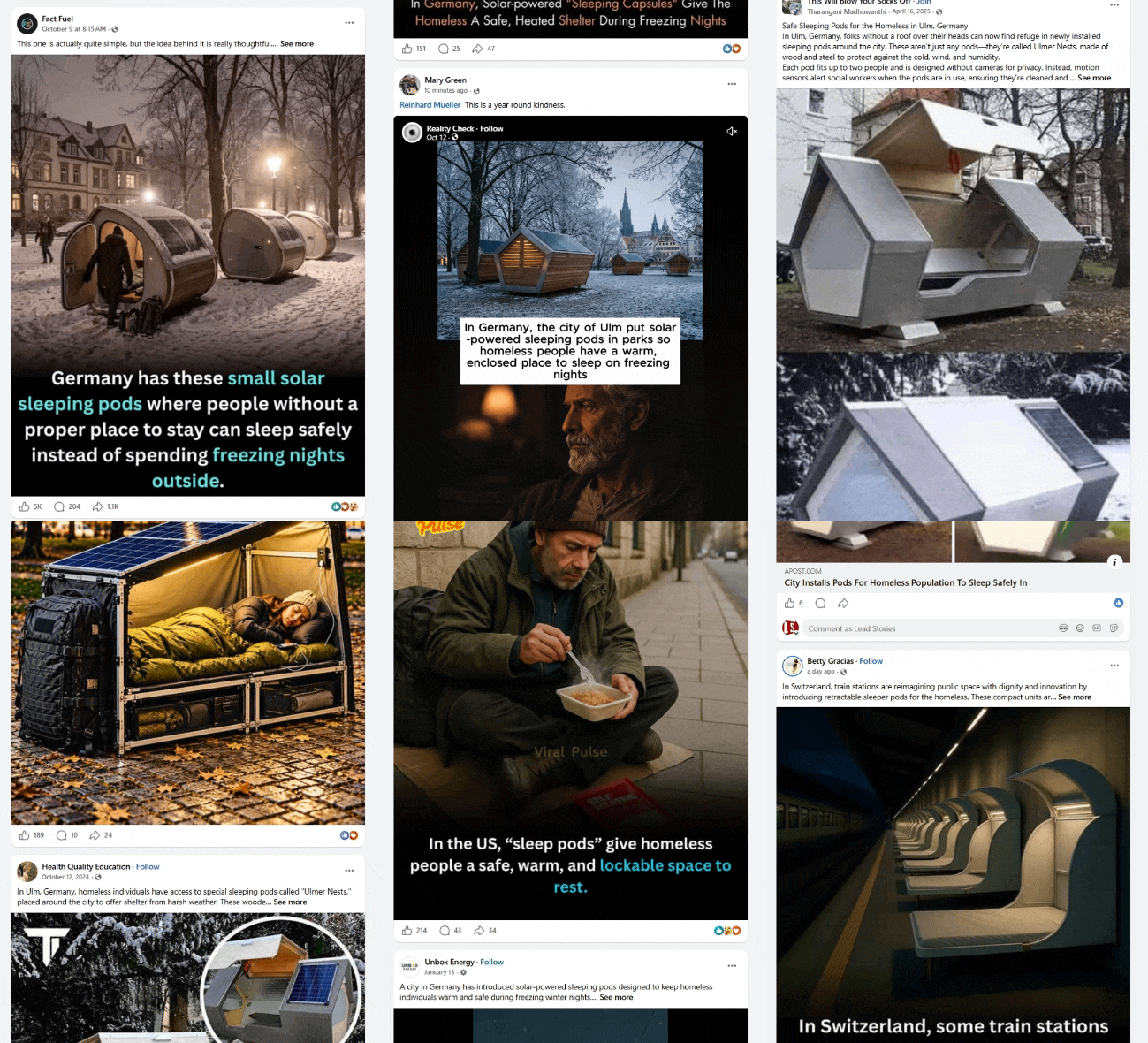
These images purport to show a small, one-person individual shelter portrayed as a stand-alone structure in the middle of the street or as part of a group of similar "sleeping pods". Such pictures may feature snow or rain to create a striking visual contrast between the harsh weather and the comfort of the shelter. In some cases, we see people entering the pods.
The "sleeping pods" images are designed to be shared as a whole story because they often include several sentences attributing such projects to a specific country -- often Germany -- or city. Yet, those captions tend to be vague. For example, they omit concrete addresses or names of the involved organizations.
Some examples
One example (archived here) from Facebook was published on Oct. 9, 2026, by the account, which -- ironically -- was named "Fact Fuel". The caption read:
This one is actually quite simple, but the idea behind it is really thoughtful.
In Germany, small sleeping pods have been developed for people who do not have a stable place to stay, especially during very cold nights. These compact shelters are designed to give one person a protected space to rest instead of having to remain fully exposed outside.
Some of the pods use solar power for basic functions such as ventilation, lighting and communication features. The structure itself is insulated and enclosed, helping hold warmth better than an open bench, doorway or pavement ever could.They are not meant to replace permanent housing or proper long-term support. That part is important. The pods are more like an extra layer of protection for nights when someone needs a safer place immediately.What I really like here is how small the solution looks compared with the problem.It is basically one tiny space, one door, and some basic warmth.But for a person spending the night outside, even that small private space can feel like a very big difference.
This is what the image shared in the post looked like on Facebook at the time of writing:
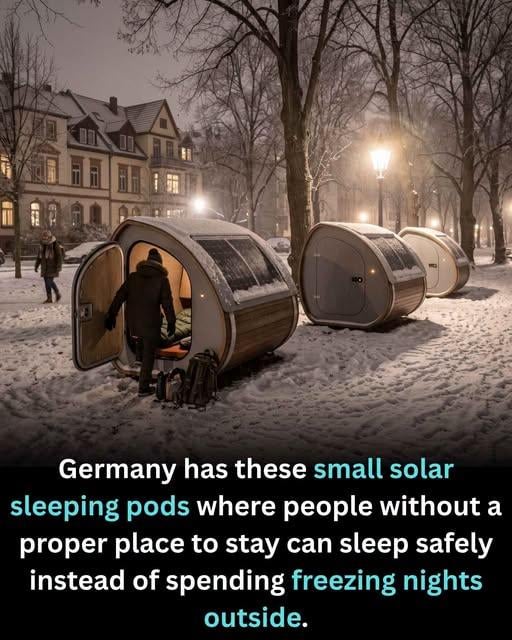
(Image source: post by "Fact Fuel" on Facebook.)
An earlier example (archived here) from Instagram published on May 5, 2026, by the @rohit_mandal1 account also set up a similar project in Germany:
In the freezing nights of winter, survival can become a daily struggle for those without shelter ❄️
In Germany, innovative insulated sleeping pods are offering a small but powerful solution -- protecting homeless individuals from extreme cold and giving them a safe place to rest.
These weatherproof pods are designed to retain warmth, shield against harsh winds, and provide dignity during the toughest nights. It's not just about shelter... it's about humanity, care, and the will to make cities more compassionate.
While this may not solve homelessness entirely, it shows how thoughtful design and empathy can make a real difference in people's lives.
Sometimes, even a small space can mean safety, hope, and a chance to get through the night.
A reminder that real progress isn't just about technology -- it's about how we treat the most vulnerable among us ❤️
#HumanityFirst #SocialInnovation #HomelessSupport #WinterRelief #UrbanSolutions
This is what this image attached to the post on Instagram looked like at the time of this writing:
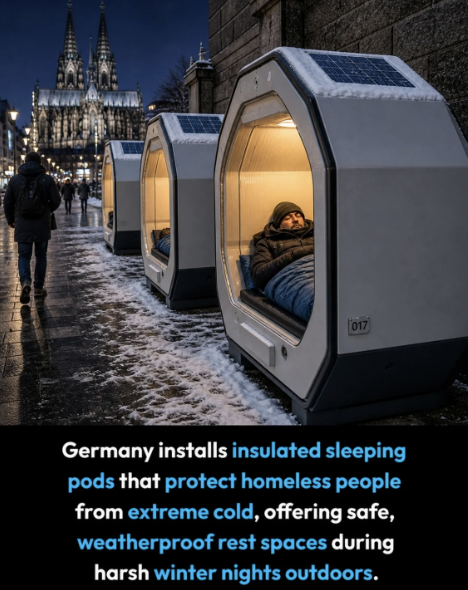
(Image source: post by @rohit_mandal1 on Instagram.)
Here is a similar post (archived here) from Oct. 12, 2026, published on X:
Germany's Solar Sleeping Pods Are Turning Freezing Nights Into a Chance for Survival Imagine spending a freezing winter night on the street, with nowhere warm to go. Now imagine a small shelter that uses the power of the sun to help protect you from the cold. In Germany, solar-powered sleeping capsules are offering homeless people a safer place to rest during harsh winter nights. Designed to provide protection from the elements, these compact shelters show how renewable energy can serve a deeply human purpose. But there is more to these unusual shelters than meets the eye. The Ulmer Nest capsules have insulated walls, fresh-air systems, and sensors that alert support workers when someone uses a shelter. The next morning, workers can check on the person and connect them with additional help. These capsules are an emergency safety measure, not a replacement for permanent housing or proper shelters. But on a bitterly cold night, a small, secure space can make a meaningful difference. Sometimes, the most powerful use of technology is not changing the world. It is helping someone survive another night. Source: Stadt Ulm. Ulmer Nester stehen ab dem 10. November wieder bereit.
-- SciTech Girl (@scitechgirl) October 12, 2026
And here is an example (archived here) from TikTok that was published in the fall of 2025:
@invisibleshelter A German startup went viral for turning backpacks into solar-powered beds -- and that's incredible innovation. But here in the United States, we've built something with the same heart -- and even greater purpose. Invisible Shelters Visible Hope is 100% U.S.-designed and U.S.-built, using a packable, solar-powered structure that blends right into the urban environment -- disguised as what most people overlook, yet designed to protect those society forgets. Every shelter offers: 🏠 A raised, insulated sleeping platform for comfort and safety ☀️ Solar-powered lighting and device charging 🔲 An urban camouflage design that reduces sweep costs and preserves dignity Built for veterans, the homeless, and the less fortunate -- because innovation shouldn't stop at compassion. Invisible Shelters. Visible Hope. Because everybody deserves a place. 🌆 Comment your city name below -- Let's see where Invisible Shelters is being seen. Together, we can make visible hope. #InvisibleSheltersVisibleHope#USInnovation#HomelessNotHopeless#VeteranSupport#becauseeverybodydeservesaplace♬ Lead Me Home - Jamey Johnson
Keywords
These are some of the keywords associated with the images and videos reviewed in this prebunk:
sleeping, pod, pods, homeless, winter, solar, solar-powered, nights, people, freezing, Germany, survive, protection, temporary, warmth, safety, dignity, housing, Iceland-inspired, cold, colder months, insulated, protect, shelter, capsule.
Real 'sleeping pod' projects vs. made-up feel-good stories
Several, relatively small-scale programs offering unhoused people temporary capsules to stay were actually launched in real life, but they looked different, and the information about their existence came from established media organizations. In January 2021, BBC reported (archived here) that one existed in German city of Ulm. According to the British public broadcaster, one more program of this type (archived here) was run in Bradford, U.K., in the spring of 2025. Portland Monthly (archived here) wrote about a similar project in that American city in 2019.
But the number of AI-generated programs far exceeded the number of real projects.
In August 2025, NBC's Today show aired a report (archived here) documenting the rise of AI-generated feel-good content that can be used to drive engagement in the same fashion as outrageous, divisive materials, thereby generating income for the creators behind it.
In some instances, accounts posted dozens of "sleeping pod" videos (archived here) creating a misleading impression that they might represent the manufacturer of the temporary shelters to boost the audience of some apparel-selling and printing business (archived here).
How to tell that some of the 'sleeping pod' images are fake
"Sleeping pod" content was occasionally explicitly labeled as AI:
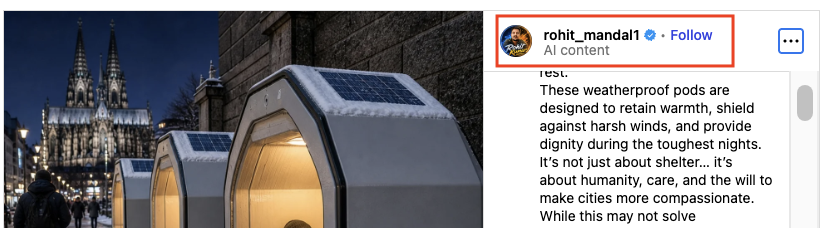
(Image source: post by @rohit_mandal1 on Instagram.)
However, more often than not such images were posted without a disclaimer. Yet, online detectors such as Hive Moderation and Sightengine placed the odds of such pictures being products of generative AI close to 100%: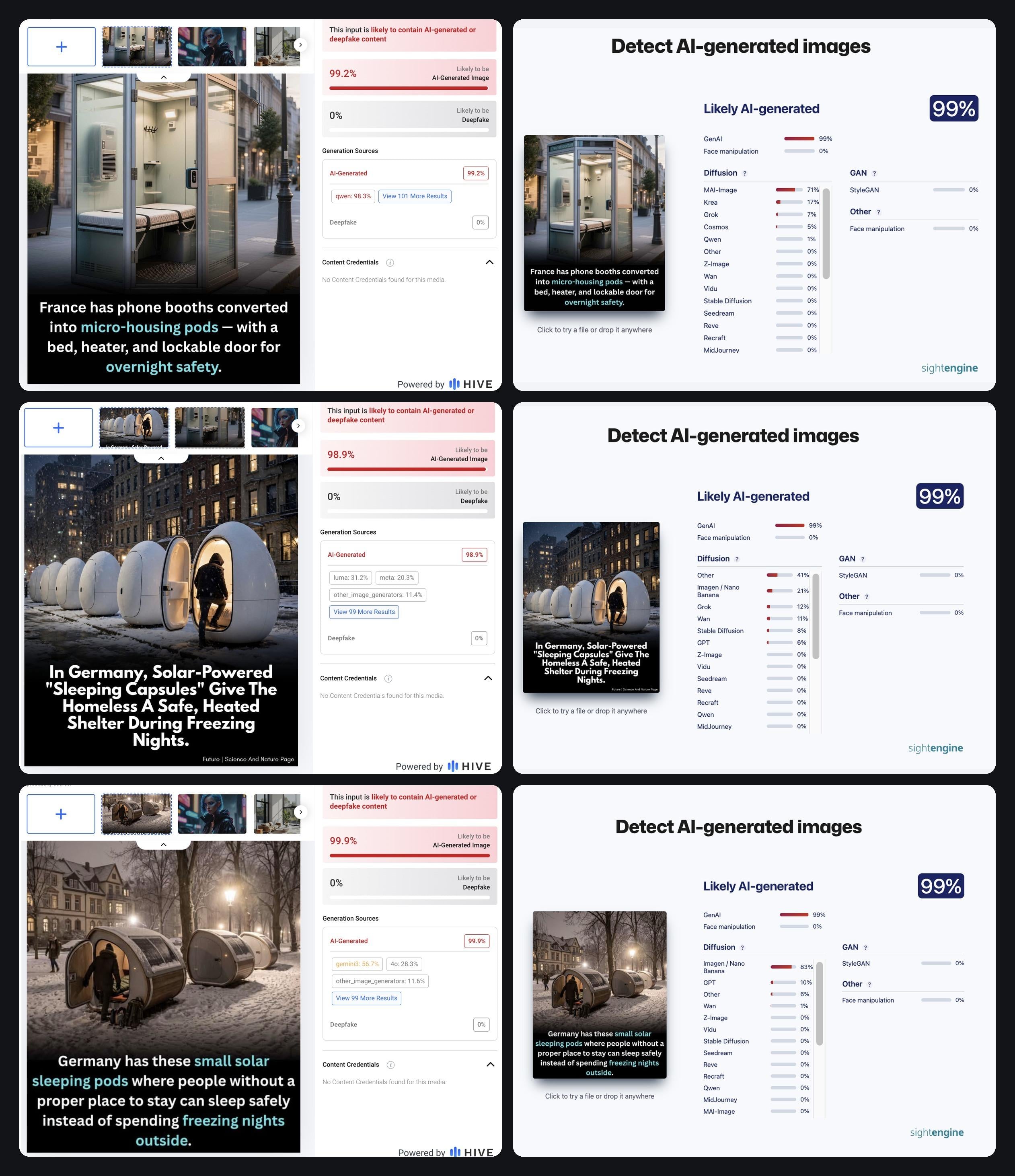
(Image sources: Hive Moderation and Sightengine.)
A critical look at the images oftentimes revealed that some of the details didn't make much sense. For example, the sleeping surface was too short of an average adult to comfortably lie down. Furthermore, it was unclear why people would elect to sleep with lights on while also not closing the privacy blind also designed to protect them from cold:
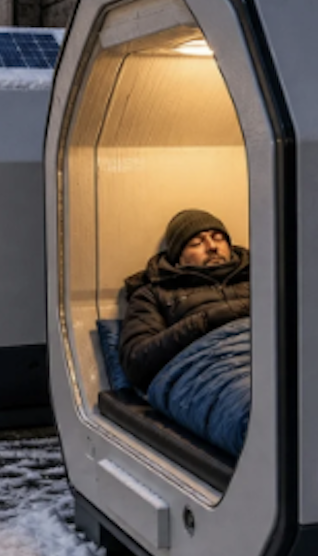
(Image source: post by @rohit_mandal1 on Instagram.)
If you see images or videos like these on social media, here are some things you can try.
First, look for AI-disclaimers added by the platform or the poster. On TikTok they might say "Contains AI-generated media" or "AI-generated" (archived here), on X they read "Made with AI" (archived here) and on Facebook and Instagram they often say "AI info" (archived here). Check the description of the picture too: in some cases the creator might have added a note or a hashtag like #AI, #madewithAI or #fiction. Do not forget to check the main page of the account that posted the video either: maybe there is a disclaimer in the bio and in some cases AI use is really obvious when an account is posting dozens and dozens of variations of the same type of video.
Do not stop at the account that posted the image or the video: maybe they copied it from somewhere else. Use a tool to take a screenshot of the first frame of the video and run it through a reverse image searching tool to see where else on the internet it appears. It may have originated on an account that posts satire, AI-creations or actual art.
If you are still not sure, try downloading the image or the video. There are several AI detection tools that can tell you if there are watermarks or other technical characteristics present in the video that would indicate it was likely made with AI.
Finally, use common sense: if the video shows an event that would otherwise be newsworthy, use a news search engine to check if it has been reported on by a news service you trust. Also pay close attention to the image or video itself: look for physical impossibilities or glitches typical of AI-generated footage like:
- People or things appearing (or disappearing) out of thin air
- Objects behaving in physically impossible ways (heavy objects falling slowly, rigid objects bending...)
- Garbled writing, oddly shaped letters or signs
- People or objects blending into or moving through each other
- Inconsistencies between different shots of the video (extra architectural elements in buildings, changing backgrounds, differences in clothing or hairstyle)
- An audio track that sounds strange: flat, unnatural speech, scripted-sounding yelling from bystanders ("Did you see that? OMG!"), sound effects being out of sync with events
Unsure about a video or an image? Email [email protected] and we will take a look!
These materials were developed in 2026 for the Prebunking at Scale project, with support from the European Fact-Checking Standards Network. If you share this on social media, use #prebunkingatscale.