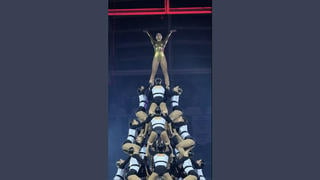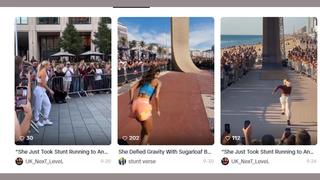
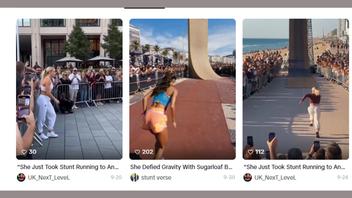
Have you seen viral videos showing astonishing "stunt running" up steep ramps, which sometimes end with impossible jumps? Lead Stories has spotted a number of such videos recently and has found that many of them were created using artificial intelligence. Parkour, whose name appeared in many descriptions of such clips, is a real athletic discipline, but what the viral clips adressed in this article showed are not real people's stunts.
This article is part of a series of stories examining various types of what is commonly called "AI-slop": short, vertical videos generated with artificial intelligence tools with the aim of going viral, often by exploiting the emotions or curiosity of the viewer with made-up content.
What these 'stunt running' videos look like
These videos typically feature an athlete performing the stunts in settings that appear to be either a sporting event or a contest held next to prominent landmarks in various cities around the world. The main character would run up to the top of a tall ramp, occasionally performing a gymnastic jump as the final element.
Some examples
One example (archived here) of this trend was published on X by @DataChaz on Oct. 3, 2026, under the caption:
.@grok is this real?
This is what it looked like on X at the time of writing:
.@grok is this real? https://t.co/WDzWpceRya
-- Charly Wargnier ☄️ (@DataChaz) October 3, 2026
The 29-second video appeared to capture a sporting event during which a female athlete reached the top of a tall turquoise ramp. When she got there, she pushed off the ramp to complete a jump, rotating around herself. Then, the woman briefly landed in a sitting position at the top of the ramp and ran down, greeted by the crowd and the announcer.
Online AI detector Sightengine said that the clip was 92% likely to have been produced by AI:
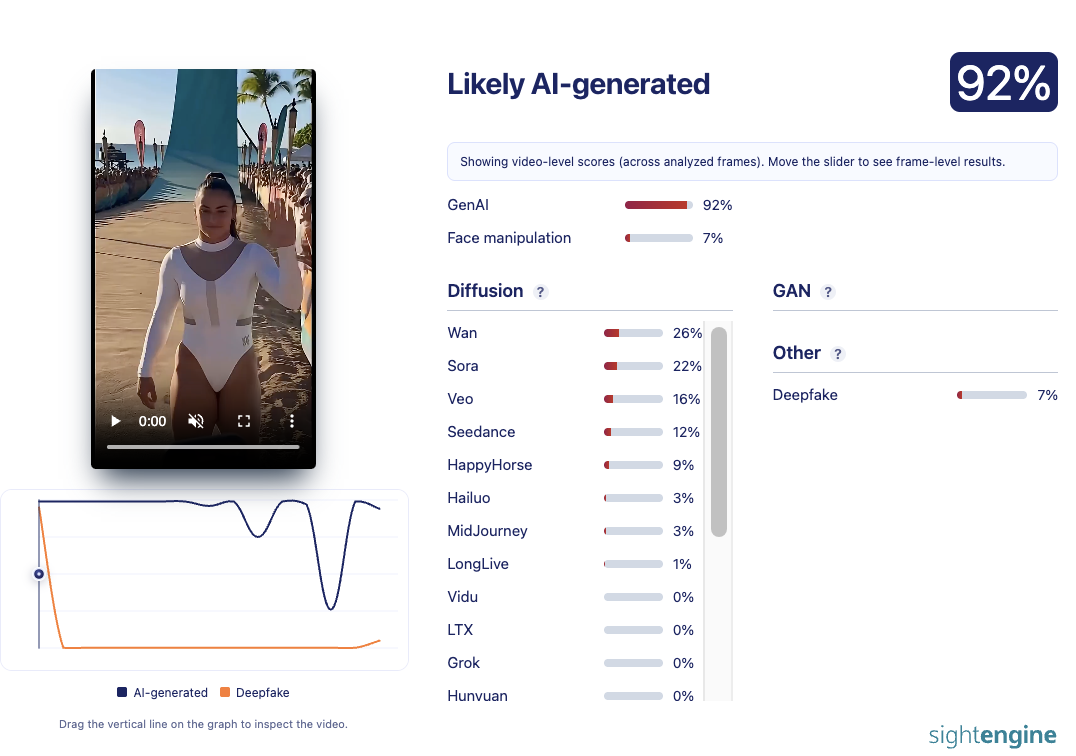
(Image source: Sightengine.)
Another detector, FauxLens, returned a similar score of 93% to be likely AI-generated:

(Image source: FauxLens.)
A closer look showed typical hallmarks associated with AI: The woman's right arm disappeared between the shoulder and the hand while her left foot appeared barefoot and distorted only to regain an anatomically correct shape and be seen in a sneaker fraction of a second later:
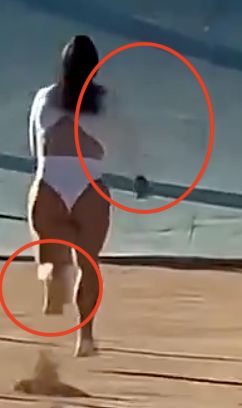
(Image source: post by @DataChaz on X.)
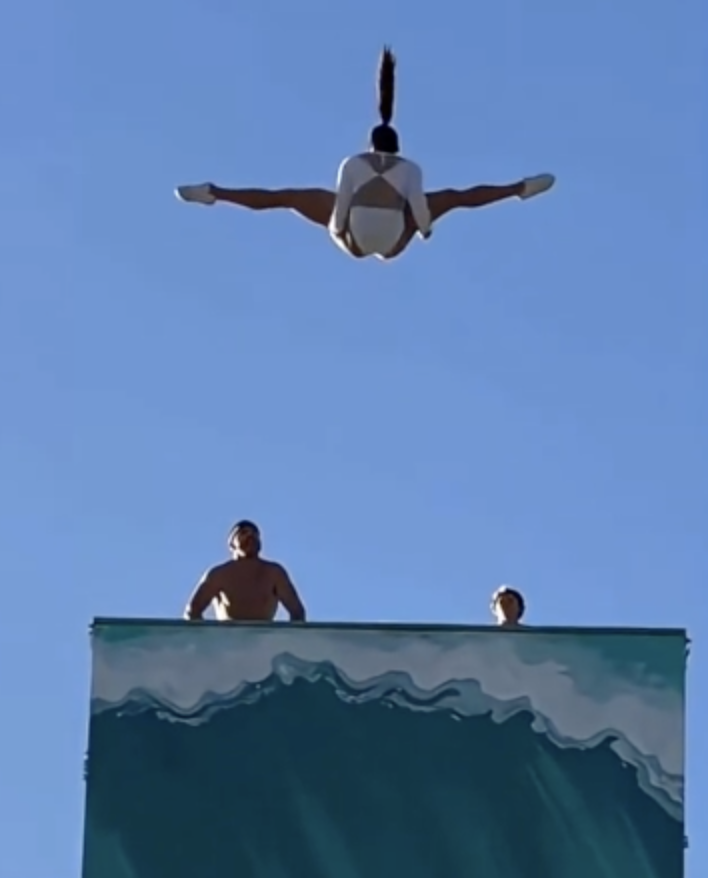
(Image source: post by @DataChaz on X.)
Another example (archived here) that was published on TikTok by the @stuntversehq account on Sept. 29, 2026, was straightforwardly labeled as containing AI content, but that disclaimer would not always appear in reports:
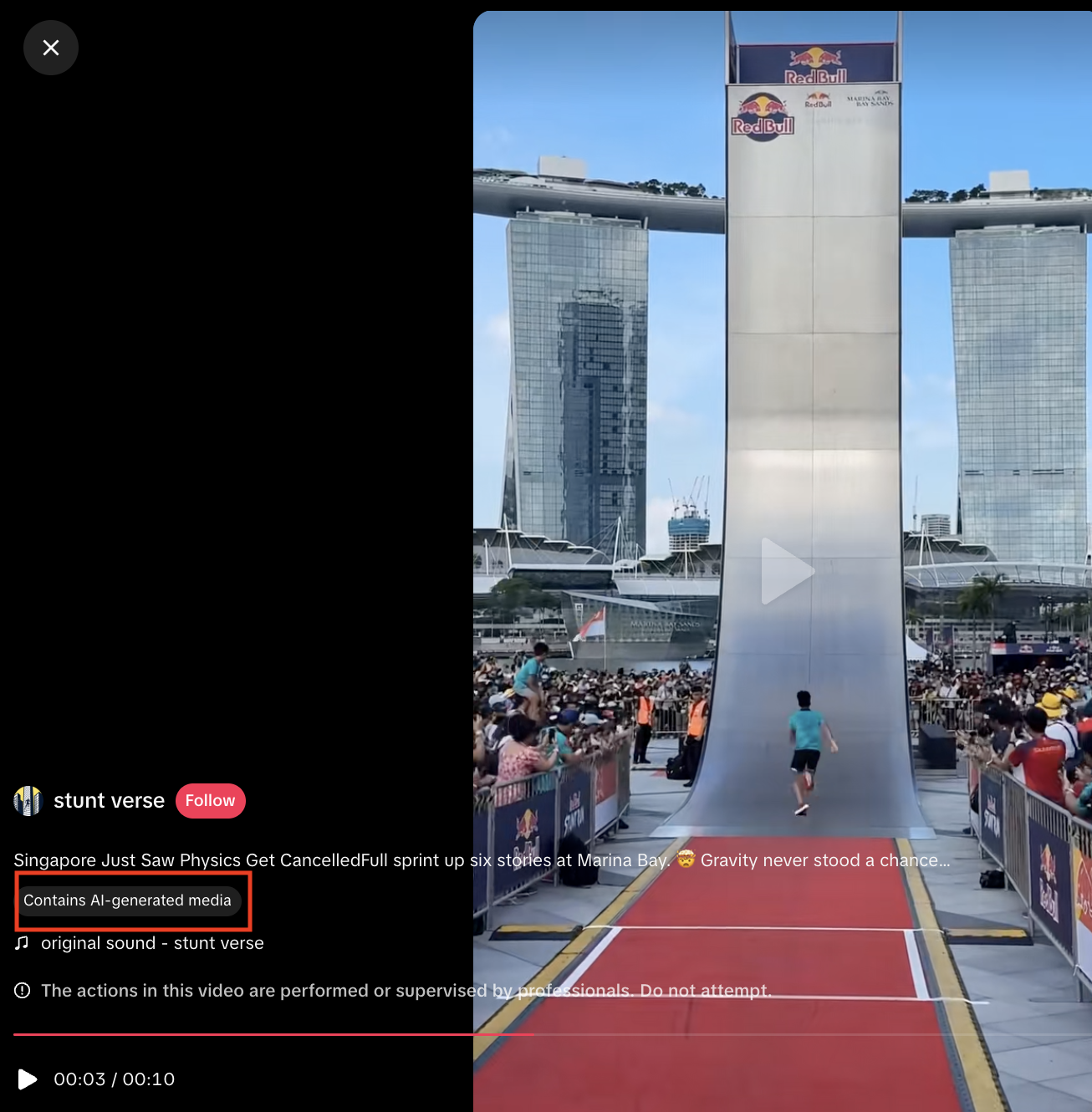
(Image source: post by @stuntversehq on TikTok.)
The same account published other videos supposedly showing the same stunt replicated by athletes at other locations such as Las Vegas (archived here), Russia's Moscow (archived here) and Egypt's Giza (archived here).
Similar clips were uploaded on YouTube (archived here), too, and, when accessed from the Google search results page, some of those shorts showed an AI label:
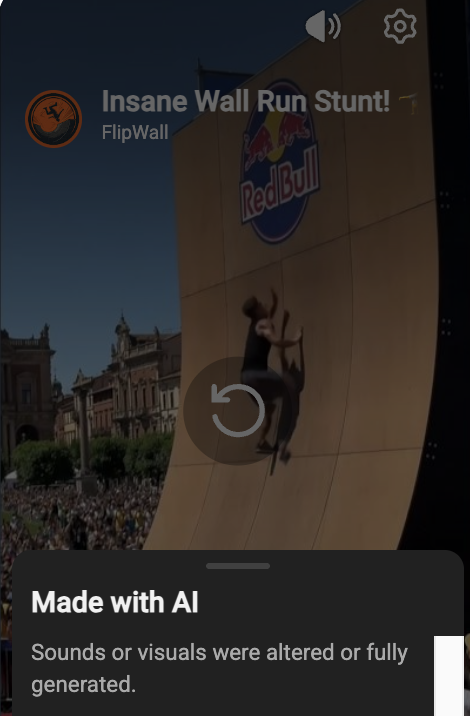
(Image source: post by @FlipWall on YouTube.)
Not all of the videos making the trend reviewed in this prebunk appeared to portray the stunts that seemed to be at odds with physics. Some of them -- for example, this clip (archived here) published on Facebook on Sept. 29, 2026, by @Birds-Build-Love --- looked more realistic:
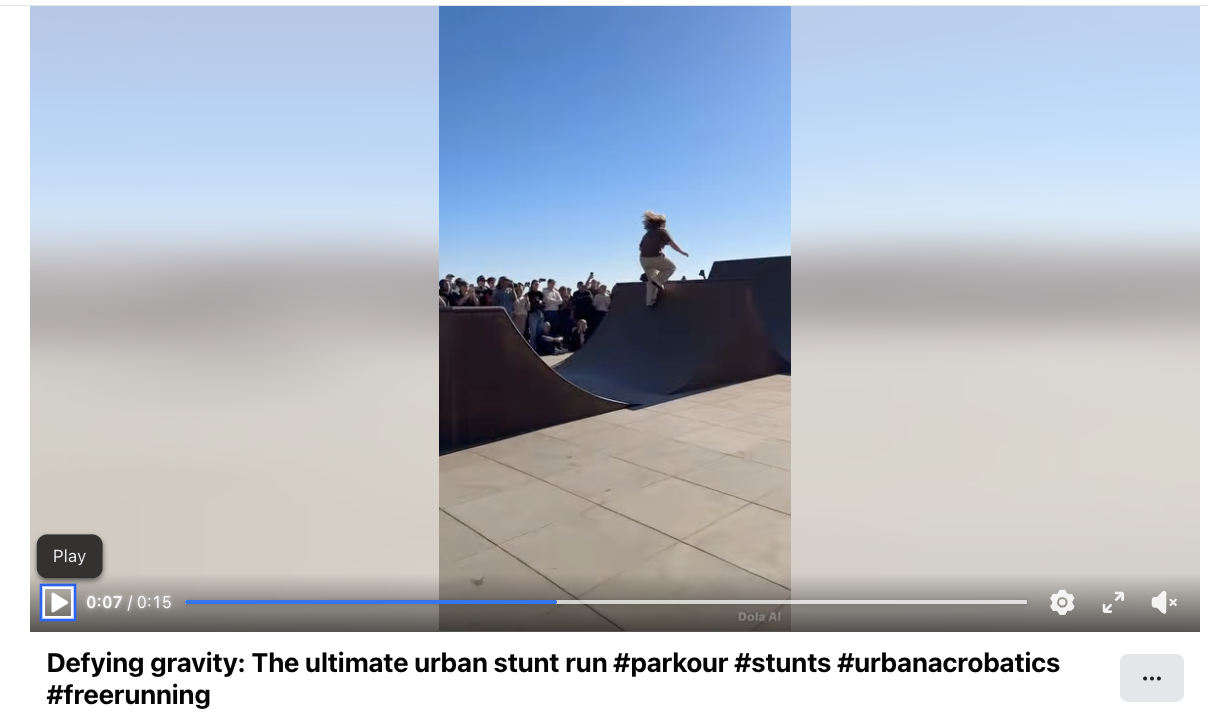
(Image source: post by @Birds-Build-Love on Facebook.)
Yet, the bottom of the video showed a watermark pointing to a specific type of generative AI, Dola AI:

(Image source: post by by @Birds-Build-Love on Facebook.)
In another video (archived here), posted on Facebook on Sept. 28, 2026, by @Yasmin.art.and.craft, an AI-associated watermark seemed to be either cut off or digitally removed. Nevertheless, that didn't erase a nonsensical scene taking place in front of the ramp. The members of the audience, who supposedly came to see the athlete featured in the clip, turned their bodies away from her, all while holding phones in unnatural positions to film the runner:
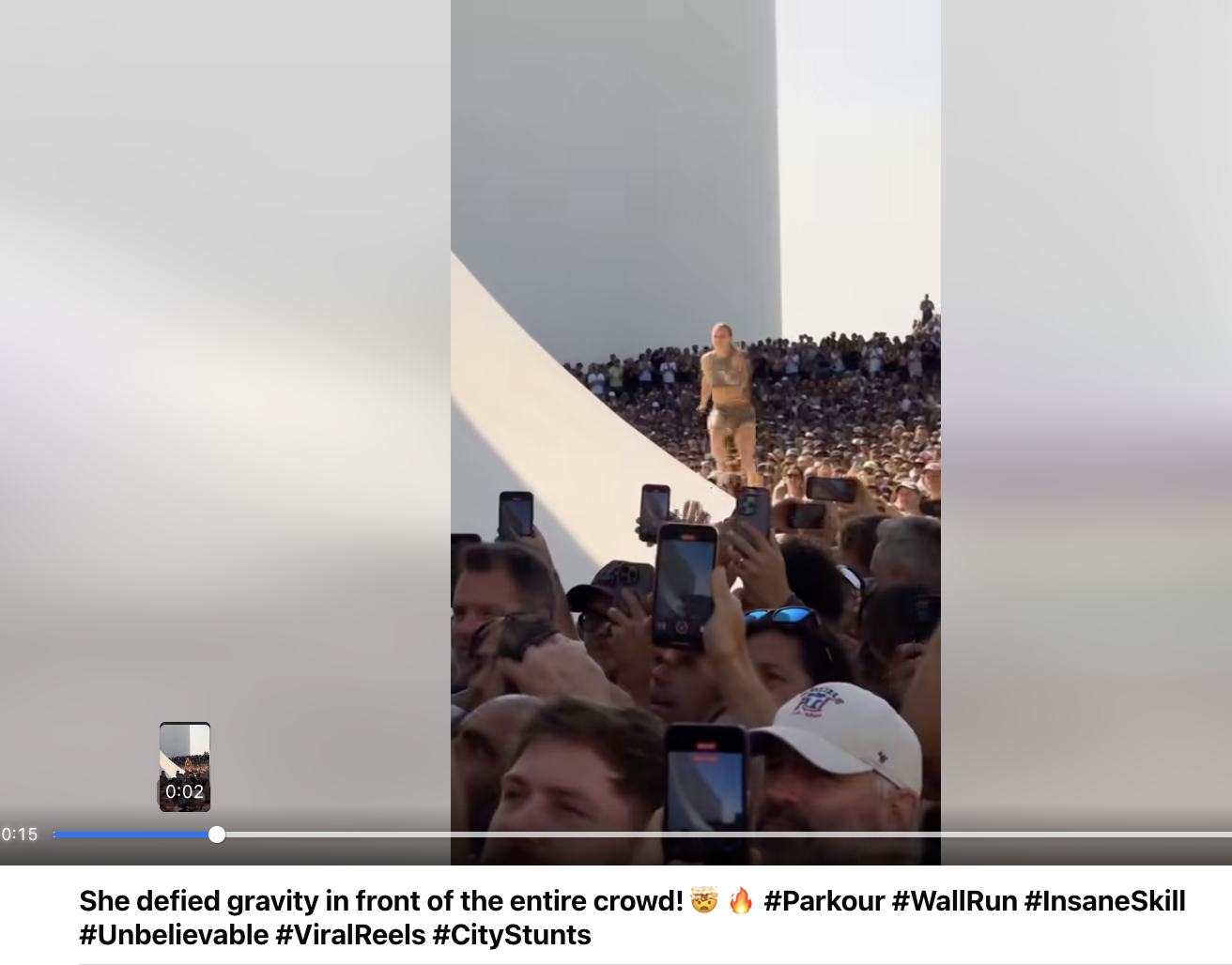
(Image source: post by @Yasmin.art.and.craft on Facebook.)
Yet, the woman didn't appear in frame of the smartphones that are used to capture her stunt:
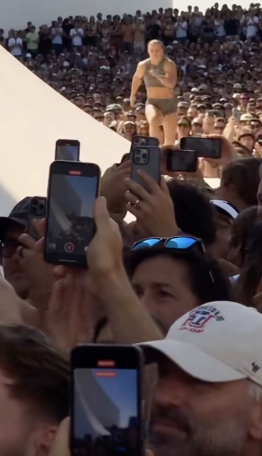
(Image source: post by @Yasmin.art.and.craft on Facebook.)
Keywords
athlete, stunt running, giant curved wall, just saw physics get cancelled, gravity never stood a chance, #freerunning, #WallRun, #extremeathletics, #CityStunt, #SpectatorFootage, #Parkour, #Stunts, #FlipWall, #ExtremeSports, #ViralShorts, #InsaneSkill, #Unbelievable.
What is parkour
Oxford Reference defines (archived here) "parkour" as:
a movement-based physical practice involving running, jumping, and climbing, and is centered around challenge, exploration, and self-improvement.
According to Parkour U.K. (archived here), the discipline originated from the teachings of Paris-born physical educator Georges Hébert who observed movements of indigenous populations while serving in the French military at the end of the nineteenth century. However, it wasn't until the 1980s (archived here) that it became what it is now, with the efforts of practitioners such as David Belle, wrote the New Yorker in 2007.
How to tell videos are false
If you see videos like what is described in this article on social media, here are some things you can try.
First, look for AI-disclaimers added by the platform or the poster. On TikTok they might say "Contains AI-generated media" or "AI-generated" (archived here), on X they read "Made with AI" (archived here) and on Facebook and Instagram they often say "AI info" (archived here). Check the description of the video too: in some cases the creator might have added a note or a hashtag like #AI, #madewithAI or #fiction. Don't forget to check the main page of the account that posted the video either: maybe there is a disclaimer in the bio and in some cases AI use is really obvious when an account is posting dozens and dozens of variations of the same type of video.
Don't stop at the account that posted the video: maybe they copied it from somewhere else. Use a tool to take a screenshot of the first frame of the video and run it through a reverse image searching tool to see where else on the internet it appears. It may have originated on an account that posts satire, AI-creations or actual art.
If you are still not sure, try downloading the video itself. There are several AI detection tools that can tell you if there are watermarks or other technical characteristics present in the video that would indicate it was likely made with AI.
Finally, use common sense: if the video shows an event that would otherwise be newsworthy, use a news search engine to check if it has been reported on by a news service you trust. Also pay close attention to the video itself: look for physical impossibilities or glitches typical of AI-generated footage like:
- People or things appearing (or disappearing) out of thin air
- Objects behaving in physically impossible ways (heavy objects falling slowly, rigid objects bending...)
- Garbled writing, oddly shaped letters or signs
- People or objects blending into or moving through each other
- Inconsistencies between different shots of the video (extra architectural elements in buildings, changing backgrounds, differences in clothing or hairstyle)
- An audio track that sounds strange: flat, unnatural speech, scripted-sounding yelling from bystanders ("Did you see that? OMG!"), sound effects being out of sync with events
Unsure about a video? Email [email protected] and we will take a look!
These materials were developed in 2026 for the Prebunking at Scale project, with support from the European Fact-Checking Standards Network. If you share this on social media, use #prebunkingatscale.