
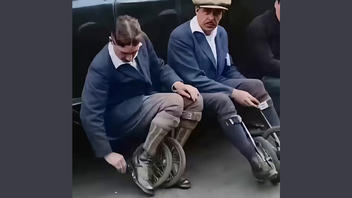
Is the color footage showing a 1923 demonstration of one-wheeled roller skates or cycle-skates real? Yes, that's true: The movie footage from 1923 is real, but it has been colorized. This design of the skates by a French inventor was promoted with some races in 1923. Black and white archive footage of a skating demonstration and one of the races was published by British Pathé and Reuters; colorized versions of these have surfaced on social media.
One colorized video clip was published in a post (archived here) on X by @One_Way_Home on May 26, 2026. It was captioned:
It's like looking through a time capsule into 1923. We have a unique opportunity to watch these two men demonstrate some of the first roller skates ever invented.
This is a screenshot from the video:

(Image source: post by @One_Way_Home on X.com.)
The overly processed quality of the colorized clip might lead a viewer to question if the video is AI-generated. While the colorization was likely done with an AI tool, the scenes shown in the 21-second clip are real.
The original black and white footage (archived here) can be found in the newsreel archives of British Pathé, titled "A NEW SPORT CYCLE SKATING (1923)." The archive's data lists the issue date as Oct. 9, 1923. The silent video is one minute 31 seconds and contains several caption cards of descriptive text. These have been edited out of the colorized version. A copy of the video (embedded below) is published on a British Pathé YouTube channel dedicated to sports.
A second copy of the same footage in the British Pathé archive appears to be mislabeled. It is titled "A NEW SPORT (1912)." Considering the men's fashion, the models of the cars visible and the fact that the paticycle was not invented until 1923, there is little doubt that the 1912 date on the second copy is an error.
Footage of a paticycle race that took place on Oct. 7, 1923, was published on April 29, 2026, by Reuters Connect on YouTube (embedded below). This footage is titled "1923 Paticycle race from Paris to Versailles" -- but this race actually followed a course in the opposite direction, from Versailles to Paris. A colorized clip featuring some of this footage was published on Facebook on Nov. 13, 2025.
The Reuters clip has these details:
Date: 22nd October 1923
Location: PARIS, FRANCE
Source: Reuters Historical News Collection: GAUMONT GRAPHIC NEWSREEL (REUTERS)
The Oct. 22, 1923, date must refer to the date of the newsreel's publication. The race pictured took place on Oct. 7, 1923. The RetroNews archive of the Bibliothèque nationale de France (BNF) has an Oct. 8, 1923, article in L'Oeuvre reporting on a race that took place the day before, with an illustration of the winner Charles Morel. This newspaper illustration appears to be a hand-enhanced still from a scene appearing at five seconds in the Reuters race footage. The newspaper story (translated by Google Lens) describes the 17-kilometer race (10.5 miles) starting in Versailles and finishing at the Porte Maillot, an ancient gateway to Paris.
The paticyclists went to Versailles yesterday.
-and they raced down to the Porte Maillot in a scattered order.
An extensive article on the invention and history of the paticycle in France, (archived here), with photos and footnotes, is published on the French inline skating website rollerenligne.com. A second article (archived here) focuses on the history of "bicycle skate" designs from 1860-1928.