
Have you seen viral videos showing people making Indian street food using their feet or other body parts or pouring dirty water in it? Lead Stories has spotted a number of such clips recently and has found that many of them were created using artificial intelligence. Often the goal of such videos is to generate engagement on social media by baiting people into reacting emotionally via the triggering of disgust and shock.
This article is part of a series of stories examining various types of what is commonly called "AI-slop": short, vertical videos generated with artificial intelligence tools with the aim of going viral, often by exploiting the emotions or curiosity of the viewer with made-up content.
What these viral Indian street food videos look like
Most videos from this category showed nonwhite men, often shirtless, preparing traditional Indian foods such as flatbreads. In the process, they would roll out doughs on their naked, often protruding belly and then press the dough or spread the batter with their feet when the product is already on the hot frying surface. In some cases, that would be followed by a scene featuring a young woman tasting the food with a visibly disgusted facial expression.
Variations included nonwhite people serving or eating food with their bare hands in messy surroundings.
The implied notion was that Indian food is being prepared and consumed in unsanitary conditions.
Some examples
Here is one example found on TikTok (archived here):
@lkytxx #indian #IndianFood ♬ 原声 - Mi sang
@lkytxx #IndianFood #indian ♬ 原声 - Mi sang
Here is one variation from X (archived here and here):

(Image source: post by @catetaneko on X.)
And another, also from X (archived here):

(Image source: post by @DemosKratosCA on X.)
Keywords
Here are hashtags or keywords often associated with videos like these: "Indian food", "Indian street food", "Indian snack", "Indian street food at its finest", "#indianstreetfood", "#streetfoodindia", "#fyp", "#foryou," "#foryoupage". Most captions were short and didn't elaborate beyond naming what the videos showed.
How to tell they are false
Such videos don't address the most basic practical considerations. Why would able-bodied people want to use their feet for cooking when it's apparently inconvenient and requires more energy? Why would people working at street food kiosks, which a job that can't be realistically described as the most lucrative, risk getting burns to their feet from a heated pan or their hands from submerging them in boiling oil, given that any physical injury will likely lead to medical expenses and days or weeks of inability to work?
The videos contained the typical hallmarks of AI-made clips. Let's take this example from TikTok.
Within fractions of a second, a man's hand shapeshifts into what reminds one of a foot and back:

(Image source: post by @lkytxx on TikTok.)
The hair on the same man's belly appear only in a close-up and disappear in a wider shot:

(Image source: post by @lkytxx on TikTok.)
Upon closer examination, the man's actions don't make much sense. He puts the already-flat dough on his belly to flatten it more, but the dough doesn't change its shape while the man is attempting to flatten it with what looks more like a flat knife than a rolling pin normally used in baking:

(Image source: post by @lkytxx on TikTok.)
Four online detecters -- Hive Moderation, AI or Not, InVID and ZeroGPT -- ruled the thumbnail image from the video was a product of generative AI, estimating the odds of that between 95% and 99.9%:
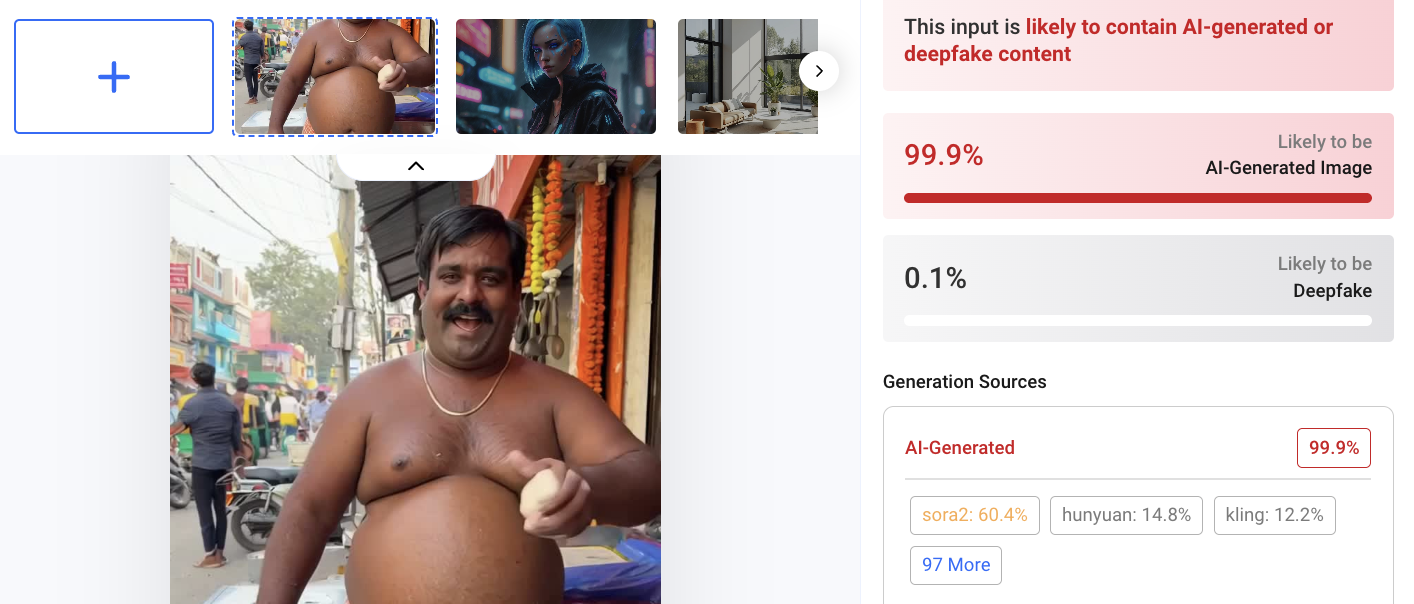
(Image source: Hive Moderation.)

(Image source: AI or Not.)
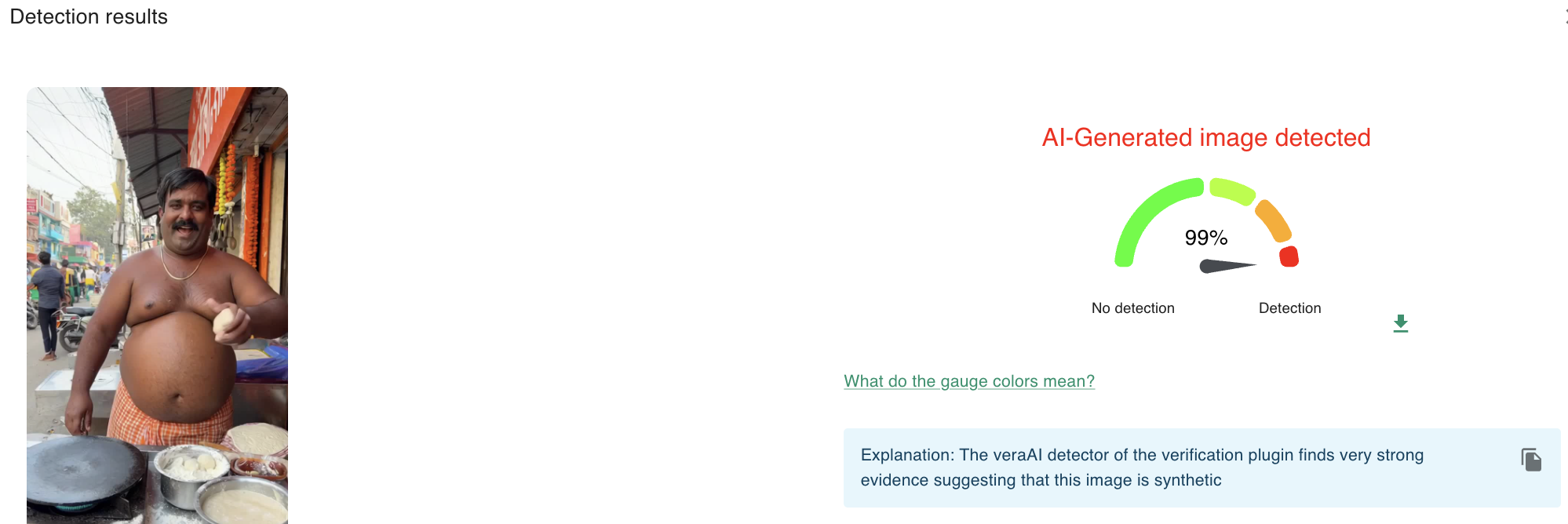
(Image source: InVID.)
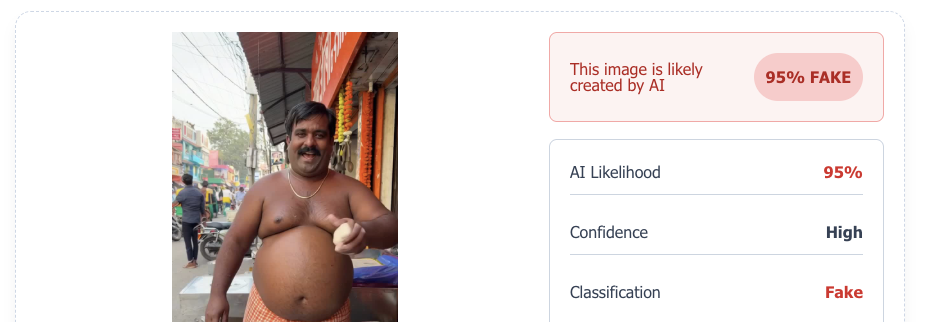
(Image source: ZeroGPT.)
Finally, in some cases, earlier versions of the videos had the AI label:

(Image source: post by @lkytxx on TikTok.)
Videos like these are designed to generate curiosity or wonder, keeping viewers watching long enough for platform algorithms to amplify them. This drives views, which creators monetize through advertising or brand deals. Sometimes viral videos also try to trigger underlying prejudices or fears in the audience, or they take a slightly propagandistic angle when they evoke the supposed technical superiority of certain nations.
If you see videos like these on social media, here are some things you can try.
First, look for AI-disclaimers added by the platform or the poster. On TikTok they might say "Contains AI-generated media" or "AI-generated" (archived here), on X they read "Made with AI" (archived here) and on Facebook/Instagram they often say "AI info" (archived here). Check the description of the video too: in some cases the creator might have added a note or a hashtag like #AI, #madewithAI or #fiction. Don't forget to check the main page of the account that posted the video either: maybe there is a disclaimer in the bio and in some cases AI use is really obvious when an account is posting dozens and dozens of variations of the same type of video.
Don't stop at the account that posted the video: maybe they copied it from somewhere else. Use a tool to take a screenshot of the first frame of the video and run it through a reverse image searching tool to see where else on the internet it appears. It may have originated on an account that posts satire, AI-creations or actual art.
If you are still not sure, try downloading the video itself. There are several AI detection tools that can tell you if there are watermarks or other technical characteristics present in the video that would indicate it was likely made with AI.
Finally, use common sense: if the video shows an event that would otherwise be newsworthy, use a news search engine to check if it has been reported on by a news service you trust. Also pay close attention to the video itself: look for physical impossibilities or glitches typical of AI-generated footage like:
- People or things appearing (or disappearing) out of thin air
- Objects behaving in physically impossible ways (heavy objects falling slowly, rigid objects bending...)
- Garbled writing, oddly shaped letters or signs
- People or objects blending into or moving through each other
- Inconsistencies between different shots of the video (extra architectural elements in buildings, changing backgrounds, differences in clothing or hairstyle)
- An audio track that sounds strange: flat, unnatural speech, scripted-sounding yelling from bystanders ("Did you see that? OMG!"), sound effects being out of sync with events.
Unsure about a video? Email [email protected] and we will take a look!
These materials were developed in 2026 for the Prebunking at Scale project, with support from the European Fact-Checking Standards Network. If you share this on social media, use #prebunkingatscale.