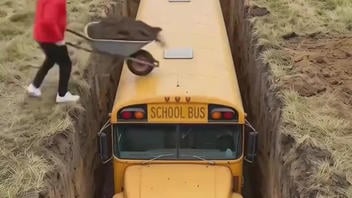
Have you seen viral videos showing timelapse construction of secret bunkers, underground rooms or hidden lairs out of wild materials and objects that would give the builders a safe place to hide to survive a catastrophic event? Lead Stories has spotted a number of such videos recently and has found that many of them were created using artificial intelligence. They do not show real people or situations but appear to be a form of escapist fantasy clickbait designed to get social media engagement.
This article is part of a series of stories examining various types of what is commonly called "AI-slop": short, vertical videos generated with artificial intelligence tools with the aim of going viral, often by exploiting the emotions or curiosity of the viewer with made-up content.
What these 'secret survival bunker construction' videos look like
These videos claim to feature real-life examples of people constructing hidden bunkers or lairs either underground or below their homes that would allow them to survive without needing the outside world in case of a catastrophic event. The hidden rooms are centered on common objects such as a yellow school bus, a plane or large storage containers.
Some examples
Here is a video uploaded on June 27, 2026, on TikTok account @Its_hacks (archived here) that shows a yellow school bus being buried in the yard in front of a small house:
@its_hacks I made my house inside an underground bus #construction #built #diyproject ♬ original sound - It's hacks ✅
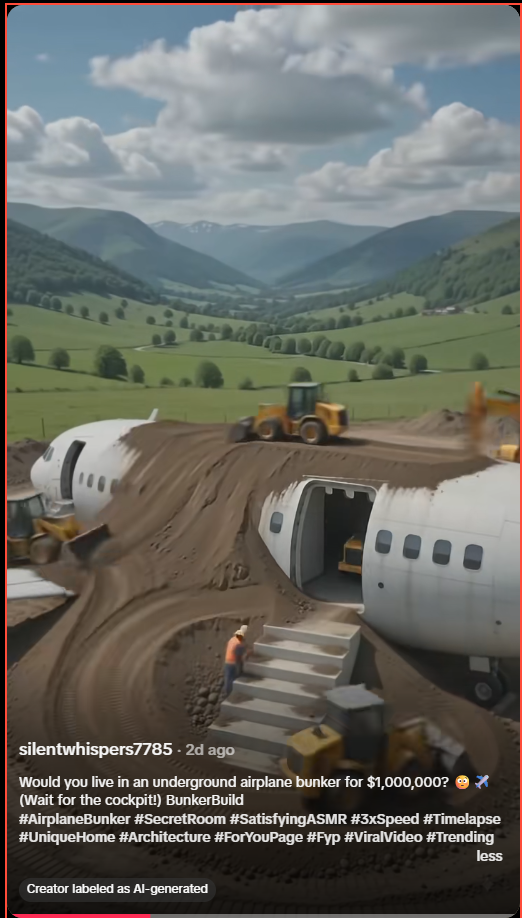
@silentwhispers7785 Would you live in an underground airplane bunker for $1,000,000? 😳✈️ (Wait for the cockpit!) BunkerBuild #AirplaneBunker #SecretRoom #SatisfyingASMR #3xSpeed #Timelapse #UniqueHome #Architecture #ForYouPage #Fyp #ViralVideo #Trending ♬ Relax Aesthetic - Bwd sound
Building a Secret Underground Luxury Bunker Beneath a Backyard. 💯💯🌺✔️ pic.twitter.com/cTMvZt0Yyv
-- Buraq (@Buraq515) April 2, 2026
Keywords
Here are hashtags and keywords often associated with videos like these: #SecretRoom, #AirplaneBunker, "underground bus house conversion," "Building Secret Bunker," "Survivor," "underground," "bunker," "secret," "underground" and "container." Some of the clips had a little more descriptive coverage. For example, one read: "I made my house inside an underground bus -- a DIY construction project that turned a retired bus into a livable, subterranean home. The idea was to reuse the bus shell and place it below ground level, creating a compact, insulated living space with a unique profile."
How to tell they are false
A Google search (archived here) and a search on TikTok (archived here) for keywords building, secret and bunker found numerous examples of videos labeled as AI-generated, including school buses and shipping containers buried underground.
Here is a screenshot of a video posted on TikTok account @silentwhispers7785 that shows the label "Creator labeled as AI-Generated."
These videos are created for engagement bait that preys on people's fears and insecurities about the state of the world by selling them a fantasy about a safe place where they can hide away if a catastrophic event happens. The fast-moving video format gives the impression that construction of such lairs would be easy to accomplish in a backyard of any size. From fears of a nuclear war to people wanting to hide following an insurrection and overthrowing of the government, the videos provide a fictional escape designed to draw people into viewing an account's content.
If you see videos like these on social media, here are some things you can try.
First, look for AI-disclaimers added by the platform or the poster. On TikTok they might say "Contains AI-generated media" or "AI-generated" (archived here), on X they read "Made with AI" (archived here) and on Facebook/Instagram they often say "AI info" (archived here). Check the description of the video too: In some cases the creator might have added a note or a hashtag like #AI, #madewithAI or #fiction. Don't forget to check the main page of the account that posted the video either: Maybe there is a disclaimer in the bio. In some cases AI use is really obvious when an account is posting dozens and dozens of variations of the same type of video.
Don't stop at the account that posted the video: Maybe they copied it from somewhere else. Use a tool to take a screenshot of the first frame of the video and run it through a reverse image searching tool to see where else on the internet it appears. It may have originated on an account that posts satire, AI-creations or actual art.
If you are still not sure, try downloading the video itself. There are several AI detection tools that can tell you if there are watermarks or other technical characteristics present in the video that would indicate it was likely made with AI.
Finally, use common sense: If the video shows an event that would otherwise be newsworthy, use a news search engine to check if it has been reported by a news service you trust. Also pay close attention to the video itself: Look for physical impossibilities or glitches typical of AI-generated footage like:
- People or things appearing (or disappearing) out of thin air
- Objects behaving in physically impossible ways (heavy objects falling slowly, rigid objects bending ...)
- Garbled writing, oddly shaped letters or signs
- People or objects blending into or moving through each other
- Inconsistencies between different shots of the video (extra architectural elements in buildings, changing backgrounds, differences in clothing or hairstyle)
- An audio track that sounds strange: flat, unnatural speech, scripted-sounded yelling from bystanders ("Did you see that? OMG!"), sound effects being out of sync with events.
Unsure about a video? Email [email protected] and we will take a look!
These materials were developed in 2026 for the Prebunking at Scale project, with support from the European Fact-Checking Standards Network. If you share this on social media, use #prebunkingatscale.