
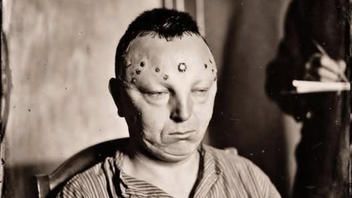
Does a mid-twentieth-century photograph capture the consequences of a transorbital lobotomy performed on a man named "James Peterson" for being gay in 1948? No, that's not true: The image is not a photograph -- it's an image generated by the AI tool Grok, as a barely visible watermark in the bottom right corner indicated. The content of the picture contradicts historical accounts of how such an operation was performed, which is also consistent with discrepancies pointing to AI. Lead Stories found no record confirming the existence of the specific person, "James Peterson," who was allegedly subjected to the controversial procedure for his sexual orientation in 1948.
The claim appeared in a post (archived here) on Instagram published on Mar. 2, 2026. It opened:
In 1948, James Peterson was lobotomized for being gay. His parents committed him after discovering his love for another man. The asylum labeled it 'sexual perversion' and 'treated' him with a transorbital lobotomy--ice picks hammered above his eye sockets into his frontal lobe. It took just 15 minutes, but it erased his vibrant, artistic spirit forever. The doctor assured his parents: 'Your son's perversion is corrected.'
What returned was an empty shell--no desires, no passions, not even for life.
Entry wounds above his eyes, a vacant stare where intelligence once shone. The doctor notes: 'Patient calm, no deviant interests. Success.'
But that 'calm' was brain damage; the 'success' was personality murder. James never painted, laughed, or loved again. He lived 46 more years in a group home, a hollow routine without preferences or joy, dying in 1994 at 74. His parents visited once, saw the void they'd created, and never came back. To them, a son who was nothing beat one who was gay...
We've come far--conversion therapy is banned in many places, and love is increasingly celebrated. But remember James and countless others: their stories fuel our fight for dignity.
No one should be 'treated' for being themselves.
The post included what looked like a portrait of a person in a striped shirt:
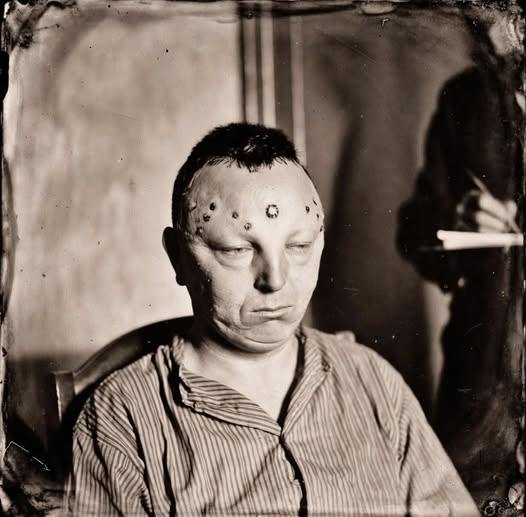
(Image source: post by @lattergaystories on Instagram.)
The contents of the image
Contrary to the caption, however, the image did not show a person who underwent a transorbital lobotomy. The now-abandoned, controversial neurosurgical procedure (archived here) that severed connections in the prefrontal cortex utilized other points of access to the brain, and while it had numerous side effects, including loss of personality and death, transorbital lobotomy did not leave people with multiple holes on their foreheads.
A prefrontal lobotomy, which was an early technique, was performed through drilling holes in the patient's temples or through accessing a person's brain through the top part of the skull, as this archival video (archived here) shows.
A transorbital lobotomy was a later variation of the procedure. It was neurologist Walter Freeman who was widely credited (archived here) with promoting this operation in the U.S. He sought a technique that would allow lobotomies to be performed on a greater scale, although there was no scientific consensus on the benefits of the procedure. Freeman, who did such surgeries himself without having proper surgical training, accessed the prefrontal cortex through two holes in the eye sockets.
This consists of knocking them out with a shock and while they are under the 'anesthetic' thrusting an ice pick up between the eyeball and the eyelid through the roof of the orbit actually into the frontal lobe of the brain and making the lateral cut by swinging the thing from side to side. I have done two patients on both sides and another on one side without running into any complications, except a very black eye in one case.
Professor of sociology and researcher of social history of medicine Andrew Scull (archived here) told PBS (archived here) in 2008 that Freeman "would peel back each eyelid, insert his ice pick and with a hammer tap through the brain, wiggle it about, sever the frontal lobes, withdraw it."
No Record of such patient
Lead Stories searched Google Scholar for the keywords seen here (archived here) to find out if there have been any credible scientific publications about the supposed case of "James Peterson", but that produced zero results.
After that, Lead Stories searched CLIO (archived here), which is the online catalogue of Columbia University Libraries, and showed no matches, either:
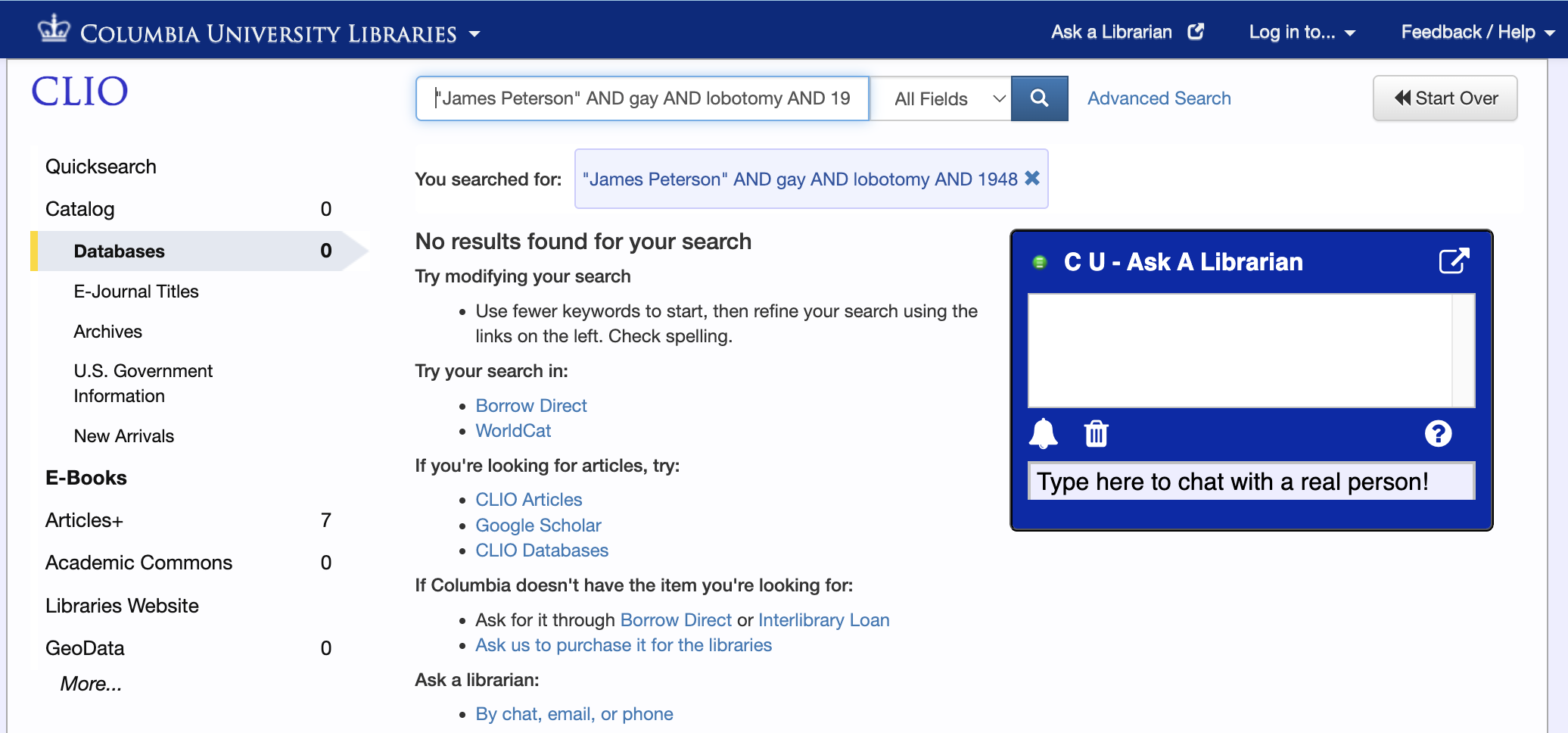
(Image source: CLIO.)
Lead Stories searched multiple databases from the list of resources available (archived here) to the alumni community. That included Academic Search Premier, Directory of Open Access Books, JSTOR, Journals of the American Medical Association (JAMA), MIT Press Direct, ProQuest Health Management, ProQuest Medical Library and ProQuest U.S. Newsstream.

(Image source: Academic Search Premier.)

(Image source: Directory of Open Access Books.)

(Image source: JSTOR.)


(Image source: JAMA.)

(Image source: MIT Press Direct.)

(Image source: ProQuest Health Management.)

(Image source: ProQuest Medical Library.)

AI traces

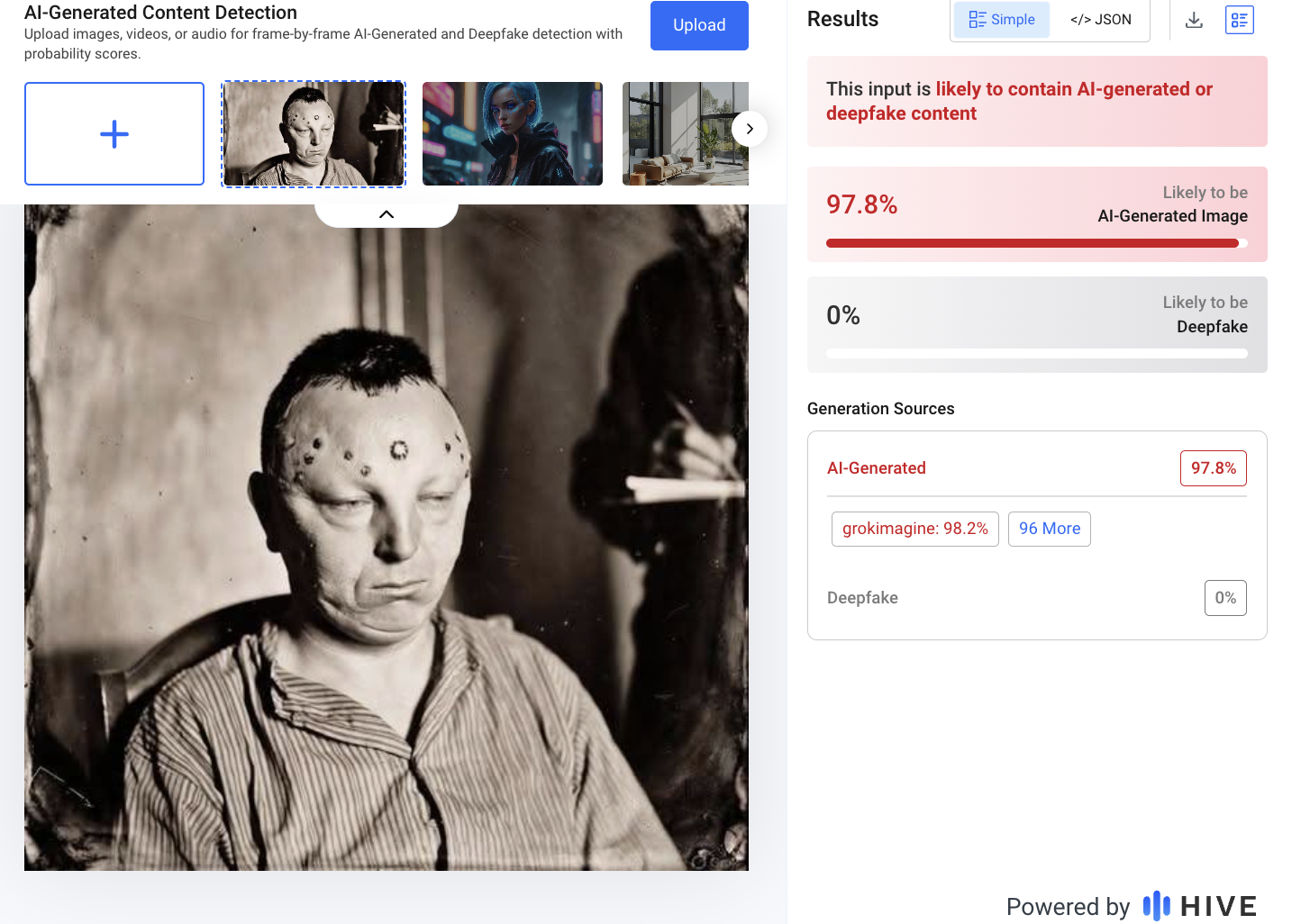
At its height, lobotomies were performed on people with a wide range of mental health and psychological conditions.
While homosexuality was perceived as a mental health illness (archived here) at the height of the lobotomy popularity in the U.S., Lead Stories was unable to find a reliable figure evaluating the share of LGBTQ+ people among those who underwent lobotomies in the U.S.
While there are real cases of documented psychiatric abuse, it is not the first time a made-up story based on an AI-generated image has appeared on social media. Lead Stories previously debunked a similar claim about a Connecticut woman, Ada Morrisson, committed to asylum for "excessive reading".