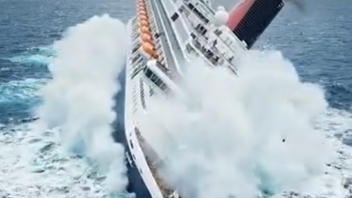
Have you seen viral videos showing large cruise ship disasters with the boats sinking dramatically into the water? Lead Stories has spotted a number of such videos recently and found that many of them were created using artificial intelligence. The videos have similar looking cruise ships sinking with various crowds watching as the ships go down. Some of these accounts state that they are AI creators, in an apparent effort to build up a social media following.
This article is part of a series of stories examining various types of what is commonly called "AI-slop": short, vertical videos generated with artificial intelligence tools with the aim of going viral, often by exploiting the emotions or curiosity of the viewer with made-up content.
What these 'cruise ship disasters' videos look like
The videos show a large ship at sea often flipped on its side and sinking into the water. Some show people on shore or on another boat watching the ship sink under the sea. The boats can resemble the Titanic with two smoke stacks on the deck or appear to be gigantic cruise ships with multiple levels.
Some examples
Instagram account @maritimeconnect posts AI-generated videos of cruise ships in peril like this one (archived here):
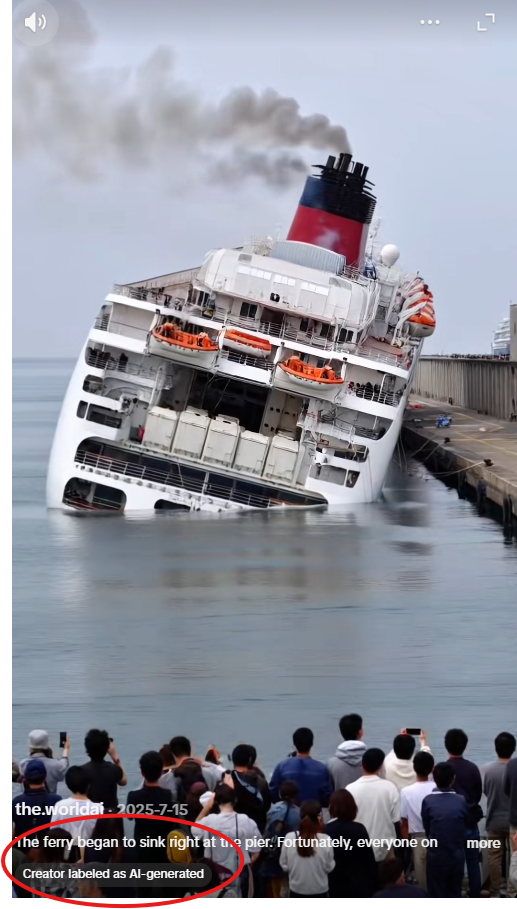
This video (archived here) posted on TikTok account @the.worldai includes the tag, "Creator labeled as AI-generated," and shows a ship sinking with a crowd of people watching from the shore:
@the.worldai The ferry began to sink right at the pier. Fortunately, everyone on board managed to evacuate in time. A crowd gathered nearby, watching the vessel's final moments -- both mesmerizing and terrifying to witness. #crash #crashed #damage #ai #news #collapse #sea #ocean #wave #pier #ship #boat #cruiseship #wow #fail ♬ оригинальный звук - the.worldai
This video (archived here) posted on YouTube account @levelhigher shows a cruise ship going over a waterfall with the caption labeling it as AI, "Cruise Ship HORROR: Worst Cruise Ship Disasters ! 🚢💥ai video #wow."
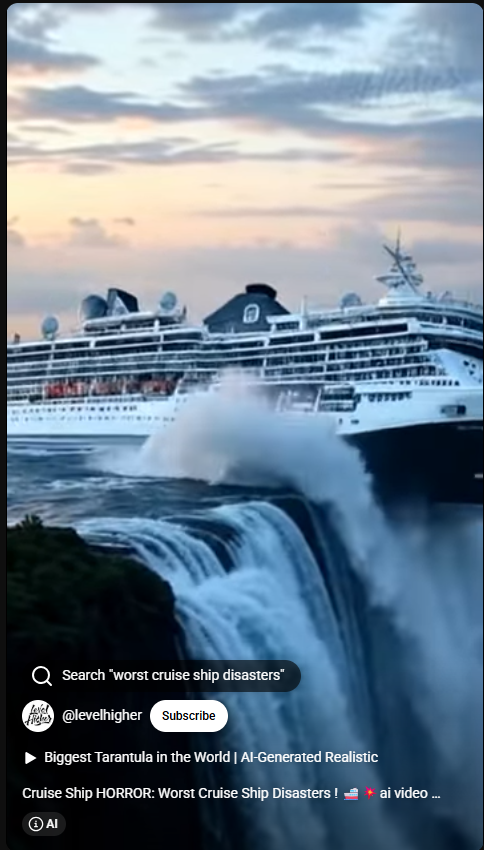
(Image source: Post by @levelhigher on YouTube.)
Keywords
Here are hashtags or keywords often associated with videos like these: "worst cruise ship disasters," #cruiseship #disaster #shocking #crash #crashed #damage #sea #ocean #wave #pier #ship #boat
How to tell they are false
Many of the videos are clearly labeled as AI-generated or AI-created, as this screenshot shows of the aforementioned video posted on the TikTok account @the.worldai (red circle added by Lead Stories):
Real life cruise ship disasters are titillating but there have not been hundreds of them dramatically sinking into the ocean as the videos claim to show. The Titanic (archived here) is the most famous disaster. Late in the evening on April 15, 1912, the brand new cruise liner hit an iceberg and sank into the freezing Atlantic Ocean, killing 1500 people.
In January 2013 the Costa Cruises vessel Costa Concordia (archived here) struck a rock formation on the sea floor in the Mediterranean, flipped on her side and partially sank. The ship's captain, Francesco Schettino, left the boat before all of the passengers and crew were able to evacuate safely, 32 of whom died.
The Hive Moderation AI-Generated Content Detection tool gave one video (archived here) posted on TikTok account @yen.gia.od.1995 showing two large cruise ships crashing into each other an aggregated score of 77.2% "likely to contain AI-generated or deepfake content":
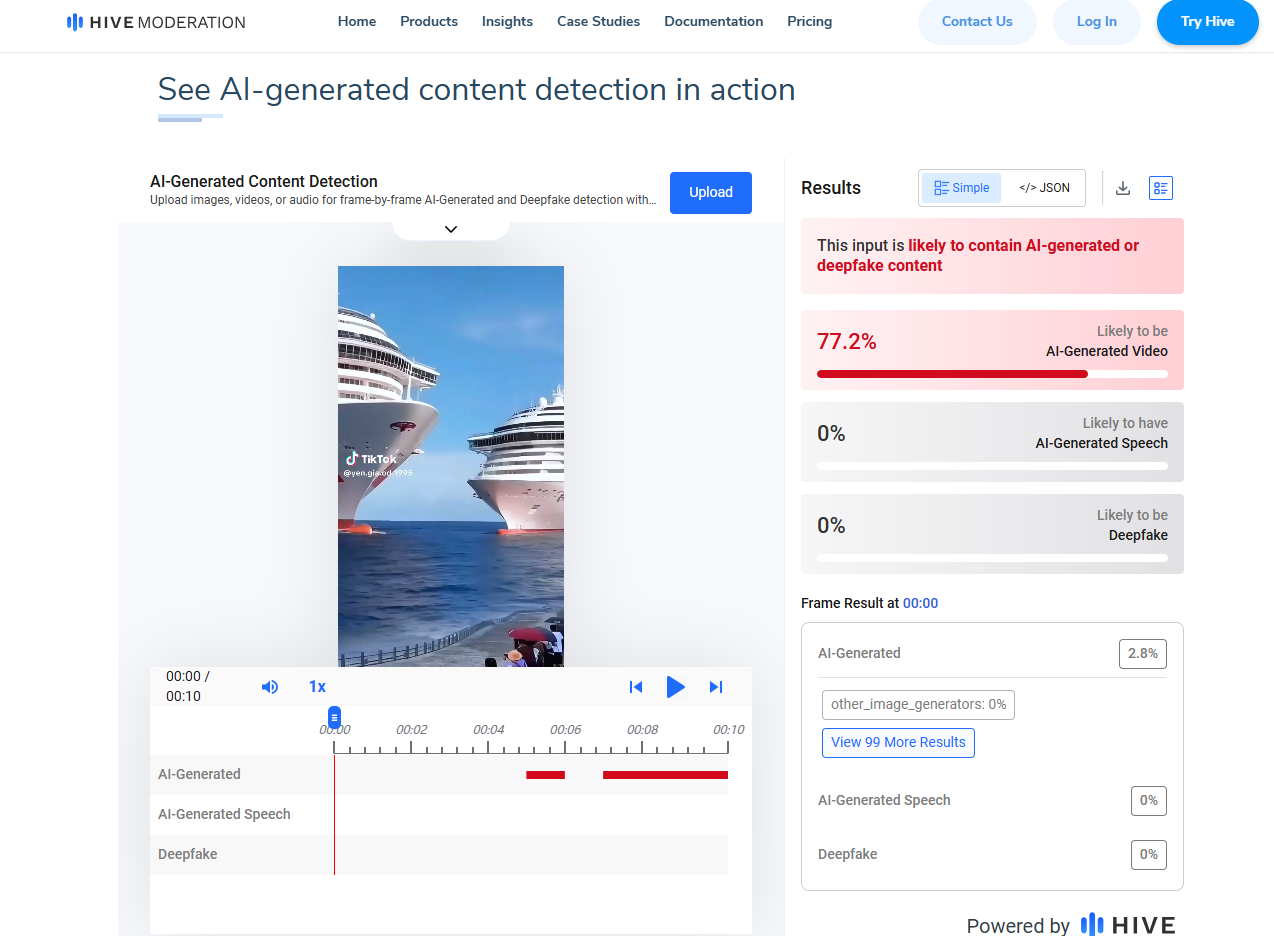
(Image source: Hive Moderation.)
If you see videos like these on social media, here are some things you can try.
First, look for AI-disclaimers added by the platform or the poster. On TikTok they might say "Contains AI-generated media" or "AI-generated" (archived here), on X they read "Made with AI" (archived here) and on Facebook/Instagram they often say "AI info" (archived here). Check the description of the video too: in some cases the creator might have added a note or a hashtag like #AI, #madewithAI or #fiction. Don't forget to check the main page of the account that posted the video either: maybe there is a disclaimer in the bio and in some cases AI use is really obvious when an account is posting dozens and dozens of variations of the same type of video.
Don't stop at the account that posted the video: maybe they copied it from somewhere else. Use a tool to take a screenshot of the first frame of the video and run it through a reverse image searching tool to see where else on the internet it appears. It may have originated on an account that posts satire, AI-creations or actual art.
If you are still not sure, try downloading the video itself. There are several AI detection tools that can tell you if there are watermarks or other technical characteristics present in the video that would indicate it was likely made with AI.
Finally, use common sense: if the video shows an event that would otherwise be newsworthy, use a news search engine to check if it has been reported on by a news service you trust. Also pay close attention to the video itself: look for physical impossibilities or glitches typical of AI-generated footage like:
- People or things appearing (or disappearing) out of thin air
- Objects behaving in physically impossible ways (heavy objects falling slowly, rigid objects bending...)
- Garbled writing, oddly shaped letters or signs
- People or objects blending into or moving through each other
- Inconsistencies between different shots of the video (extra architectural elements in buildings, changing backgrounds, differences in clothing or hairstyle)
- An audio track that sounds strange: flat, unnatural speech, scripted-sounded yelling from bystanders ("Did you see that? OMG!"), sound effects being out of sync with events.
Unsure about a video? Email [email protected] and we will take a look!
These materials were developed in 2026 for the Prebunking at Scale project, with support from the European Fact-Checking Standards Network. If you share this on social media, use #prebunkingatscale.