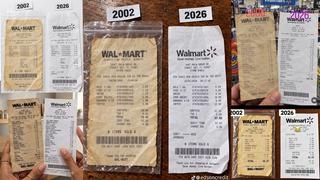
Have you seen viral videos showing Walmart receipts compared, one old and one new? Lead Stories has spotted a number of such images recently and has found that many of them were created using artificial intelligence. They do not show real store receipts and they exaggerate how much prices have gone up in the past two decades.
This article is part of a series of stories examining various types of what is commonly called "AI-slop": social media posts with pictures or short, vertical videos generated with artificial intelligence tools with the aim of going viral, often by exploiting the emotions or curiosity of the viewer with made-up content.
What these 'Walmart receipt price comparison' images look like
This assortment of images shows two store receipts. On the left is an old receipt which is wrinkled and yellowed; it may even be preserved in a resealable plastic bag. On the right is a more recent receipt on still-white paper. The receipts feature many realistic details such as the store logo, slogan, store number and address, and the date. There may be product codes, a barcodes and cashier details. The receipts may be displayed next to each other on a table or held up in hands.
Some examples
A Sept. 18, 2026, post on Instagram (archived here and embedded below) contains two slides. In the second slide, a man's hand can be seen, holding up two receipts, one old one new, with a Walmart store aisle in the background. Some products are visible in the foreground. The old yellowed receipt is dated July 8, 2006, and is from a Norman, OK, store. The crisp new receipt is dated April 14, 2026, and shows the address of an Austin, TX, store.
The following day, on Sept. 19, 2026, a different image (pictured below) showing these same two receipts was posted in the Facebook group Nonna's Italian Recipes (archived here) by the associated Facebook page and group admin, Nonna's Daily Recipes. According to the Facebook page transparency report (archived here), the page manager is from India. This photo shows a woman's manicured hands holding the two receipts from a Norman, OK, and Austin, TX, store in a chic modern kitchen. In the lower right corner of the image is the four-pointed sparkle icon representing material made with Google's AI (archived here). The receipts in these two posts contain the same words and prices, but the two receipts are not held in the same angle relative to each other. The old receipt even has the same wrinkles and stains in both images, but the torn edge at the top of the receipt is different.
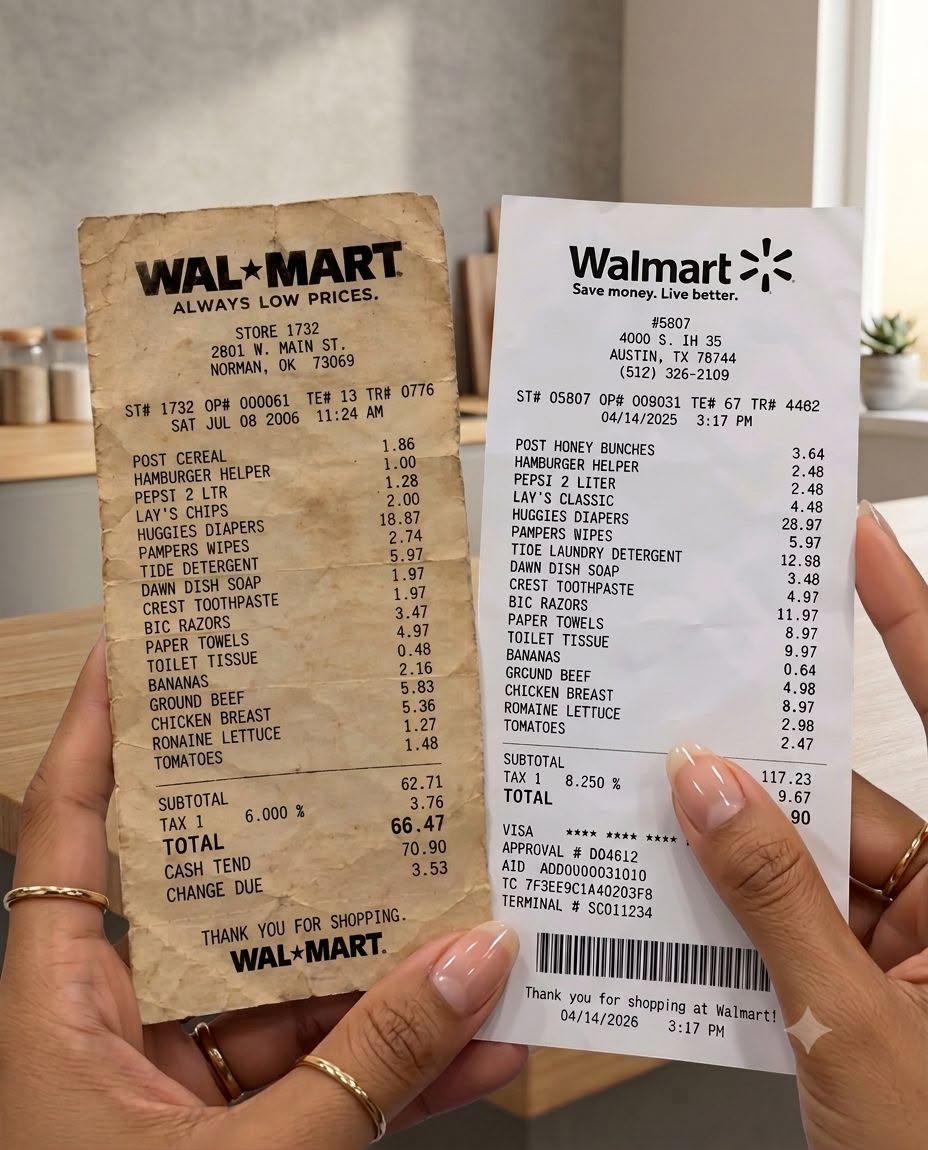
(Image source: post by @Nonnadailyrecipes on Facebook.)
A Sept. 22, 2026, post on Facebook (archived here) shows a similar set up as the previous Instagram post, with the Walmart store providing the backdrop for the displayed receipts. In this example (embedded below) the receipts show different itemized lists of things purchased from two different Florida stores. Here the prices of 14 and 17 items are compared in a more general way, not item by item.
An Oct. 11, 2026, post on Facebook (archived here) shows two receipts displayed on a wood table, with the old receipt in a resealable plastic bag, but in this example the Walmart store is in Port Orange, FL (embedded below).
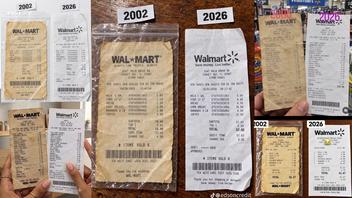
On Oct. 13, 2026, the post embedded below was uploaded by @edsoncredit on TikTok (archived here). The account's bio (archived here) says it is focused on business loans and the caption with the post uses inflation as an example to consider investing over saving. In this case, the two receipts, with the old one protected in a resealable plastic bag, appear to be from the same Sunset Bay, FL Walmart location. The catch here is there is no Walmart store (archived here) in Sunset Bay, in fact there is no town in Florida (archived here) by that name.
@edsoncredit
An Oct. 14, 2026, post (archived here) on Facebook by the page Bella shows the same two Sunset Bay receipts with 2002 and 2026 labels, but the image (embedded below) shows them displayed on a white background rather than dark wood as shown above. Facebook has added an "AI content" label to the post. The Page transparency report (archived here) for Bella says the page managers are from Pakistan, the U.S. and U.K.
Keywords
Here are some of the keywords, key phrases and hashtags associated with these videos:
What people used to spend at Walmart versus what they spend today, rising economic pressures have completely reshaped the modern cost of living, the same amount of money simply doesn't buy what it once did.
#Walmart #2006vs2026 #GroceryPrices #Inflation #ThenAndNow #CostOfLiving #RememberWhen #ViralPost #MoneyTalk #GroceryShopping #2026 #Throwback #ThisIsCrazy #lifestyle #facts #DidYouKnow #InterestingFacts #fblifestyle #Groceries
How to tell they are false
Some of the images contain clues they are fake when compared to similar posts. They may feature identical details on the receipts -- but the receipts depicted are in different settings. Or the settings are duplicated but with different receipts used for examples. These clues only become apparent when a person gets a picture of the overall trend. If they do a reverse image search -- or a text-based search for a phrase like 'Walmart receipts compared' on Facebook or Google -- they may find other instances of the same trend.
If a person feels skeptical about the claim, they may be able to discover if it is fake with straightforward verification questions like, "Does this town exist?" or "Does the store # match the number of the Walmart in that town?" They might compare the pictured prices to the real prices seen in their local store, or compare data from the U.S. Bureau of Labor Statistics Consumer Price Index.
Another approach is to see if the image is real. Look for AI-disclaimers added by the platform or the poster. On TikTok they might say "Contains AI-generated media" or "AI-generated" (archived here), on X they read "Made with AI" (archived here) and on Facebook/Instagram they often say "AI info" (archived here). Check the description of the post too: in some cases the creator might have added a note or a hashtag like #AI, #madewithAI or #fiction. Do not forget to check the main page of the account that made the post: maybe there is a disclaimer in the bio and in some cases AI use is really obvious when an account is posting dozens and dozens of variations of the same type of thing.
Do not stop at the account that made the post: maybe they copied it from somewhere else. Copy the image and run it through a reverse image searching tool to see where else on the internet it appears. It may have originated on an account that posts satire, AI-creations or actual art. There are several AI detection tools like Hive Moderation's AI-Generated Content Detection Tool or the SynthID Detector that can tell you if there are watermarks or other technical AI-generated characteristics present.
Finally, use common sense: if the post shows an event that would otherwise be newsworthy, use a news search engine to check if it has been reported on by a news service you trust. Also pay close attention to the post itself: look for physical impossibilities or glitches typical of AI-generated footage like:
- People or things appearing (or disappearing) out of thin air
- Objects in videos behaving in physically impossible ways (heavy objects falling slowly, rigid objects bending...)
- Garbled writing, oddly shaped letters or signs
- People or objects blending into or moving through each other
- Inconsistencies between different shots of the video (extra architectural elements in buildings, changing backgrounds, differences in clothing or hairstyle)
- An audio track that sounds strange: flat, unnatural speech, scripted-sounding yelling from bystanders ("Did you see that? OMG!"), sound effects being out of sync with events.
Unsure about a post? Email [email protected] and we will take a look!
These materials were developed in 2026 for the Prebunking at Scale project, with support from the European Fact-Checking Standards Network. If you share this on social media, use #prebunkingatscale.